


What Does Bromelain Actually Do for Your Body?
Spike Protein Support · Efficacy
Medically reviewed by TWC Editorial Team
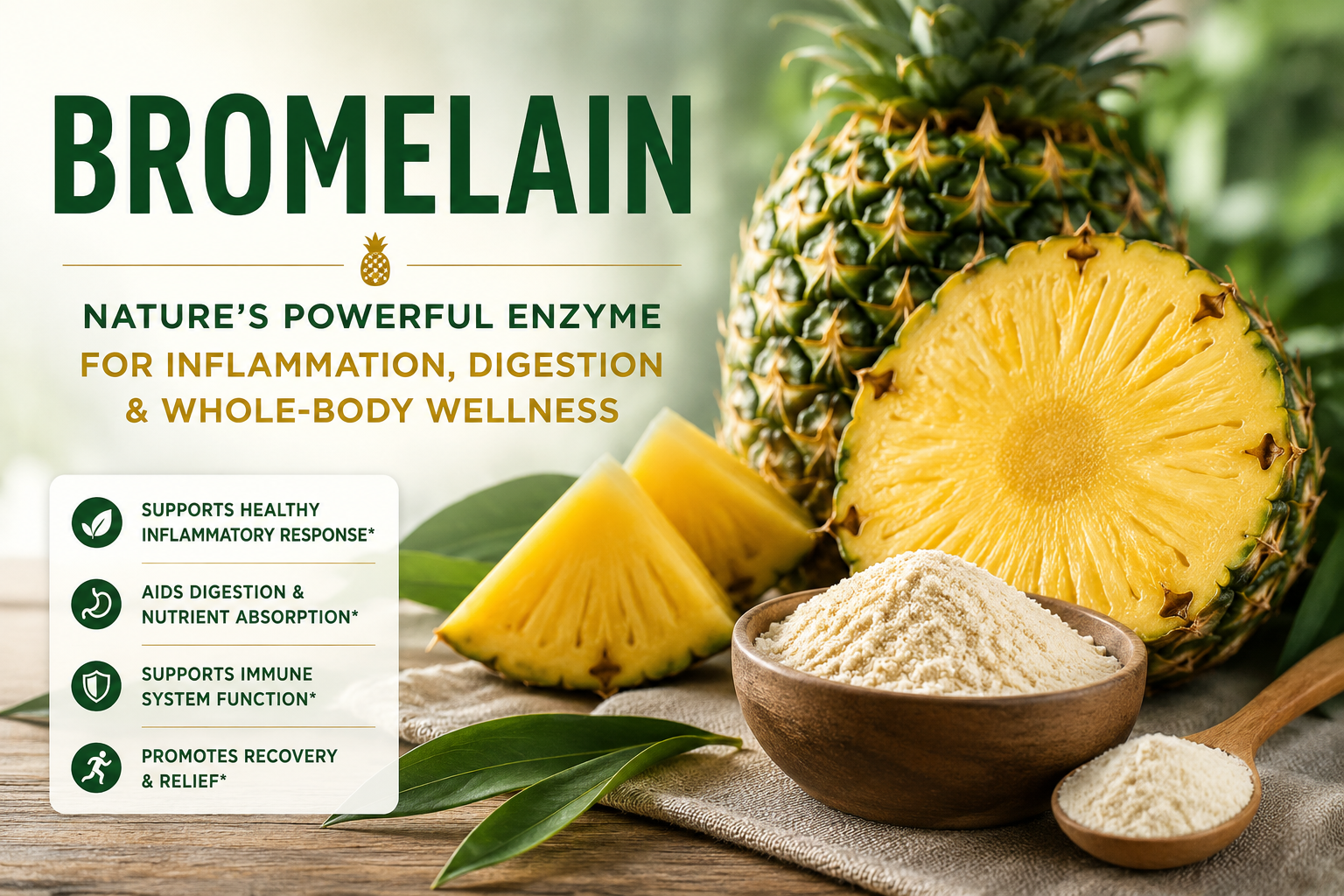
Bromelain is a group of protein-digesting enzymes from the stem of the pineapple plant. It does three things in the body that matter: it lowers inflammation, it breaks down proteins in circulation (including the SARS-CoV-2 spike protein in lab studies), and it modulates immune signaling. The body's ability to use it depends entirely on dose, source, and timing.
You have probably seen bromelain on a supplement label and assumed it was a digestive aid. That is part of the story. The more interesting part is what bromelain does once it gets past your stomach.
What is bromelain used for?
Bromelain is a mixture of cysteine protease enzymes extracted primarily from pineapple stems. It has been studied for inflammation reduction, surgical recovery, sinusitis, post-exercise muscle soreness, digestive support, and — more recently — degradation of viral proteins including the SARS-CoV-2 spike protein.
Germany approved bromelain decades ago for post-surgical inflammation and trauma. Sports medicine clinics use it to shorten recovery after intense training. Practitioners working with post-COVID patients use it for a different reason entirely: research published in Clinical and Translational Medicine (PMC7811777) showed that bromelain cleaves the spike protein of SARS-CoV-2 and reduces ACE2 receptor expression in human cells.
That single 2021 finding repositioned bromelain from a supporting actor in supplement formulas to a central ingredient in spike-detox protocols.
Does bromelain reduce inflammation?
Yes — bromelain has been shown in human trials to lower inflammatory markers, reduce post-surgical edema, and decrease pain after dental procedures. The mechanism involves blocking the production of pro-inflammatory cytokines and modulating the kinin pathway.
Bromelain is not a COX inhibitor like ibuprofen — it works through different pathways, which is why it can be used alongside conventional anti-inflammatories without redundancy.
How bromelain reduces inflammation:
- Reduces bradykinin, a peptide that drives swelling and pain
- Lowers prostaglandin E2 (PGE2), a major inflammation mediator
- Modulates T-cell signaling so the immune response calms down faster
For post-exercise inflammation, doses of 200–400 mg taken between meals appear effective. For chronic inflammatory support, ongoing doses of 500 mg daily are common in clinical protocols.
Bromelain vs. NSAIDs
NSAIDs like ibuprofen are quick and powerful but carry GI, kidney, and cardiovascular risks with chronic use. Bromelain works more slowly but does not carry the same long-term risk profile when taken at standard doses. It is not a replacement for acute pain control; it is a tool for sustainable, low-grade inflammation management.
Can bromelain help break down spike protein?
In a 2021 study in human cells, bromelain reduced expression of ACE2 and TMPRSS2 — the two host receptors SARS-CoV-2 uses to enter cells — and directly cleaved the spike protein at two specific disulfide-bond sites. The effect was dose- and time-dependent.
The bromelain study went beyond binding affinity. Researchers performed protein-protein docking simulations and showed bromelain cleaves the spike at the 131–166 disulfide bond (50.4% likelihood) and the 617–649 disulfide bond (49.6% likelihood). When SARS-CoV-2 viral particles were treated with bromelain, the spike protein was visibly absent from the viral surface afterward.
This is what makes bromelain a credible companion to nattokinase. They attack the spike protein from different angles: nattokinase as a serine protease, bromelain as a cysteine protease that also reduces the receptors the spike binds to. A second study, the BromAc paper (PMC7999995), showed bromelain combined with N-acetylcysteine inactivated SARS-CoV-2 in cell culture in a concentration-dependent manner.
How much bromelain should you take?
Bromelain is measured in GDU (gelatin digesting units) or MCU (milk clotting units). A 500 mg capsule labeled "2,400 GDU/g" is roughly equivalent to a 500 mg capsule labeled "3,600 MCU/g."
Dosing by goal:
- General anti-inflammatory support: 200–500 mg, 2,000–2,500 GDU/g, taken between meals
- Spike-protein protocol use: 500 mg minimum, taken alongside nattokinase and curcumin on an empty stomach
How Ultimate Spike Detox Fits In
Step 1
Understand the mechanisms — bromelain cleaves disulfide bonds and downregulates the spike's entry receptor.
Step 2
Use the right form (stem-derived) at the right dose — 500 mg minimum with GDU clearly labeled.
Step 3
Stack with nattokinase and curcumin on an empty stomach for the full McCullough Protocol effect.

Frequently Asked Questions
Can I get enough bromelain from eating pineapple?
The fruit contains some bromelain, but the highest concentration is in the stem, which is not commonly eaten. A typical serving of fresh pineapple delivers maybe 50–100 GDU — far below therapeutic doses.
Are there side effects?
Mild GI symptoms are most common. People with a pineapple allergy should avoid it. Like nattokinase, bromelain has mild blood-thinning activity and should not be combined with anticoagulants without medical supervision.
Can children take bromelain?
Bromelain has not been adequately studied in children. Pediatric use should be guided by a clinician.
Does bromelain need to be enteric-coated?
For systemic effects, enteric coating helps protect the enzyme from stomach acid and improves absorption. For digestive use, uncoated forms are fine.
Get Started Today
Bromelain is not just a digestive enzyme. It is an anti-inflammatory, an immune modulator, and — based on 2021 research — a protein that directly cleaves the SARS-CoV-2 spike. The effect requires real dosing, the right form, and the right timing. Ultimate Spike Detox delivers all three.
Learn MoreReferences
- Sagar, S., et al. (2021). Bromelain inhibits SARS-CoV-2 infection via targeting ACE-2, TMPRSS2, and spike protein. Clinical and Translational Medicine. pmc.ncbi.nlm.nih.gov/articles/PMC7811777
- Maurer, H.R. (2001). Bromelain: biochemistry, pharmacology and medical use. Cellular and Molecular Life Sciences. pubmed.ncbi.nlm.nih.gov/11523899
- Chakraborty, A.J., et al. (2021). Bromelain a potential bioactive compound: a comprehensive overview from a pharmacological perspective. Life. pmc.ncbi.nlm.nih.gov/articles/PMC8197592
- Akhtar, N.M., et al. (2004). Oral enzyme combination versus diclofenac in the treatment of osteoarthritis of the knee. Clinical Rheumatology. pubmed.ncbi.nlm.nih.gov/15375669
- Annexy, M., et al. (2021). BromAc synergistically inactivates SARS-CoV-2. Antiviral Research. pmc.ncbi.nlm.nih.gov/articles/PMC7999995
Author
Works alongside our network of US-licensed clinicians and the McCullough Foundation research team.
This article is for informational purposes only and is not a substitute for professional medical advice, diagnosis, or treatment. Always seek the advice of a qualified healthcare provider with any questions you may have regarding a medical condition.


