



View Featured Categories
Lab-Grown Meat Sounds Like Progress. The Science Isn't So Sure.


Food & Nutrition · Alternative Proteins
Medically reviewed by TWC Editorial Team
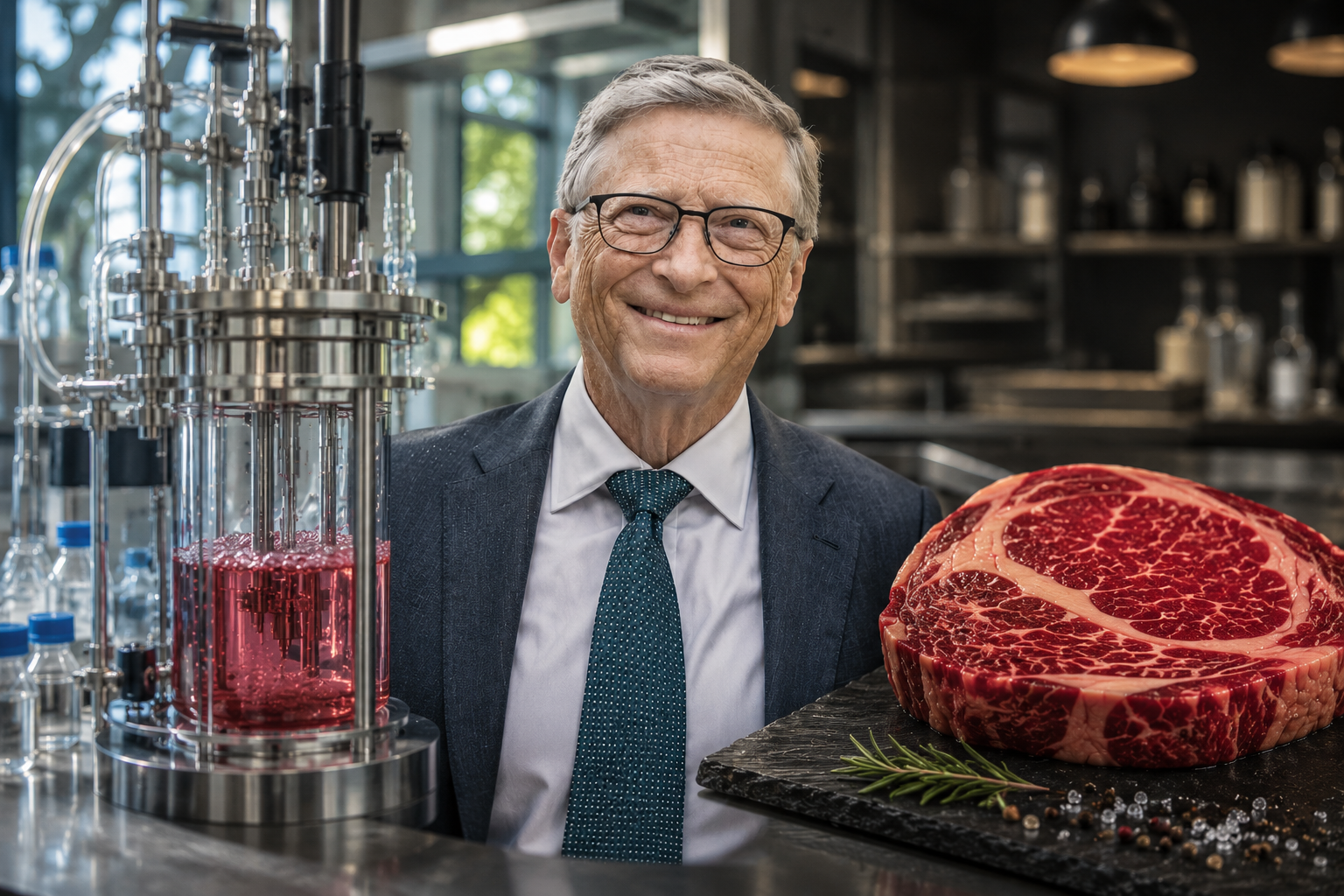
Bill Gates has been consistent on this: rich countries should switch to 100% synthetic beef. He's backed that conviction with his wallet — investing in Beyond Meat, Impossible Foods, Memphis Meats, and a handful of other cell-cultured protein companies.
His reasoning? The climate. Livestock farming drives roughly 14.5% of global greenhouse gas emissions, and lab-grown meat eliminates the cow from the equation.
It's a compelling argument — but very misleading.
The promise of cultivated meat—real animal protein grown in bioreactors from harvested cells, no slaughter required—has attracted billions in venture capital and a remarkable amount of media coverage. But beneath the glossy pitch deck, a quieter body of research has been accumulating. And it is less flattering than the industry would like.
The Carbon Problem No One Wants to Talk About
Lab-grown meat may carry a carbon footprint 4 to 25 times worse than conventional retail beef — if produced at pharmaceutical-grade purity.
In 2023, researchers at UC Davis published a lifecycle analysis that landed like a cold bucket of water on the industry's climate claims. The study, led by environmental scientist Derrick Risner, modeled the energy demands of producing cell-cultured meat at pharmaceutical-grade purity—the level most producers would need to ensure a safe, contamination-free product. The findings were striking.
“If companies are having to purify growth media to pharmaceutical levels, it uses more resources, which then increases global warming potential.”
— Derrick Risner, Environmental Scientist, UC DavisThe UC Davis team found that, depending on the purification standard applied, cultivated meat's global warming potential could be four to 25 times higher per kilogram than conventional retail beef. The reason: growing animal cells outside a living body requires an extraordinary amount of energy and highly refined growth media — the nutrient bath that keeps cells alive and multiplying. Achieving pharmaceutical-grade purity for this is metabolically expensive in a way that no cow has ever been.
What We Don't Know About Safety
International food safety bodies have identified dozens of potential hazards in cell-cultured meat production — and the regulatory frameworks to address them barely exist.
In April 2023, the Food and Agriculture Organization of the United Nations and the World Health Organization released a joint report identifying 53 potential food safety hazards associated with cell-based food production. These range from biological risks—contamination by mycoplasma, viruses, and prions during cell cultivation—to chemical concerns about residual growth factors, scaffolding materials, and novel compounds introduced during processing. The regulators' conclusion was blunt: current frameworks are not adequate to govern this technology.
Consumers seem to sense this. A 2024 survey found 62% of Australians were not confident in the safety of cultivated meat products. A separate 2023 U.S. poll found that safety concerns were the top barrier for roughly half of American adults who said they were unlikely to try lab-grown meat. These aren't irrational anxieties — they reflect a reasonable read of where the science actually stands.
The Nutritional Gap
The UN FAO has noted that lab-grown meat cannot yet replicate the full nutritional profile of conventional animal foods.
Meat is nutritionally complex. Beyond protein, it delivers heme iron, zinc, B12, creatine, carnosine, and a matrix of fatty acids — many of which are absent or structurally different in cell-cultured products. The UN FAO has acknowledged that lab-grown meat, in its current form, cannot replicate the nutritional profile of animal foods. Scaffolding proteins, fat distribution, and micronutrient density all remain active research problems. What you'd be eating, at this stage, is a protein approximation — not a nutritional equivalent.
The Political Verdict Is Already In
Florida and Alabama banned the sale of lab-grown meat in 2024. South Dakota and South Carolina have moved to require prominent labeling.
In May 2024, Florida became the first U.S. state to outright ban the manufacture and sale of cultivated meat — a move to protect consumers and the agricultural industry alike. Alabama followed. South Dakota and South Carolina have enacted labeling requirements that mandate cell-cultured products be clearly identified as such. Regulatory action at the state level is accelerating faster than federal guidance can keep up with.
None of this means cultivated meat has no future. The technology is genuinely novel, and some of its drawbacks are engineering problems that may yet be solved. But the gap between what the industry is selling and what the peer-reviewed literature currently supports is significant — and growing. Gates may be right that synthetic protein is part of the answer to feeding a hotter, more crowded planet. He's probably wrong that we're close to the point where that claim can be made without serious caveats.
The cow, it turns out, is harder to replace than it looks.

References
Risner, D., Li, F., Fell, J. S., Pace, S. A., Siegel, J. B., Tagkopoulos, I., & Treich, N. (2023). Preliminary life cycle analysis of commercial cell-cultured beef production. PLOS ONE, 18(5), e0284036. https://doi.org/10.1371/journal.pone.0284036
Food and Agriculture Organization of the United Nations & World Health Organization. (2023). Food safety aspects of cell-based food. FAO/WHO. https://doi.org/10.4060/cc4855en
Food and Agriculture Organization of the United Nations. (2023). Meat and meat products in human nutrition (FAO Food and Nutrition Paper No. 92). FAO.
MIT Technology Review. (2021, February 14). Bill Gates: Rich nations should shift to 100% synthetic beef. https://www.technologyreview.com/2021/02/14/1018296/bill-gates-climate-change-beef-trees-microsoft/
Author
This article is for informational purposes only and is not a substitute for professional medical advice, diagnosis, or treatment. Always seek the advice of a qualified healthcare provider with any questions you may have regarding a medical condition.


