


View Featured Categories
Your Colon's Hidden Shield: How Mucus Protects Against Colorectal Cancer


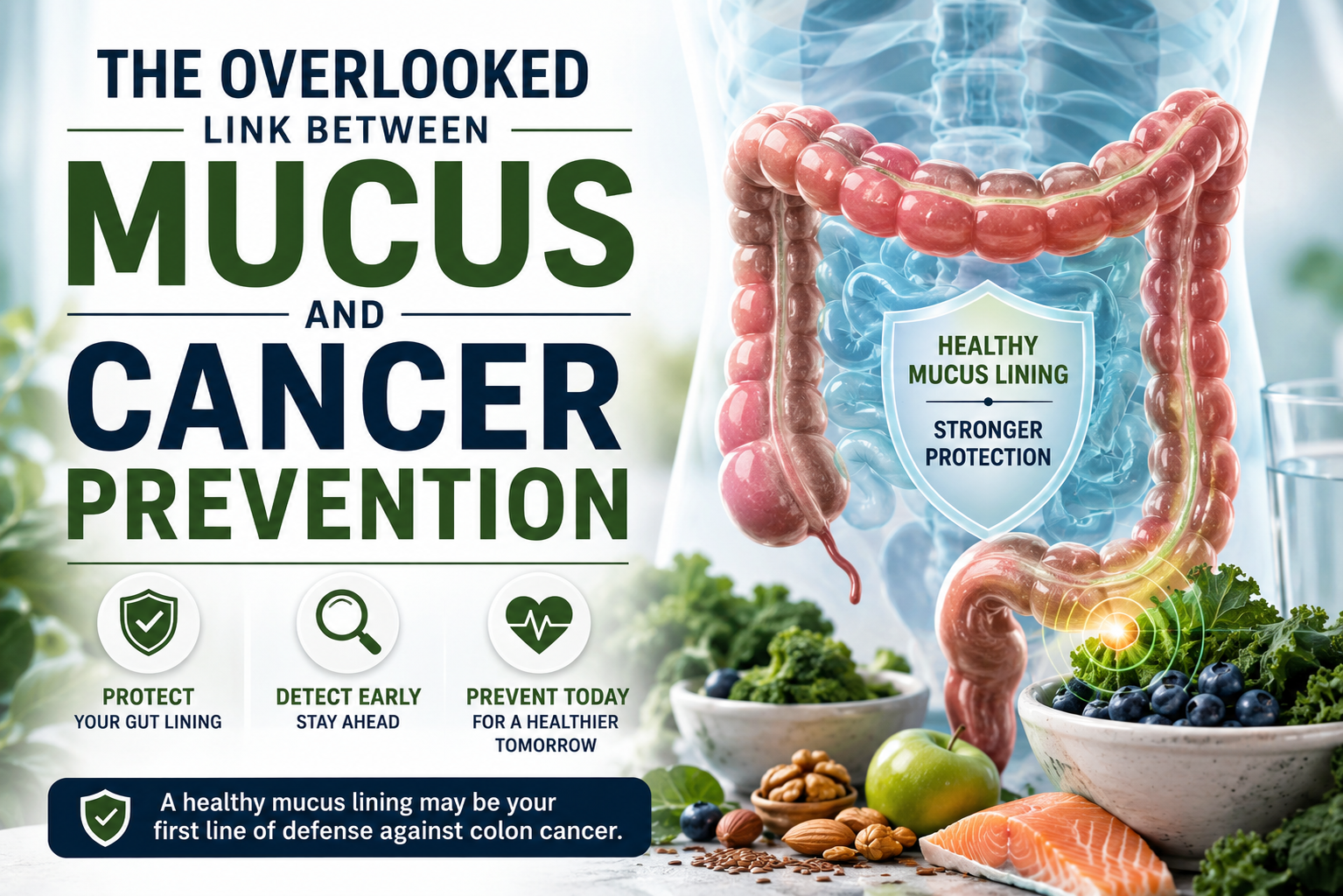
Gut Health · Cancer Prevention
Colorectal cancer is the third most commonly diagnosed cancer worldwide, with approximately 1.9 million new cases and over 900,000 deaths recorded globally in 2022. In the U.S., an estimated 158,850 new cases and 55,230 deaths are expected in 2026. (1)
Most people think of mucus as little more than a nuisance. But inside the colon, mucus plays a critical, life-preserving role. Understanding how it works — and what happens when it breaks down — can change the way you think about gut health and cancer prevention.
"A disrupted or damaged mucus layer in the colon is considered a significant factor in the development of colorectal cancer. Harmful bacteria that can cause DNA damage and inflammation are believed to trigger tumor growth."
— Research Consensus, Colorectal Cancer Literature (4,5,6)Types of Colon Cancer (2)
Colon cancer is categorized by the type of cell where the cancer starts. Over 95% of cases develop in mucus-producing gland cells that line the colon — these are called adenocarcinomas. Other, rarer types include carcinoid tumors, gastrointestinal stromal tumors (GISTs), lymphomas, and sarcomas.
Described as a primary cancer, colon cancer almost always originates from a precancerous polyp that develops into a tumor in the large intestine. From the colon, the cancer can spread (metastasize) to nearby organs such as the lungs or liver. (1,2)
Causes and Risk Factors (3)
To understand the causes and risk factors of colon cancer, a review of colon anatomy is necessary. The colon is comprised of two layers that serve as a protective barrier against pathogens, chemicals, and other substances that could breach it.
Inner Mucus Layer (4)
A dense layer that acts as an impermeable barrier, protecting the epithelial cells from pathogens, digestive byproducts, and potentially harmful chemicals.
Outer Mucus Layer (4)
Where healthy gut bacteria reside. This layer is derived from the conversion of the inner layer through enzymatic action and other biological processes.
Both layers are maintained by goblet cells, which continuously produce new mucus, keeping both layers healthy and serving as the first line of defense. Goblet cells accomplish this by lubricating and separating the underlying colon structure from pathogens, bacteria, and digestive byproducts.
Disrupted Mucus Lining and Health Implications (4,5,6)
- When goblet cells are interrupted from doing their job, inflammation and diseases such as ulcerative colitis and Crohn's disease are more likely to follow.
- A disrupted or damaged mucus layer in the colon is considered a significant factor in the development of colorectal cancer.
- Harmful bacteria that can cause DNA damage and inflammation are believed to trigger tumor growth.
Risk Factors (1)
Your risk of getting colorectal cancer increases as you get older. Other risk factors include:
Medical & Genetic Factors
Inflammatory bowel disease (Crohn's disease or ulcerative colitis), a personal or family history of colorectal cancer or polyps, and genetic syndromes such as familial adenomatous polyposis (FAP) or Lynch syndrome.
Lifestyle Factors
Lack of regular physical activity, a diet low in fiber and high in processed meats, obesity, alcohol consumption, tobacco use, and vitamin D deficiency — which is strongly linked to the development of polyps. (8)
Prevention, Symptoms, and Tests (7)
Colorectal polyps — precancerous abnormal growths in the colon or rectum — can turn into cancer if not removed. Colorectal cancer doesn't always cause symptoms, especially at first. You could have polyps or colorectal cancer and not even know it.
Prevention Starts With
Maintaining a healthy mucus lining through healthy lifestyle practices, regular screening, and early testing and removal of precancerous polyps.
Symptoms May Include
A change in bowel habits, blood in or on your stool, diarrhea or constipation, a feeling that the bowel does not empty fully, abdominal pain or cramps that don't go away, and unexplained weight loss.
The U.S. Preventive Services Task Force recommends that adults aged 45 to 75 be screened for colorectal cancer — earlier if at risk or symptomatic. (7)
Screening Tests (7)
- Guaiac-based fecal occult blood test (gFOBT) — an at-home stool test that checks for the presence of blood.
- Fecal immunochemical test (FIT) — uses antibodies to detect blood in the stool; performed once a year, same as gFOBT.
- FIT-DNA test (stool DNA test) — combines FIT with detection of altered DNA in stool; requires collection of an entire bowel movement sent to a lab.
- Flexible sigmoidoscopy — a short, flexible, lighted tube inserted into the rectum to check for polyps or cancer in the lower third of the colon.
- Colonoscopy — uses a longer tube to check for and remove polyps and some cancers throughout the entire colon.
- CT colonography (virtual colonoscopy) — uses X-rays and computers to produce images of the entire colon for physician analysis.
Treatment Approaches: Conventional and Emerging
Standard treatments for colon cancer include surgery, chemotherapy, radiation therapy, targeted therapy, and immunotherapy.
Ivermectin and mebendazole are being studied as possible add-on treatments for colon cancer and polyps, but they are not standard care.
Emerging Research
- Ivermectin can slow the growth of colon cancer cells and trigger programmed cell death in lab studies. (9)
- In animals, ivermectin has reduced colon tumor formation and changed cancer-related genes in a protective direction. (10)
- Mebendazole has lowered the number and size of colon polyps in cancer-prone mice. (11)
- Mebendazole also affects cancer pathways (like MYC and COX2) and can increase cancer cell death in preclinical colon cancer models. (11)
- Early research suggests that ivermectin and mebendazole may someday be used alongside standard treatments, but they remain experimental and should only be considered under an oncology team's guidance, ideally in a clinical trial. (12)

The Bottom Line: Prevention Starts in the Gut
As with any cancer, early diagnosis and intervention are key to improving survival rates. Given the harsh side effects of conventional therapies, many are looking at alternatives to supplement — or use alongside — standard care. Nothing, however, replaces a healthy lifestyle, a well-maintained gut mucus barrier, and early intervention.
References
- Centers for Disease Control and Prevention. (2025). Colorectal cancer statistics. U.S. Department of Health & Human Services. https://www.cdc.gov/united-states-cancer-statistics/publications/colorectal-cancer-stat-bite.html
- Cancer Research Institute. (n.d.). Immunotherapy for colorectal cancer. https://www.cancerresearch.org/immunotherapy-by-cancer-type/colorectal-cancer
- Johansson, M. E., Larsson, J. M., & Hansson, G. C. (2011). The two mucus layers of colon are organized by the MUC2 mucin, whereas the outer layer is a legislator of host–microbial interactions. Proceedings of the National Academy of Sciences, 108(Suppl 1), 4659–4665. https://doi.org/10.1073/pnas.1006451107
- Herath, M., Hosie, S., Bornstein, J. C., Franks, A. E., & Hill-Yardin, E. L. (2020). The role of the gastrointestinal mucus system in intestinal homeostasis: Implications for neurological disorders. Frontiers in Cellular and Infection Microbiology, 10, 248. https://doi.org/10.3389/fcimb.2020.00248
- Loktionov, A. (2022). Colon mucus in colorectal neoplasia and beyond. World Journal of Gastroenterology, 28(32), 4475–4492. https://doi.org/10.3748/wjg.v28.i32.4475
- [Reference 6 — see source document]
- Centers for Disease Control and Prevention. (2025, February 25). Screening for colorectal cancer. U.S. Department of Health & Human Services. https://www.cdc.gov/colorectal-cancer/screening/index.html
- Vitamin D deficiency, supplementation, and colorectal cancer: An updated review. (2025). Journal of Nutritional Biochemistry and Disease Prevention, 15(3), 101–120. https://pmc.ncbi.nlm.nih.gov/articles/PMC12463832/
- Tang, M., Hu, X., Chen, Y., & Zhang, W. (2021). Ivermectin has new application in inhibiting colorectal cancer cell growth. Frontiers in Pharmacology, 12, 717529.
- Ahmed, O. M., Abdelazem, A. Z., ElMahdi, M. M., & ElTawab, S. S. (2022). Efficacy of ivermectin against colon cancer induced by 1,2-dimethylhydrazine in rats. Journal of Experimental Pharmacology, 14, 123–137.
- Nygren, P., Fryknäs, M., Agerup, B., & Larsson, R. (2016). Mebendazole and a non-steroidal anti-inflammatory drug combine to reduce tumor burden in the ApcMin/+ mouse model of intestinal and colon cancer. Journal of Experimental & Clinical Cancer Research, 35, 86.
- De Witt, M., Gamble, A., Williams, M., et al. (2024). In vitro and in vivo anticancer activity of mebendazole in colorectal cancer models. Cancer Chemotherapy and Pharmacology, 93(2), 245–258.
Author
This article is for informational purposes only and does not constitute medical advice. Always consult a qualified healthcare provider regarding any health concerns, screening decisions, or treatment options.


