


View Featured Categories
The Food Group Colon Cancer Hates


Gut Health · Cancer Prevention
Cancer doesn't just happen. It arises from a series of events and genetic factors that work against the body's defenses, leading to uncontrolled growth of renegade cells.
Science is increasingly recognizing that probiotic-rich foods such as sauerkraut, yogurt, kefir, and kombucha may play an important role in supporting gut health and overall wellness.*
Colon Cancer Is Rising in Younger Adults
What the Numbers Say
- Colorectal cancer is currently one of the fastest-rising cancers in adults under 52
- It is increasing faster in younger adults than in older adults
- It is one of the few major cancers showing a steeper rise in people under 50
- In the U.S., colorectal cancer is becoming a leading cause of cancer-related death among young adults
- The lifetime risk of developing colorectal cancer is about 1 in 25 men and 1 in 26 women
The 3 “P’s” — Nature’s Arsenal for Colon Health
How does the food you eat affect your health? When it comes to colon health, it plays a significant role. The fuel (food) we put into our bodies is converted through a complex series of chemical reactions into building blocks that help support normal digestive function, immune health, and overall wellness.*
1. Prebiotics — The Fuel
Indigestible fibers that arrive in the large intestine intact, nourishing beneficial bacteria in the digestive tract.*
2. Probiotics — The Workers
Living beneficial bacteria and yeasts that break down prebiotic fibers and support digestive and immune health.*
3. Postbiotics — The Helpers
Bioactive compounds produced during fermentation that may help support gut barrier function, immune health, and normal inflammatory responses.*
Prebiotics — The Fuel
Prebiotics help support a healthy gut microbiome by nourishing beneficial bacteria in the digestive tract.* Probiotics consume foods rich in indigestible fibers that arrive in the large intestine intact.
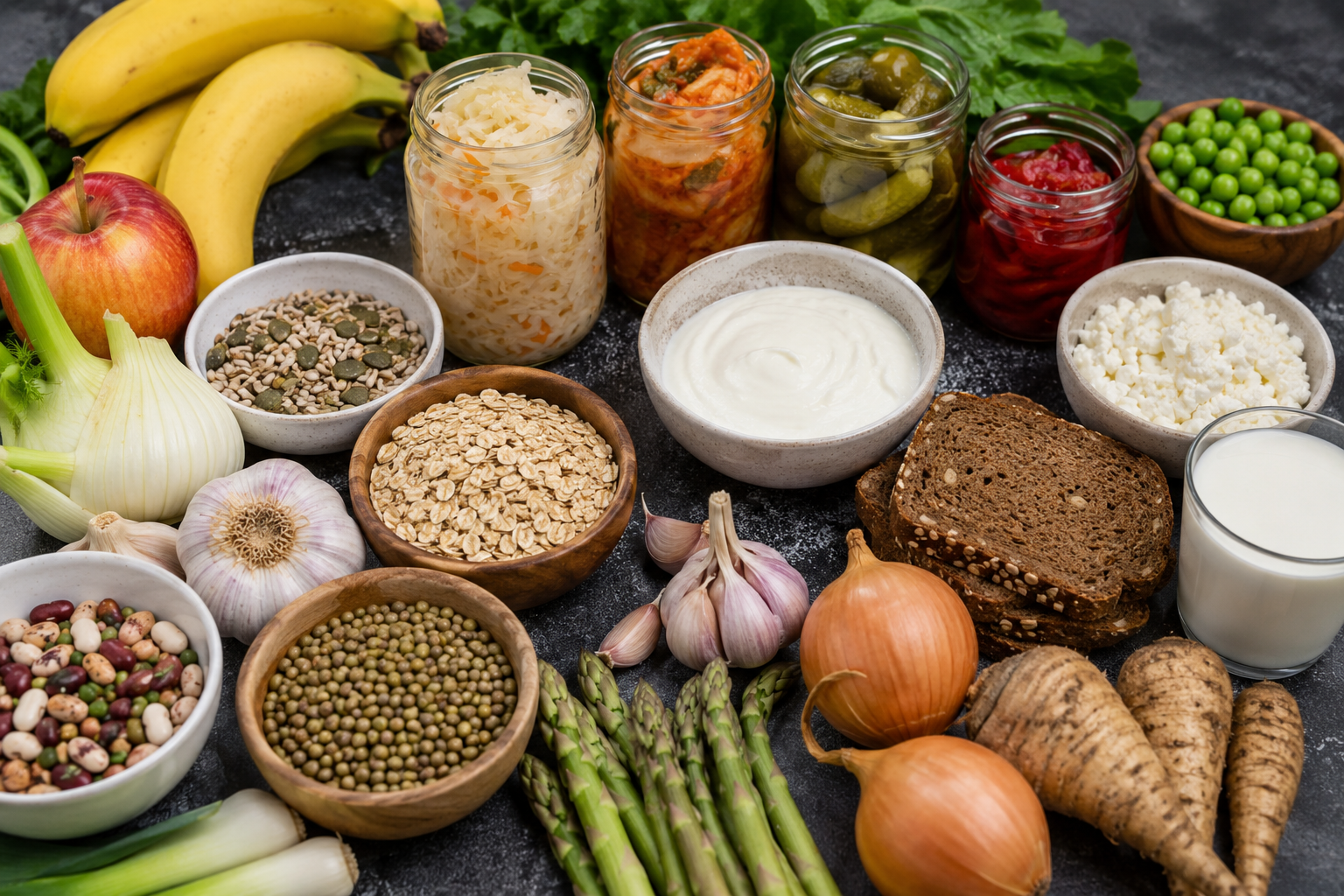
Prebiotic-Rich Foods
- Jerusalem artichoke
- Chicory root
- Onions and garlic
- Oats and barley
- Apples and unripe bananas
- Asparagus
Probiotics — The Workers
As living organisms, probiotics need food. These beneficial bacteria and yeasts help break down prebiotic fibers and support the production of compounds associated with digestive and immune health.* The most common probiotic bacteria belong to the genera Bifidobacterium and Lactobacillus.
Fermented Dairy
Kefir (one of the most diverse), yogurt, aged raw cheeses, cultured sour cream, cultured butter
Fermented Vegetables
Sauerkraut, lacto-fermented pickles, kimchi, fermented condiments
Fermented Soy & Other
Miso, tempeh, natto
Safflower and sunflower oils provide linoleic acid, which may be converted into conjugated linoleic acid (CLA), a fatty acid that has been studied for its potential role in supporting healthy cellular function.*
Postbiotics — The Helpers
As beneficial bacteria consume prebiotic foods, they produce compounds known as postbiotics — bioactive compounds, metabolic byproducts, and microbial components produced during fermentation that may help support gut barrier function, immune health, and normal inflammatory responses.*
Short-chain fatty acids (SCFAs) are produced when beneficial gut bacteria ferment dietary fiber in the colon. They serve as an energy source for colon cells and help support healthy metabolism, immune function, and normal inflammatory balance.*
Butyrate
Helps support healthy colon cell function and has been extensively studied for its role in maintaining a healthy gut environment.*
Butyrate-supporting foods:
Oats, barley, under-ripe bananas, lentils
Indole-3-Lactic Acid (ILA)
A microbial metabolite studied for its potential role in supporting healthy immune and cellular function.*
Foods that support ILA production:
Poultry, pumpkin seeds, eggs
The Takeaway
Along with recommended screening guidelines, you may support long-term colon health by adopting healthy lifestyle habits that include stress management, regular physical activity, and a diet rich in fruits, vegetables, fiber, and fermented foods.*
Featured Product

Cellular Defense / Immune Support
Full-Spectrum Cellular Support for Periods of Heightened Stress
SHIELD pairs a polyphenol-rich antioxidant Cocoa Drink Mix with a targeted botanical Softgel to support oxidative stress, inflammatory balance, immune modulation, and cellular detox — with EGCG and curcuminoids among the most studied plant-based compounds in oncology-adjacent nutrition research.*
Shop NowYou Might Also Be Interested In
References
- Staff, C. (2025, March 5). Colorectal Cancer Rates Are Skyrocketing in Young Adults—Is Your Lifestyle Putting You at Risk? Cancer Research Institute. https://www.cancerresearch.org/blog/colorectal-cancer-awareness-month
- Semeco, A. (2016, June 8). The 19 Best Prebiotic Foods You Should Eat. Healthline. https://www.healthline.com/nutrition/19-best-prebiotic-foods
- Chen, L., Wang, Y., Zhang, R., Li, J., & Zhao, L. (2026). Functional foods and gut microbiota: Modulation of short-chain fatty acid production. International Journal of Molecular Sciences, 27(5), 2293. https://doi.org/10.3390/ijms27052293
- Leeuwendaal, N. K., Stanton, C., O’Toole, P. W., & Beresford, T. P. (2022). Fermented Foods, Health and the Gut Microbiome. Nutrients, 14(7), 1527. https://doi.org/10.3390/nu14071527
- den Hartigh, L. J. (2019). Conjugated linoleic acid effects on cancer, obesity, and atherosclerosis. Nutrients, 11(2), 370.
- Bailey, J. K., & Young, M. A. (2025). Conjugated linoleic acid: A fatty acid with health benefits (Publication HNFE-1123). Virginia Cooperative Extension, Virginia Tech. https://pubs.ext.vt.edu/HNFE/hnfe-1123/hnfe-1123.html
- D’Amore, T., et al. (2025). Using Postbiotics from Functional Foods for Managing Colorectal Cancer. Microorganisms, 13(6), 1335. https://doi.org/10.3390/microorganisms13061335
- Zhou, S., Wang, K., Huang, J., Xu, Z., Yuan, Q., Liu, L., Wang, Z., Miao, J., Wang, H., Wang, T., Guan, W., & Ding, C. (2025). Indole-3-lactic acid suppresses colorectal cancer via metabolic reprogramming. Gut Microbes, 17(1), 2508949.
Author
*These statements have not been evaluated by the Food and Drug Administration. This article is for educational purposes only and is not intended to diagnose, treat, cure, or prevent any disease.


