


View Featured Categories
What Are Proteases and Why Do They Matter?


Spike Protein Detox · Enzymes
Medically reviewed by TWC Editorial Team
You have probably never thought much about proteases — until you started reading about spike protein detox. Now they are everywhere. Here is what they actually are, why they matter, and how specific supplemental proteases target the SARS-CoV-2 spike protein at the molecular level.
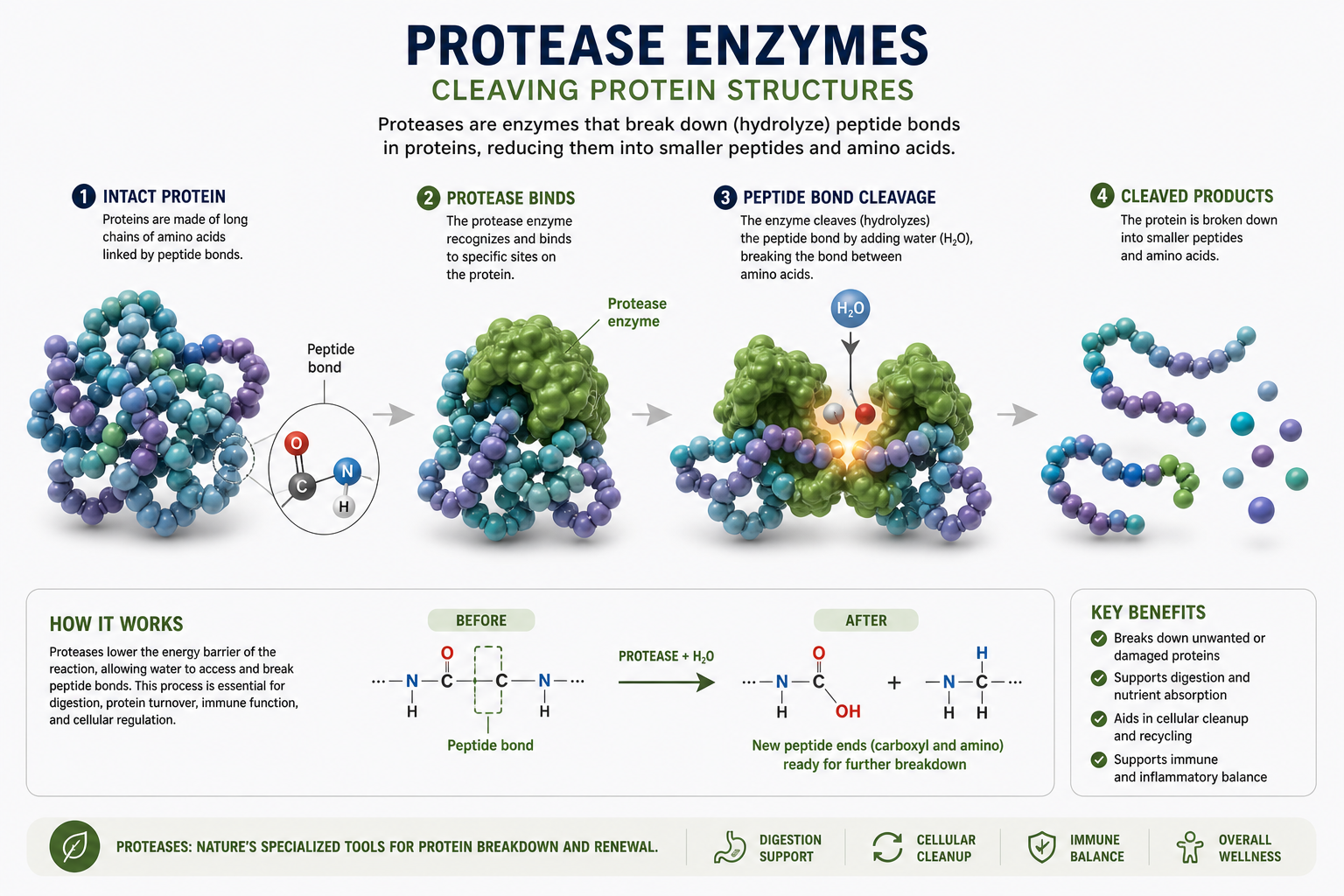
WHAT YOU NEED TO KNOW: Proteases are enzymes that cleave proteins by breaking peptide bonds. Your body produces hundreds of them — for digestion, immunity, blood clotting, cellular maintenance, and tissue repair. Supplemental proteases like nattokinase (a serine protease) and bromelain (a cysteine protease) act systemically when taken on an empty stomach, and have been shown in laboratory studies to cleave specific viral proteins including the SARS-CoV-2 spike.
What is a protease?
A protease is any enzyme that cleaves proteins by hydrolyzing peptide bonds. Proteases are categorized by their catalytic mechanism: serine proteases (like trypsin and nattokinase), cysteine proteases (like bromelain and papain), aspartic proteases (like pepsin), metalloproteases, and threonine proteases.
Different proteases act on different protein substrates. Some are specific — they only cleave certain amino acid sequences. Others are broad-spectrum. The catalytic mechanism determines which substrates a protease can act on, which is why combining proteases from different classes (serine + cysteine) provides broader coverage than using a single enzyme alone.
Why do proteases matter for spike protein?
The SARS-CoV-2 spike protein has specific cleavage sites and disulfide bonds that make it vulnerable to certain proteases. Nattokinase (serine protease) cleaves the protein backbone; bromelain (cysteine protease) cleaves at disulfide bonds. Combined, they target the spike from multiple angles.
This is the molecular logic behind protocols that combine nattokinase with bromelain rather than using either alone. The Tanikawa et al. 2022 study (PMC9458005) confirmed nattokinase degrades the spike protein in a dose- and time-dependent manner using Western blot analysis. The bromelain research (PMC7811777) showed it cleaves the spike at two specific disulfide-bond sites — 131–166 and 617–649 — and downregulates ACE2 and TMPRSS2 receptor expression. These are complementary, non-overlapping mechanisms.
Protease Classes in Ultimate Spike Detox
- Nattokinase — serine protease; cleaves the spike protein backbone; fibrinolytic activity for microclot support
- Bromelain — cysteine protease; cleaves spike disulfide bonds; reduces ACE2 and TMPRSS2 receptor expression
- Curcumin — not a protease but computationally modeled to bind the spike receptor binding domain (PMC9056388)

Frequently Asked Questions
Are systemic proteases safe?
Yes, at standard doses, in healthy adults not on anticoagulants. Both nattokinase and bromelain have mild fibrinolytic activity and should not be combined with prescription blood thinners (warfarin, apixaban, rivaroxaban) without physician supervision.
How are systemic proteases absorbed?
Whole-protein absorption is a subject of ongoing study; what is well-documented is the systemic effect on circulating substrates when taken on an empty stomach. Taken with food, these enzymes act primarily in the GI tract rather than circulating systemically.
Plant or microbial source — does it matter?
Both work. Bromelain is plant-derived (pineapple stem); nattokinase is microbial, produced by Bacillus subtilis var. natto fermentation. What matters is standardized potency — measured in GDU for bromelain and fibrinolytic units (FU) for nattokinase.
Do supplemental proteases survive stomach acid?
Many supplemental proteases use enteric coatings to improve survival through the acidic stomach environment. Check whether the product you use specifies enteric coating or delayed-release capsules, particularly for bromelain.
Get Started Today
Proteases are how your body breaks down proteins — and how supplemental enzymes can target specific problem proteins like the SARS-CoV-2 spike. Ultimate Spike Detox combines nattokinase (serine protease) and bromelain (cysteine protease) at the doses studied in peer-reviewed research, in a single daily formula designed by Dr. Peter McCullough.
Learn MoreReferences
- Tanikawa, T. et al. (2022). Degradation of SARS-CoV-2 Spike Protein by Nattokinase. Molecules. pmc.ncbi.nlm.nih.gov
- Sagar, S. et al. (2021). Bromelain Inhibits SARS-CoV-2 Infection via Targeting ACE-2, TMPRSS2, and Spike Protein. Clinical and Translational Medicine. pmc.ncbi.nlm.nih.gov
- Patel, P. H., & Mada, P. K. (Updated 2023). Mebendazole. In StatPearls. ncbi.nlm.nih.gov
- Merck & Co., Inc. STROMECTOL (ivermectin) Prescribing Information. U.S. FDA. accessdata.fda.gov
- McCullough Foundation. Real-world cohort study: Spike Detoxification Protocol. Zenodo preprint records/19455636.
Author
Works alongside our network of US-licensed clinicians and the McCullough Foundation research team.
This article is for informational purposes only and is not a substitute for professional medical advice, diagnosis, or treatment. Always seek the advice of a qualified healthcare provider with any questions you may have regarding a medical condition.


