


View Featured Categories
This Seed Oil has a Reputation for Healing


Herbal Medicine · Integrative Oncology
Black Cumin Seed Oil: Ancient Remedy, Modern Science, and a Growing Role in Cancer Research
"The black cumin is healing for all diseases except death."
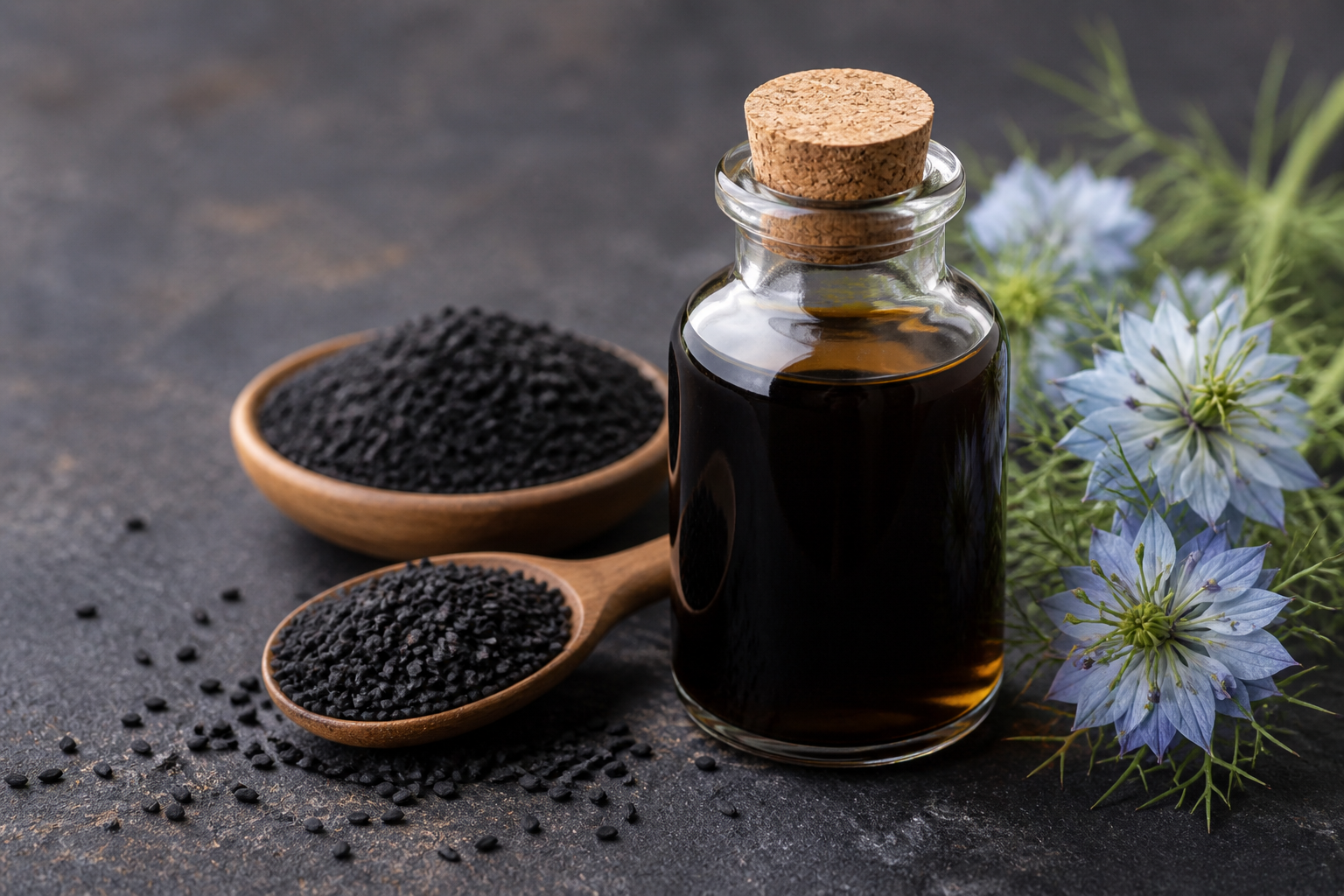
Nigella sativa — commonly known as black cumin — is a flowering plant belonging to the Ranunculaceae family, which also includes clematis, delphinium, and ranunculus. This annual herb produces aromatic black seeds with a pungent flavor reminiscent of fennel. For thousands of years, these seeds have held an important place in both culinary traditions and herbal medicine across regions from the Middle East to South Asia.
In recent decades, modern research has begun validating what traditional healers have long recognized — and the active compound at the center of that research, thymoquinone, is turning out to be one of the most pharmacologically interesting molecules in the botanical world.
A Remedy Across Traditions
In Ayurvedic medicine, black cumin seeds are recognized for their potent healing properties — traditionally used to expel intestinal worms, reduce inflammation, and alleviate rheumatoid arthritis. The seeds also exhibit antimicrobial, antifungal, and antiparasitic activity, supporting their historical use in managing infections and maintaining gut health.
In Unani and traditional Islamic medicine, black cumin seed oil — commonly called kalonji oil — has long been revered as a "remedy for everything but death," a phrase that reflects the breadth of its recognized therapeutic potential across millennia of use.
"The black cumin is healing for all diseases except death."
— Traditional saying, author unknownThymoquinone: The Active Molecule
Modern research has focused on thymoquinone — the primary bioactive compound in black cumin seed oil — a quinone molecule known for its anti-inflammatory, antioxidant, and anticancer effects. Preclinical studies have shown that thymoquinone can induce apoptosis (programmed cell death) in cancer cells, arrest tumor cell cycles, and inhibit metastasis.
Perhaps most significantly, thymoquinone appears to modulate several major signaling pathways involved in tumor development — including PI3K/AKT/mTOR, NF-κB, and STAT3 — while selectively protecting healthy cells from damage. This selectivity is a key feature that distinguishes it from conventional cytotoxic approaches and has made it a subject of growing interest in integrative oncology.
Apoptosis Induction
Triggers programmed cell death in cancer cells through multiple pathways while sparing healthy tissue.
Cell Cycle Arrest
Halts the replication cycle of tumor cells, limiting their ability to proliferate and spread.
Metastasis Inhibition
Shown to inhibit tumor migration and invasion in preclinical models across multiple cancer types.
Pathway Modulation
Modulates PI3K/AKT/mTOR, NF-κB, and STAT3 — major signaling pathways that cancer cells exploit to survive and grow.
Cancer Types Under Investigation
Because of thymoquinone's multi-pathway activity, it is being investigated as a potential adjunct treatment across a wide range of cancer types. While larger human clinical trials are still needed to confirm safety and efficacy, the preclinical research base is substantial and growing.
Cancer Types Currently Being Studied
- Acute lymphoblastic leukemia and various other leukemias
- Bladder cancer
- Breast cancer
- Cervical cancer
- Colon and colorectal cancers
- Glioblastoma
- Lung cancer
- Multiple myeloma
- Prostate cancer
- Pancreatic cancer
- Osteosarcoma
- Squamous cell carcinoma
Safety Profile and Broader Benefits
Black cumin seed oil maintains a strong safety profile and continues to be widely used as a natural remedy for immune support, digestive balance, and inflammation reduction. Its traditional uses — antimicrobial, anti-inflammatory, antiparasitic — are increasingly supported by modern evidence, and its potential role as a supportive therapy in cancer and chronic disease management represents an exciting frontier for both traditional and integrative medicine.
As modern science continues to unpack the molecular mechanisms behind this ancient seed, black cumin stands as a compelling example of how traditional wisdom and evidence-based research can intersect — and reinforce each other — in the pursuit of better health.
The Bottom Line
Black cumin seed oil is not a recent wellness trend — it is a plant with thousands of years of documented therapeutic use and a rapidly growing body of modern science to support it. Thymoquinone's ability to target multiple cancer-related pathways while protecting healthy cells makes it one of the most pharmacologically interesting natural compounds under investigation today. Larger clinical trials are still needed, but the foundation being built in preclinical research is substantial — and the safety profile is reassuring.
References
- Petruzzello M. (2025, July 18). Black cumin. In Encyclopaedia Britannica. https://www.britannica.com/plant/black-cumin
- Yarnell E, Abascal K. (2011). Nigella sativa: holy herb of the Middle East. Altern Complement Ther. 17(2):99–105. https://doi.org/10.1089/act.2011.1720
- Asaduzzaman Khan M, Tania M, Fu S, Fu J. (2017). Thymoquinone, as an anticancer molecule: from basic research to clinical investigation. Oncotarget. 8(31):51907–51919. https://doi.org/10.18632/oncotarget.17206
- Majdalawieh AF, Al-Samaraie S, Terro TM. (2024). Molecular mechanisms and signaling pathways underlying the therapeutic potential of thymoquinone against colorectal cancer. Molecules. 29(24):5907. https://doi.org/10.3390/molecules2924590
Author
These statements have not been evaluated by the Food and Drug Administration. This content is intended for educational and informational purposes only and does not constitute medical advice. Black cumin seed oil is not intended to diagnose, treat, cure, or prevent any disease, including cancer. Always consult a qualified healthcare professional before adding any supplement to your regimen, particularly if you are undergoing cancer treatment or taking prescription medications.


