


View Featured Categories
Which Supplements Actually Support Cardiovascular Health?


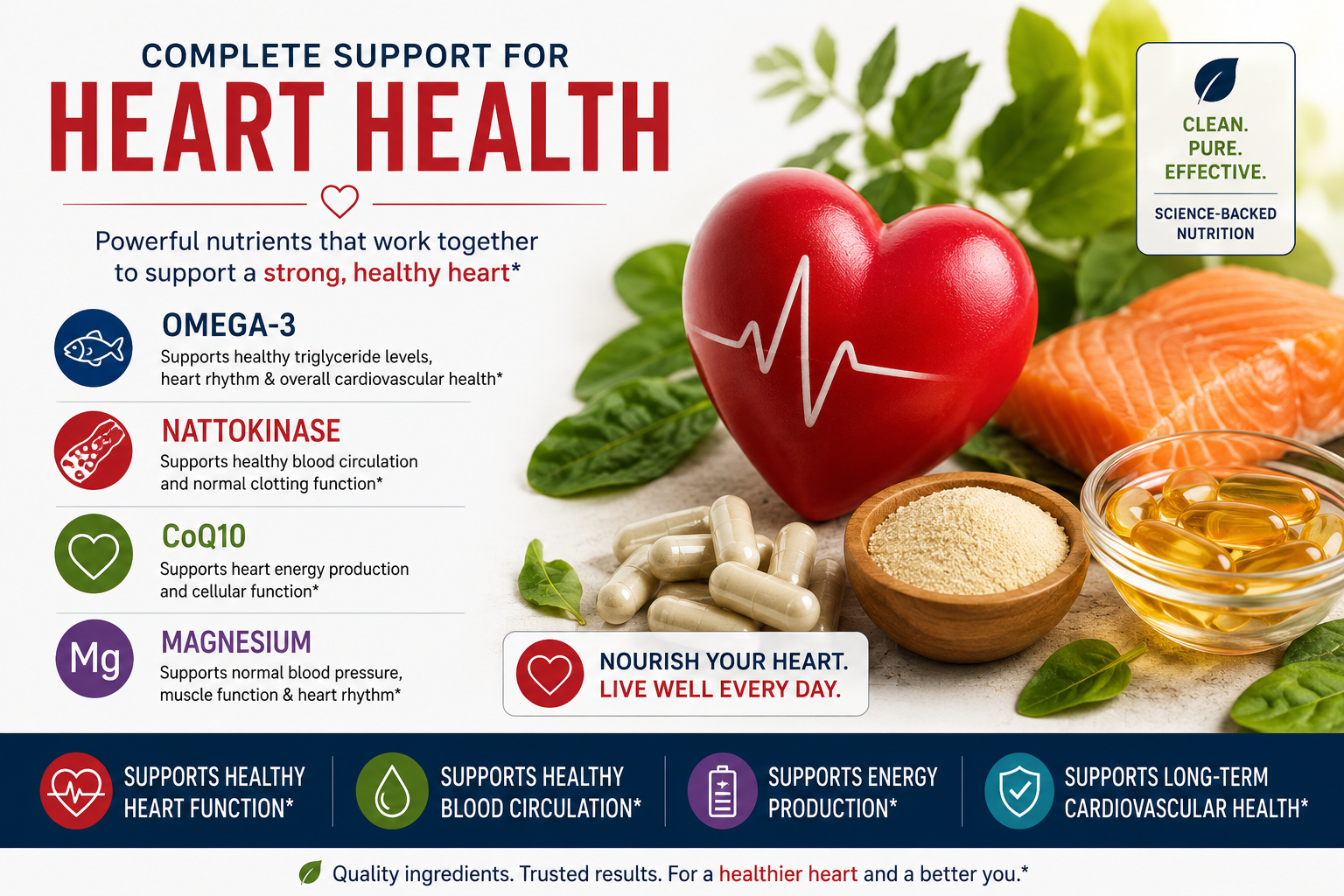
Cardiovascular Health · Supplement Evidence
Medically reviewed by TWC Editorial Team
Five supplements have meaningful human cardiovascular evidence: omega-3 fatty acids (EPA/DHA), CoQ10, magnesium, vitamin K2, and nattokinase. Most "heart-healthy" supplements have either weak data or none. Nattokinase in particular has 25+ years of human cardiovascular research showing reduced fibrinogen, lower blood pressure, and improved circulation.
Cardiovascular supplements are the largest category of confusion in the supplement aisle. The vast majority of products there have no human evidence behind them. Five do.
What's the strongest cardiovascular supplement evidence?
Omega-3 fatty acids (EPA and DHA), magnesium, CoQ10, vitamin K2, and nattokinase have the strongest human cardiovascular evidence. Each works through a distinct mechanism — triglyceride lowering, vascular relaxation, mitochondrial energy support, calcium handling, and fibrinolysis respectively.
The five with real evidence:
Omega-3 fatty acids (EPA/DHA)
Lower triglycerides, reduce platelet aggregation, and modestly lower blood pressure. Dose: 1,000–2,000 mg EPA+DHA daily. Most well-established cardiovascular supplement in existence.
CoQ10
Supports mitochondrial energy production in heart muscle. Particularly relevant for people on statins, which deplete CoQ10. Dose: 100–300 mg daily as ubiquinol.
Magnesium
Involved in over 300 enzymatic reactions, including vascular smooth-muscle relaxation and cardiac rhythm regulation. Most adults are deficient. Glycinate or malate forms preferred.
Vitamin K2 (MK-7)
Directs calcium into bone and away from arterial walls. Particularly important when supplementing high-dose vitamin D3. Dose: 100–200 mcg MK-7 daily.
Nattokinase
A fibrinolytic enzyme with 25+ years of human cardiovascular research. Lowers fibrinogen, supports healthy clot dissolution, and modestly reduces blood pressure. A 2018 review in Biomark Insights (PMC6052411) summarized the human trial data.
Why is nattokinase different?
Most cardiovascular supplements affect risk factors: lipids, blood pressure, oxidative stress. Nattokinase uniquely affects fibrin — the protein scaffold of blood clots — by activating the body's natural fibrinolytic system. This makes it a complement to, not a replacement for, lifestyle-based heart health.
The fibrinolytic system is your body's clot-busting machinery. As we age, this system slows — fibrinogen levels rise, clot dissolution becomes less efficient, and circulation suffers at the capillary level. Nattokinase enhances this system, which is part of why it shows benefits across so many cardiovascular endpoints.
This cardiovascular benefit existed long before nattokinase's spike-protein research emerged. It is why nattokinase has been a foundational supplement in Japan for three decades — the spike-protein work added a second reason to a strong existing case.
How Ultimate Spike Detox Fits In
Heart Health
8,000 FU nattokinase supports fibrinolysis, healthy fibrinogen levels, and circulation — three cardiovascular endpoints with 25+ years of human data.
Spike Detox
The same nattokinase dose degrades spike protein per Tanikawa et al. 2022 — heart health and post-COVID recovery in one formula.
Anti-Inflammatory
Curcumin lowers CRP and TNF-α — inflammatory markers that independently raise cardiovascular risk.

Frequently Asked Questions
Should I take CoQ10 if I'm on a statin?
Many cardiologists recommend it. Statins inhibit the same pathway that produces CoQ10 (the mevalonate pathway), so statin users often have measurably lower CoQ10 levels. Ubiquinol form is better absorbed than ubiquinone, especially over age 40.
Which form of magnesium is best for heart health?
Glycinate, malate, or threonate for absorption and tolerance. Avoid magnesium oxide — it has poor bioavailability and is mainly a laxative. Dose: 300–400 mg elemental magnesium daily.
What omega-3 dose works for cardiovascular support?
1,000–2,000 mg of combined EPA + DHA daily. Read the label carefully — a "1,000 mg fish oil" capsule may contain only 300 mg of actual EPA+DHA. Look for the active EPA/DHA total, not the fish oil total.
Can I take nattokinase if I already have a heart condition?
Only with your cardiologist's approval. Nattokinase has mild fibrinolytic activity and should not be combined with prescription anticoagulants or antiplatelet drugs without direct medical supervision.
Get Started Today
Five cardiovascular supplements have real evidence behind them. Nattokinase is one — and it does double duty for heart health and spike-protein detox. Ultimate Spike Detox delivers 8,000 FU alongside bromelain, curcumin, selenium, and dandelion root.
Learn MoreReferences
- Dabbagh-Bazarbachi, H., et al. (2018). Nattokinase: a promising alternative in prevention and treatment of cardiovascular diseases. Biomark Insights. pmc.ncbi.nlm.nih.gov/articles/PMC6052411
- Bhatt, D.L., et al. (2019). Cardiovascular risk reduction with icosapentaenoic acid for hypertriglyceridemia. NEJM. pubmed.ncbi.nlm.nih.gov/30415628
- Mortensen, S.A., et al. (2014). The effect of coenzyme Q10 on morbidity and mortality in chronic heart failure. JACC Heart Failure. pubmed.ncbi.nlm.nih.gov/24944614
- Kurosawa, Y., et al. (2015). A single-dose of oral nattokinase potentiates thrombolysis and anti-coagulation profiles. Scientific Reports. nature.com/articles/srep11601
Author
Works alongside our network of US-licensed clinicians and the McCullough Foundation research team.
This article is for informational purposes only and is not a substitute for professional medical advice, diagnosis, or treatment. Always seek the advice of a qualified healthcare provider with any questions you may have regarding a medical condition.


