


View Featured Categories
Shield Your Body from Toxins — Naturally


Functional Mushrooms · Immune Health
The Incredible, Somewhat Edible Turkey Tail Mushroom
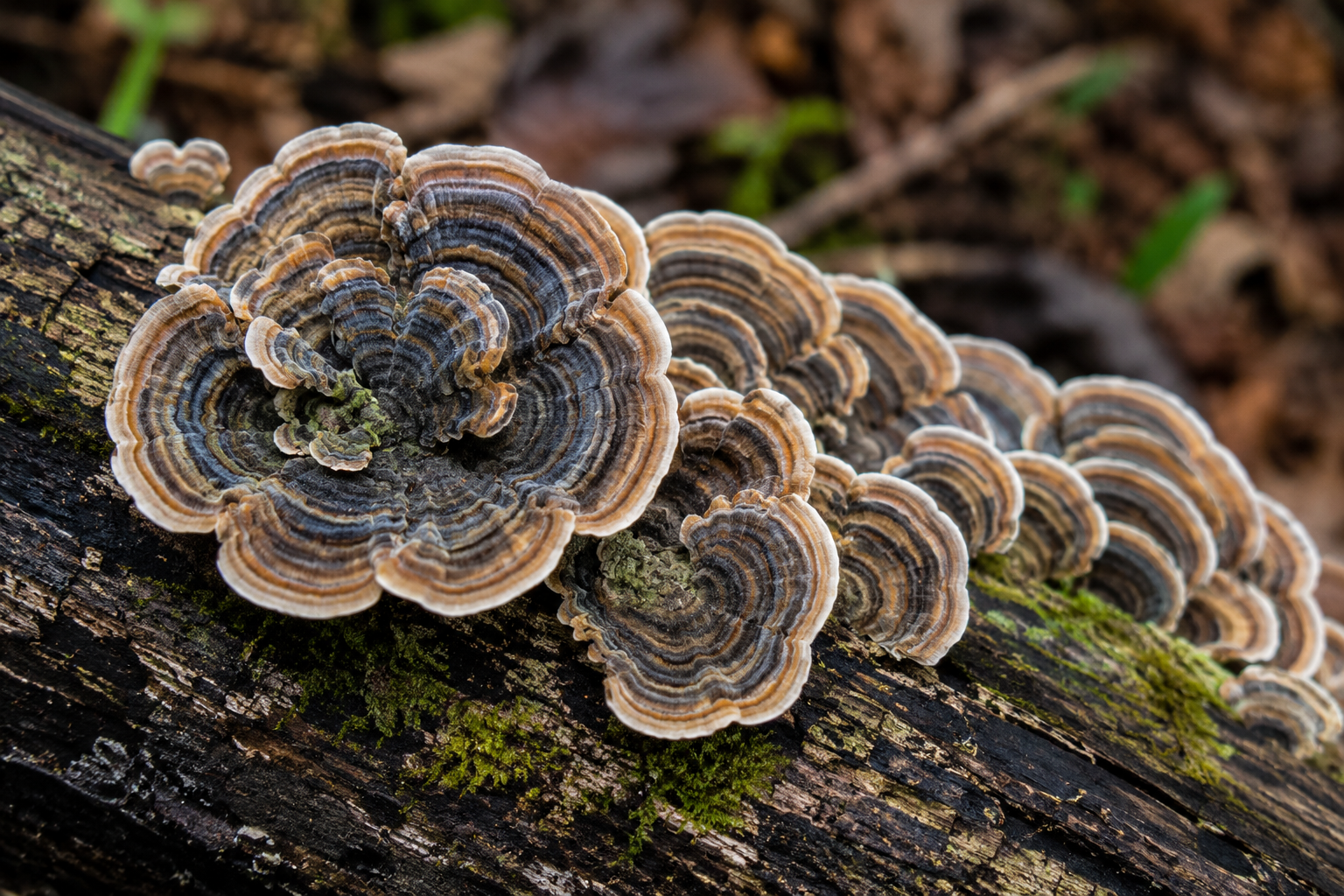
Known in the scientific world as Trametes versicolor, turkey tail is a thin, fan-shaped mushroom that thrives on decaying logs and stumps in the forest, quietly helping recycle dead wood back into the ecosystem. Its colorful, banded layers — ranging from browns and creams to hints of blue or orange — create a pattern that looks remarkably like the fanned tail of a wild turkey, which is how it gets its name.
You'll often spot turkey tail clustered in overlapping shelves on fallen trees or old stumps, adding a splash of color to damp woodland trails almost year-round. In traditional Chinese medicine, this mushroom — known as Yun Zhi — has been used for centuries as a gentle, nourishing tonic to support vitality, resilience, and overall wellness.
Functional, Not Gourmet
Turkey tail is not a gourmet mushroom — it is a functional one. Its tough texture means beneficial compounds must be extracted through thorough hot water processing to become bioavailable. The resulting tea, however, is not particularly palatable. Its bitter, earthy taste can make consistent use a challenge.
Shield has solved that problem by incorporating turkey tail into a cocoa mix, which masks the bitterness while adding natural antioxidants from cocoa and natural sweeteners from stevia — making it easy to take daily without compromise.
Health Benefits
Turkey tail's clinical and preclinical research base is among the strongest of any functional mushroom. Its benefits span immune modulation, cancer adjunct therapy, gut health, antioxidant activity, and even exercise performance.
Immunomodulation
Acts as a non-specific immune booster, enhancing the body's defense mechanisms against pathogens and cellular threats.
Immune Stimulation
Beta-glucans interact with receptor pathways (including CR3 receptors) on immune cells, enhancing their activity against pathogens and tumor cells.
Cytokine Regulation
Modulates production of both pro- and anti-inflammatory cytokines, including IL-2, IL-6, IFN, and TNF — supporting a balanced immune response.
Tumor Inhibition
PSK (polysaccharide-K) has shown potential to directly inhibit cancer cell growth, encourage apoptosis, and reduce tumor-promoting factors like TGF.
Antioxidant & Anti-Inflammatory
Rich in polyphenols and flavonoids that reduce oxidative stress and inhibit inflammatory pathways throughout the body.
Gut Health
Acts as a prebiotic, with polysaccharides and beta-glucans stimulating the growth of health-enhancing beneficial gut bacteria.
Exercise Performance
Supplementation has been shown to reduce physical fatigue and promote glucose utilization in peripheral tissues, supporting lower blood glucose levels and better endurance.
Cancer Adjunct Therapy
Polysaccharide-K — PSK, often called krestin — is among the most clinically studied compounds derived from turkey tail. It is used in Japan to improve survival rates and quality of life in gastric, lung, and breast cancer patients when combined with conventional treatments. Its use as an oncology adjunct reflects decades of clinical experience and a substantial peer-reviewed research base.
Safety Profile
Turkey tail has an exceptional safety record. Even when mice were given 100 times the usual dose, they exhibited no acute or chronic toxicity. For a supplement with this breadth of potential benefit, that safety profile is notable — and supports its use as a consistent, long-term daily supplement.
The Bottom Line
Turkey tail is not a trendy supplement — it is one of the most researched functional mushrooms in existence, with a decades-long clinical track record in immune support, oncology adjunct therapy, gut health, and oxidative stress reduction. Its safety profile is exceptional. Its breadth of benefit is unusual. And with Shield's cocoa-based formula, the one barrier to daily use — taste — has been removed.
References
- Kuo M. (2017, November). Trametes versicolor: the turkey tail. Mushroom Expert. https://www.mushroomexpert.com/trametes_versicolor.htm
- Johnson MA, Senn T, Krochmal R, Poole BD, Babcock TA. (2019). The mycelium of the Trametes versicolor (turkey tail) mushroom and its fermented substrate each show potent and complementary immune-activating properties in vitro. BMC Complement Altern Med. 19:342. https://doi.org/10.1186/s12906-019-2681-7
- Standish LJ, Wenner CA, Sweet ES, et al. (2008). Trametes versicolor mushroom immune therapy in breast cancer. J Soc Integr Oncol. 6(3):122–128.
- Kariya Y, Kiyohara H, Yamada H, Otsuka Y. (2012). Biological mechanism and clinical effect of protein-bound polysaccharide K (PSK). Gan To Kagaku Ryoho. 39(10):1525–1530.
- Matsunaga K, Yoshida K, Ueda N. (2011). Biological mechanism and clinical effect of protein-bound polysaccharide K (PSK; KRESTIN®). BioFactors. 37(6):381–387. https://doi.org/10.1002/biof.18
- Pilkington K, Wieland LS, Teng L, et al. (2022). Coriolus (Trametes) versicolor mushroom to reduce adverse effects from chemotherapy or radiotherapy in people with colorectal cancer. Cochrane Database Syst Rev. 11(11):CD012053. https://doi.org/10.1002/14651858.CD012053.pub2
- Johnson MA, et al. The mycelium of the Trametes versicolor (turkey tail) mushroom and its fermented substrate each show potent and complementary immune-activating properties in vitro. BMC Complement Altern Med. 19:342 (2019).
- Standish LJ, et al. Trametes versicolor mushroom immune therapy in breast cancer. J Soc Integr Oncol. 6(3):122–128 (2008).
- Ho CS, Huang WC, Leung WK, et al. (2017). Effect of Coriolus versicolor mycelia extract on exercise performance and anti-fatigue in mice. Int J Med Sci. 14(11):1110–1117. https://doi.org/10.7150/ijms.20547
Author
These statements have not been evaluated by the Food and Drug Administration. This product is not intended to diagnose, treat, cure, or prevent any disease. This content is for educational purposes only and does not constitute medical advice. Always consult a qualified healthcare professional before beginning any new supplement regimen.


