


View Featured Categories
Willow Bark vs Aspirin: The Bitter Bark Behind a Famous Medicine


Natural Health · Herbal History
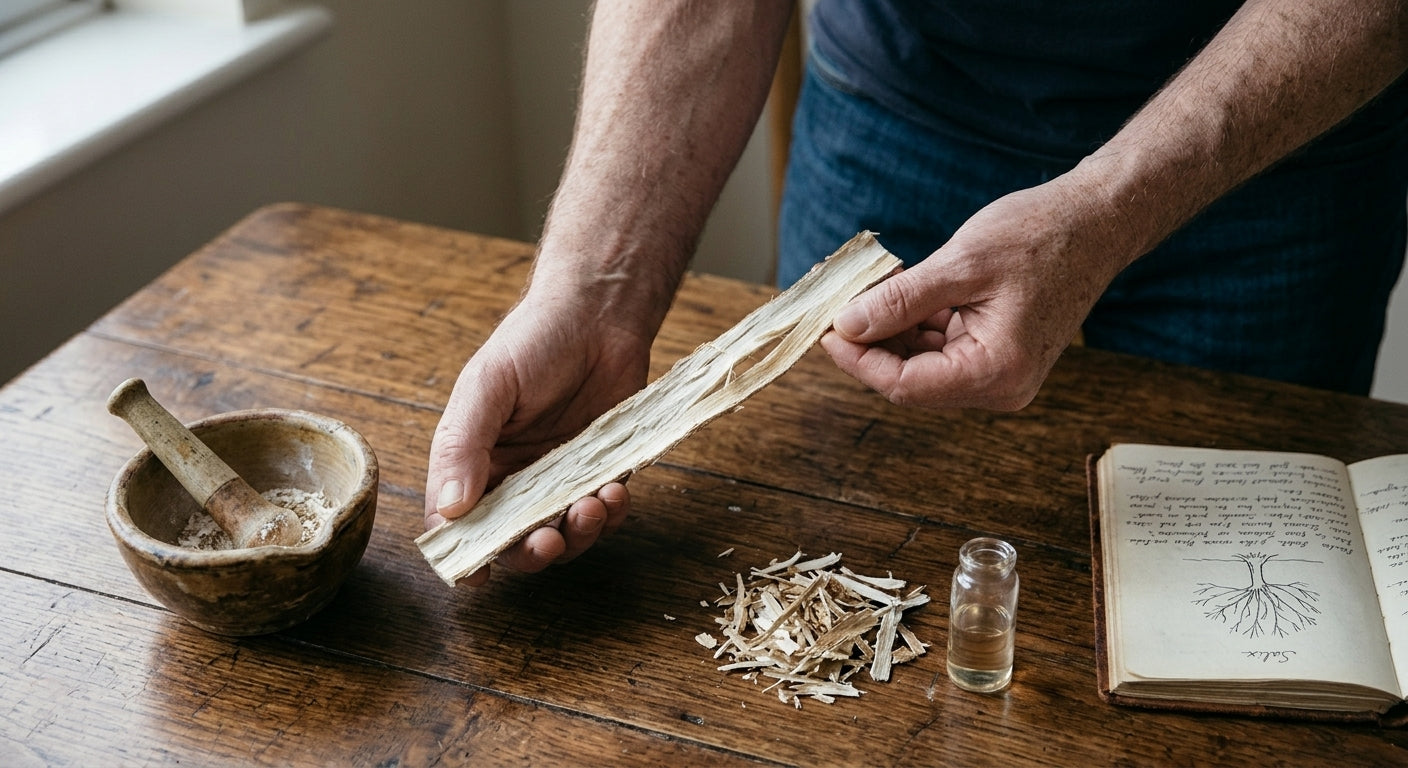
In the willow bark vs aspirin comparison, the two are related but not the same. Willow bark contains salicin, a plant compound the body converts to salicylic acid, along with many other natural compounds. Aspirin is a lab-made drug with a fixed dose and a much stronger anti-clotting effect. Willow bark is the ancestor; aspirin is the refined descendant.
The story starts in 1758, when an English clergyman named Edward Stone tasted a piece of willow bark. It was bitter, and the taste reminded him of Peruvian bark, a costly remedy for agues, the shaking fevers that troubled damp English villages.
Stone dried and powdered the bark and gave it to about 50 people over the next five years. In 1763, he sent his results to the Royal Society of London (5). His reasoning had a country-parson tone to it:
"As this tree delights in a moist or wet soil, where agues chiefly abound..."
— Rev. Edward Stone, letter to the Royal Society of London, 1763Today, researchers rely on randomized trials, not clues from the soil. Still, Stone got people looking. And what they eventually found became one of the best-known medicines in the world.
From Willow Bark to Aspirin: 150 Years of Chemistry
Stone didn't know which compound in the bark mattered. Chemists spent most of the next 150 years finding out, and the history of aspirin runs straight through that search (2).
| Year | Milestone |
|---|---|
| 1763 | Edward Stone reports his willow bark results to the Royal Society of London. |
| 1828 | Johann Büchner, a professor at the University of Munich, isolates a yellow substance from willow and names it salicin, after Salix, the Latin name for willow. |
| 1890s | Bayer chemist Felix Hoffmann works on a gentler form of salicylic acid. His father's rheumatism treatment had been making him vomit. |
| 1899 | Bayer registers the result under a name most people know today: aspirin. |
That family tree is why willow bark earned the nickname "nature's aspirin." It's catchy. It's also a little too neat, and the reasons why are where the real comparison begins.
Willow Bark vs Aspirin: How They Differ
Aspirin is made in a lab, and every tablet carries a standard dose of a single compound, acetylsalicylic acid. Willow bark comes from a tree. A pharmacist-written, medically reviewed WebMD summary describes salicin as working much like aspirin, helping block substances in the body that can cause pain, swelling, and fever (3).
The catch is consistency. Salicin levels can vary from product to product and even from batch to batch, depending on where the tree grew, the weather, when the bark was harvested, and how it was processed. Willow bark also carries many other natural compounds alongside its salicin.
Those other compounds appear to matter. A review in Phytotherapy Research noted that the salicylic acid levels reached after an analgesic dose of aspirin are roughly ten times higher than those from a typical willow bark dose, which suggests salicin alone doesn't explain the bark's effects. The authors point to the bark's flavonoids and polyphenols as likely contributors, giving willow a broader mechanism than aspirin's (7).
The biggest practical difference is blood clotting. Aspirin's anti-clotting effect comes largely from its acetyl group, which willow bark doesn't have. In the same review, an extract dose providing 240 mg of salicin had no major effect on clotting (7). That's one reason willow bark is not a stand-in for low-dose aspirin taken on a doctor's advice for heart health.
| Feature | Willow Bark | Aspirin |
|---|---|---|
| Source | Bark of willow trees (Salix species) | Lab-made drug |
| Active compounds | Salicin plus flavonoids, polyphenols, and other plant compounds | Acetylsalicylic acid only |
| Dose consistency | Varies with growing conditions, harvest, and processing | Standard dose in every tablet |
| Effect on blood clotting | No major effect seen at 240 mg salicin | Strong anti-clotting effect |
| Who should avoid it | Anyone allergic to aspirin; see safety section below | Per label and provider guidance |
So willow bark isn't just a weak aspirin. It's a more complex plant extract that shares a family link with aspirin. Whether that complexity translates into real relief is a question researchers have actually put to the test.
Willow Bark for Back Pain: What the Research Says
In a four-week, double-blind study published in The American Journal of Medicine, 191 adults with flare-ups of chronic low back pain took willow bark extract providing 240 mg of salicin a day, 120 mg a day, or a placebo (1). In the final week, the share of people who were pain-free looked like this:
The higher-dose group also showed improvement after just one week. The study did note one participant who had a severe allergic reaction that may have been caused by the extract, a reminder that "plant-based" and "risk-free" aren't the same thing.
Fourteen years later, a Cochrane review pooled several trials of herbal remedies for low back pain. It found moderate-quality evidence that a daily willow bark dosage providing 120 mg or 240 mg of salicin reduced short-term pain more than placebo, and that 240 mg performed about as well as 12.5 mg a day of rofecoxib, a prescription pain drug (4). Rofecoxib (Vioxx) has since been withdrawn from the market because of adverse effects, so the comparison is historical rather than a recommendation.
The fine print matters here. The trials in that review tested short-term use only, up to about six weeks, and the reviewers found no evidence yet on long-term safety or effectiveness (4). Willow bark is one option among many, and it works best as part of a broader plan. For the rest of that plan, see our guide to managing acute low back pain.
Still, it's a long step from one curious vicar and a mouthful of bark to a Cochrane rating.
Why White Willow Bark Is Getting Renewed Attention
White willow bark (Salix alba) has come a long way from Stone's kitchen table. Three things help explain its staying power:
The History
Few plants are tied so directly to one of the world's best-known medicines.
The Evidence
Controlled human trials and a Cochrane review rating the short-term low back pain evidence as moderate quality.
The Choice
For people who want a plant-based approach to everyday aches, a long written record plus modern research.
Today, white willow bark is common in natural formulas for everyday aches, and it's often paired with other botanicals and nutrients rather than taken alone. PureRelief, a white willow bark formula from The Wellness Company, is one example. It combines willow bark with PEA, Baikal skullcap, ginger extract, and magnesium to support comfort for everyday aches, joint discomfort, and muscle tension (6).
That kind of pairing follows the bark's own logic. Willow was never a single-compound remedy; salicin works alongside the bark's other natural compounds. Combining ingredients is a natural next step from there.
Willow Bark Side Effects and Safety
Because willow bark contains salicin, some of aspirin's cautions carry over. People who are allergic to aspirin or other pain relievers should not take it (3).
Talk With a Health Care Provider First If You
- Take a blood thinner, an NSAID, aspirin, or a steroid
- Have asthma, a bleeding disorder, G6PD deficiency, kidney or liver problems, or a stomach ulcer
- Are 60 or older
- Are pregnant or breastfeeding
Children and teenagers with chickenpox, the flu, or flu-like symptoms should not take willow bark because of the risk of Reye's syndrome (3). For most healthy adults, the sensible approach is the same one that applies to any supplement: check your current medications first, and stay within the studied, short-term window unless a provider advises otherwise.
Frequently Asked Questions About Willow Bark and Aspirin
Is willow bark the same thing as aspirin?
No. Willow bark and aspirin are related, but they are not the same. Willow bark contains salicin, a natural compound the body converts to salicylic acid, plus many other plant compounds. Aspirin is a lab-made medicine with a standard dose of one compound in each tablet.
Does willow bark thin the blood like aspirin?
Not in the same way. Aspirin's anti-clotting effect comes largely from its acetyl group, which willow bark lacks, and research found an extract providing 240 mg of salicin had no major effect on clotting. Willow bark should not replace low-dose aspirin taken on a doctor's advice, and people on blood thinners should talk with a provider before using it.
Who should avoid willow bark?
People allergic to aspirin or other pain relievers should not take willow bark. Children and teenagers with chickenpox, the flu, or flu-like symptoms should avoid it because of the risk of Reye's syndrome. Anyone who takes blood thinners, NSAIDs, aspirin, or steroids, has certain health conditions, is 60 or older, or is pregnant or breastfeeding should check with a health care provider first.
Key Takeaway
Willow bark is aspirin's botanical ancestor, not its twin. It delivers salicin alongside other plant compounds, varies from batch to batch, and lacks aspirin's strong effect on clotting, yet controlled trials suggest it can ease short-term low back pain. Edward Stone began with a bitter taste and a good question. More than 260 years later, the questions are sharper: what in the bark matters, and what works well with it?
You Might Also Be Interested In
References
- Chrubasik, S., Eisenberg, E., Balan, E., Weinberger, T., Luzzati, R., & Conradt, C. (2000). Treatment of low back pain exacerbations with willow bark extract: A randomized double-blind study. The American Journal of Medicine, 109(1), 9–14. https://doi.org/10.1016/S0002-9343(00)00442-3.
- Goldberg, D. R. (2009, June 3). Aspirin: Turn-of-the-century miracle drug. Distillations, Science History Institute. Science History Institute.
- McIntyre, C. (2025, December 1). Willow bark: Uses, side effects, and more. WebMD. WebMD.
- Oltean, H., Robbins, C., van Tulder, M. W., Berman, B. M., Bombardier, C., & Gagnier, J. J. (2014). Herbal medicine for low back pain. Cochrane Database of Systematic Reviews, 2014(12), CD004504. https://doi.org/10.1002/14651858.CD004504.pub4.
- Stone, E. (1763). An account of the success of the bark of the willow in the cure of agues. Philosophical Transactions of the Royal Society of London, 53, 195–200. https://doi.org/10.1098/rstl.1763.0033.
- The Wellness Company. (n.d.). PureRelief. Retrieved October 26, 2026. twc.health.
- Vlachojannis, J., Magora, F., & Chrubasik, S. (2011). Willow species and aspirin: Different mechanism of actions. Phytotherapy Research, 25(7), 1102–1104. https://doi.org/10.1002/ptr.3386.
These statements have not been evaluated by the Food and Drug Administration. This product is not intended to diagnose, treat, cure, or prevent any disease. This content is for informational purposes only and is not medical advice. It does not replace consultation with a qualified health care professional.


