


View Featured Categories
Why Take Low-Dose Naltrexone at Night? Timing and Benefits Explained


Health & Wellness · Pain & Inflammation
Low-dose naltrexone (LDN) is a familiar drug used in an unfamiliar way. At standard doses (50 mg), naltrexone blocks opioid receptors to treat alcohol and opioid abuse.1 At doses closer to 1.5–4.5 mg — the range used in TWC's low-dose naltrexone formulation — it appears to work through a different mechanism: a brief, partial blockade that prompts the body to increase its own endorphin and enkephalin output once the drug clears, described as a "rebound" effect.1 That rebound is the reason timing gets so much attention — get the dosing window wrong, and protocols report the effect is muted or the sleep disruption isn't worth it.
LDN is used off-label, without FDA approval at these lower doses, for a range of conditions where inflammation and immune regulation play a central role — fibromyalgia and other chronic pain syndromes, Crohn's disease and other inflammatory bowel conditions, autoimmune thyroid disease, and, more recently, as a therapy some clinicians are exploring for post-viral fatigue following long COVID. The evidence base is still developing and varies considerably by condition, but the proposed mechanism — modulating microglial activation and inflammatory signaling — is consistent across most of it.1 Check with your doctor to see if it is right for you.
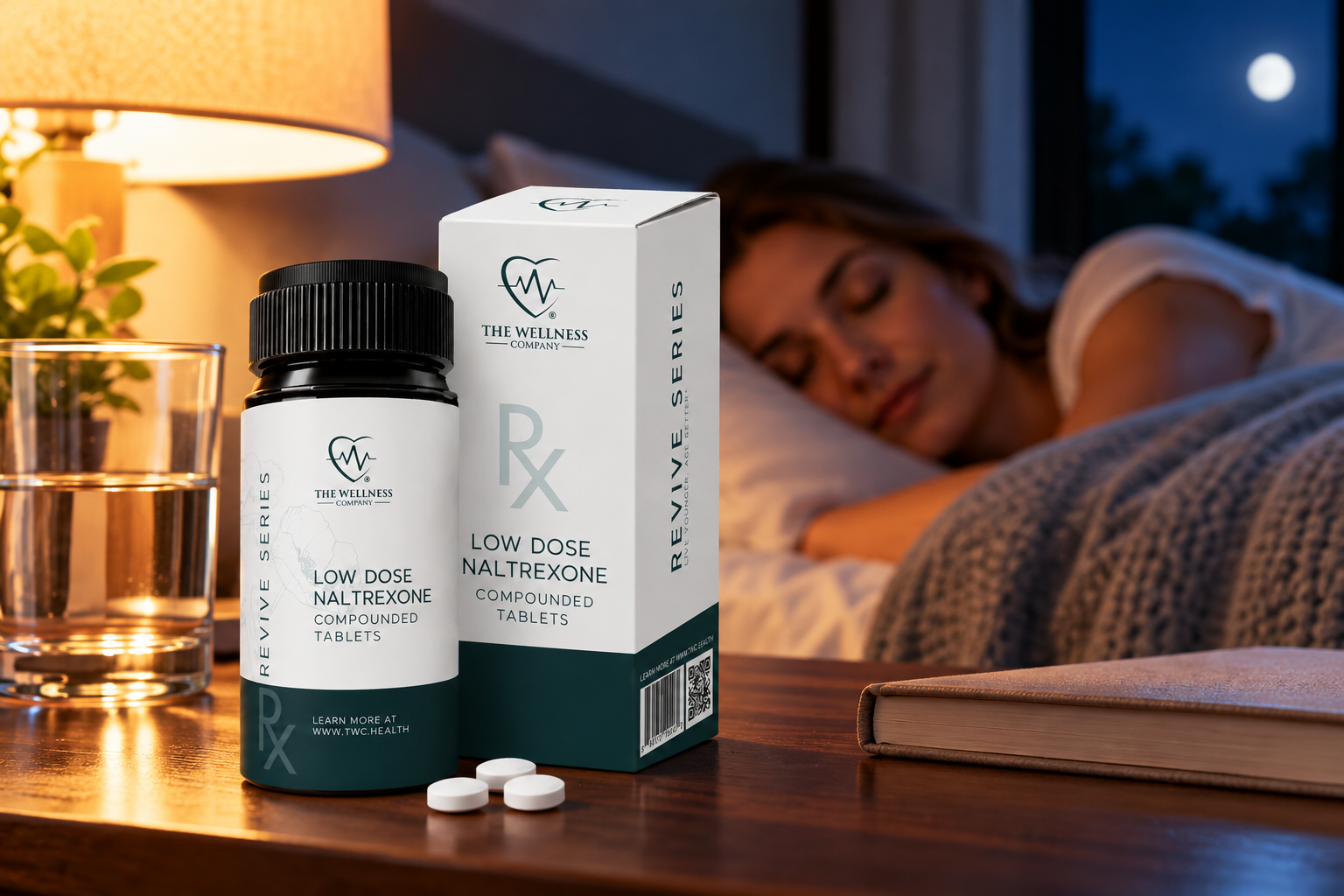
Most LDN protocols call for bedtime dosing. With a half-life of roughly 4–6 hours, taking LDN at night aligns peak blood levels with the hours when cortisol is naturally lowest, and the body's inflammatory and immune activity tends to be most active — the window LDN is thought to work in.
The Circadian Case for Nighttime Dosing
Cortisol, the body's primary stress hormone, follows a predictable daily rhythm: it peaks shortly after waking. It declines steadily throughout the day, reaching its lowest point in the first half of the night before climbing again before dawn.2 Immune and inflammatory activity run on a related but roughly inverse schedule — several types of inflammatory signaling are more active overnight, which is part of why symptoms like joint stiffness, nerve pain, or autoimmune flares are often reported as worse in the early morning than at midday.3
Bedtime dosing puts LDN's brief receptor blockade, and the endorphin rebound that follows it, inside that same overnight window — when cortisol is low and inflammatory processes are already relatively more active. That's the practical logic behind "take it at night" as a default instruction, distinct from claiming the drug works better at night in some absolute sense; individual response still varies, and some people are directed to adjust based on how they tolerate it.
| Factor | Why It Points to Nighttime Dosing |
|---|---|
| Half-life (~4–6 hours) | A bedtime dose clears while you sleep, keeping the brief receptor-blockade window overnight rather than during waking hours |
| Cortisol rhythm | Cortisol is naturally lowest in the first half of the night, the window most LDN protocols target2 |
| Overnight immune activity | Several inflammatory pathways are more active overnight, which many protocols treat as the more relevant window to target3 |
| Sleep architecture | Vivid dreams are a commonly reported early side effect; when they're disruptive, some providers shift dosing to morning instead |
Building a Consistent Routine
LDN is generally introduced at a low dose and increased gradually as tolerated, with most protocols asking for months of consistent use before concluding it does or doesn't work. That timeline makes routine more important than precision — taking the dose at roughly the same time each night matters more than hitting an exact hour. A consistent bedtime dose is also easier to fold into an existing wind-down routine, which supports the sleep quality most people are already trying to protect. If sleep is a piece you're still working on independent of LDN, building better sleep habits generally supports the same circadian rhythms this dosing strategy is built around.
LDN is generally well tolerated alongside most antidepressants, and some prescribers combine the two deliberately for treatment-resistant depression or overlapping chronic pain. Bupropion is the notable exception worth flagging to a provider: whether taken on its own or as part of a combination product, bupropion carries a labeled precaution for increased blood pressure and heart rate, particularly in the first few months of treatment.4 Opioid medications are a separate and firmer exception — LDN's receptor-blocking mechanism can trigger withdrawal and blunt the effectiveness of opioid pain relief, so the two are not combined.
Can You Take LDN in the Morning Instead?
Nighttime is the default recommendation, not an absolute rule. A meaningful share of people who start LDN report vivid or unusual dreams in the first few weeks, and for some that disruption outweighs the theoretical timing advantage of dosing at night. In those cases, providers often move the dose to the morning instead, and most people don't report a noticeable drop in benefit once their body adjusts. Anyone considering a switch should make that change with their prescriber rather than on their own, particularly early in treatment when the dose is still being titrated.
Quick Guidelines for Nighttime Dosing
- Take the dose at roughly the same time each night, generally 30–60 minutes before bed.
- Give it several weeks to months before evaluating whether it's helping — this is a foundational, not fast-acting, therapy.
- If vivid dreams or insomnia become disruptive, talk to your provider about switching to a morning dose rather than stopping on your own.
- Flag any bupropion or opioid-containing medications to your provider before starting, and don't adjust your own dose without their guidance.
Frequently Asked Questions About LDN Timing
Does taking LDN at a different time of day make it stop working?
No. Nighttime dosing is the default because it lines up with the body's cortisol and immune rhythm, not because LDN loses its effect at other times. Many people take it successfully in the morning, usually because nighttime dosing disrupted their sleep.
How soon should I expect to notice a difference after switching to nighttime dosing?
LDN is a slow, cumulative therapy regardless of when it's taken — most protocols look for changes over several weeks to months, not days. A timing change alone is unlikely to produce a fast, noticeable shift; consistency over time matters more than the specific hour.
The Bottom Line
Bedtime dosing is the standard recommendation for low-dose naltrexone because its short half-life and the body's overnight cortisol and immune rhythm line up in a way most protocols are built around — not because the drug is ineffective at other hours. Give it a consistent schedule and several months before judging results, and loop your provider in on both your medication list and any sleep disruption, rather than adjusting the timing on your own.
You Might Also Be Interested In
References
- Toljan K, Vrooman B. Low-Dose Naltrexone (LDN)—Review of Therapeutic Utilization. Med Sci (Basel). 2018;6(4):82. DOI: 10.3390/medsci6040082.
- O'Byrne NA, Yuen F, Butt WZ, Liu PY. Sleep and Circadian Regulation of Cortisol: A Short Review. Curr Opin Endocr Metab Res. 2021;18:178–186. PMC8813037.
- Waggoner SN. Circadian rhythms in immunity. Curr Allergy Asthma Rep. 2020;20(1):2. PMC7357859.
- Naltrexone and bupropion drug monograph. Drugs.com. drugs.com/monograph/naltrexone-and-bupropion.
These statements have not been evaluated by the Food and Drug Administration. This product is not intended to diagnose, treat, cure, or prevent any disease. This content is for educational and informational purposes only and is not intended as medical advice. Always consult a licensed healthcare provider before starting any new medication or treatment, and before changing the timing or dose of any existing prescription.


