


View Featured Categories
Do COVID Vaccines Shed? A New Paper Suggests They Do


Research · Vaccine Safety
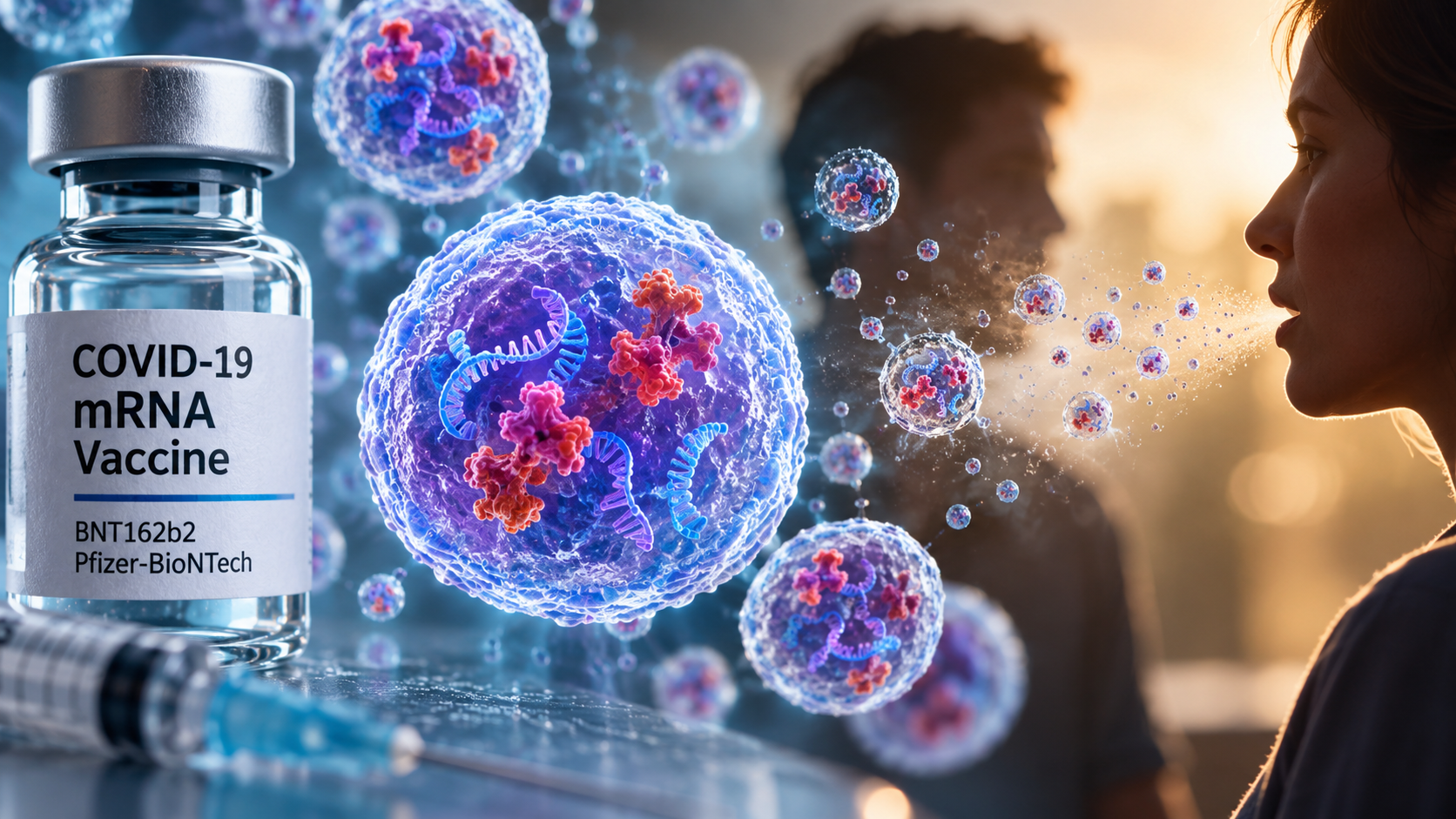
Do COVID vaccines shed? A new paper suggests they might. Trace vaccine mRNA has been found in breast milk for up to 45 hours after a shot, and spike protein has been found in exosomes in the blood. But transfer between people through saliva, sweat or breath has yet to be tested.
To see why that gap matters, it helps to go back to Aug. 31, 1854, when cholera swept through the Soho district of London. Within 10 days, about 500 people were dead. (5)
The experts of the day blamed "miasma," a foul air believed to rise from filth. A doctor named John Snow had a different hunch. He gathered the addresses of the dead and plotted them on a map. The deaths clustered around a single water pump on Broad Street.
Snow persuaded local officials to remove the pump's handle, and the outbreak subsided. (The pump, it turned out, had been contaminated by a leaky sewer, a detail that would spoil anyone's appetite for tap water.)
Snow is remembered as a pioneer of epidemiology. But the lesson worth keeping isn't the map. It's the handle. The map showed where to look. Pulling the handle was the test.
That distinction is the right lens for a new paper making the rounds this week.
COVID Vaccine Shedding: Two Different Claims
On Oct. 26, Nicolas Hulscher, MPH, of the McCullough Foundation announced a paper he co-wrote with John Catanzaro, NMD, PhD, of Neo7Bioscience, and Peter McCullough, MD, MPH. Its title is "mRNA Vaccine Shedding: Internal Transcriptional Dissemination and Potential Human-to-Human Transfer." It was posted as a preprint, meaning it has not been peer-reviewed. (1)
The authors posit two ideas. The first is that it spreads inside the body. After mRNA vaccination, cells make spike protein. (If you want a primer, here's what spike protein is and how it behaves.) The authors propose that this protein can be broken into fragments and carried through the bloodstream, and that cell division and cell-to-cell spread could extend the process into what they call a "self-reinforcing cycle." (1)
Spike protein lingering in your own body is a separate question from shedding, and it's the focus of TWC's nattokinase spike protein formula.
The second idea in the paper is spread between people, and that's the one making headlines.
Meet the Body's Tiny Couriers
To follow the argument, you need to know what an exosome is.
Picture a microscopic envelope. Cells pack bits of protein and genetic material inside, seal it and send it off. Other cells can receive these envelopes, and the cargo can change how the receiving cell behaves. Exosomes turn up in blood, saliva, sweat, breast milk and even exhaled breath.
This is where the published research gets specific. A 2021 study in The Journal of Immunology found circulating exosomes carrying spike protein 14 days after Pfizer-BioNTech vaccination, before antibodies had developed. Those exosomes declined by four months. (2) The new paper's authors go further. They cite reports of spike protein and vaccine mRNA in exosomes multiple years after vaccination, including exosomal mRNA at 1,284 days, or about three and a half years. (1)
Then there's breast milk. In a 2023 study in eBioMedicine, researchers tested milk from 13 nursing mothers. They found trace vaccine mRNA after 10 of 20 vaccinations, for up to 45 hours after the shot. It was concentrated inside extracellular vesicles, the family that includes exosomes. Those vesicles did not trigger spike production in lab-grown cells, and the researchers concluded that breastfeeding appears safe, especially 48 hours after vaccination. (3)
Breast milk is the one secretion where vaccine material has been documented. Saliva, sweat and breath all contain exosomes. Whether those exosomes carry vaccine material has not been checked.
| Body fluid | Vaccine material found? | Source |
|---|---|---|
| Blood | Yes. Spike protein in exosomes at day 14; declined by four months | J Immunol, 2021 |
| Breast milk | Yes. Trace mRNA for up to 45 hours, inside vesicles | eBioMedicine, 2023 |
| Saliva | Not directly tested | Catanzaro et al., 2026 |
| Sweat | Not directly tested | Catanzaro et al., 2026 |
| Exhaled breath | Not directly tested | Catanzaro et al., 2026 |

A Dot on the Map
The paper also points to a 2024 survey study in the International Journal of Vaccine Theory, Practice, and Research. (4) Researchers analyzed responses from 3,390 unvaccinated women who reported no COVID-19 symptoms or positive tests. Of those, 85.5% said they had been within 6 feet of a vaccinated person. Women with daily close contact outside their household reported more menstrual irregularities than women with rare contact. Curiously, daily contact with a vaccinated partner or household member did not raise the risk.
The survey ran online in spring 2021 and relied on what respondents reported about themselves, and its authors note that it does not establish cause and effect. (4) That is a dot on a map. It is a pattern, and patterns deserve attention. Snow's map was a pattern too, and it turned out to be right.
But a pattern is a starting line, not a finish line.
The Most Important Sentence in the Paper
Here's the twist. The most useful line in the paper isn't an alarm. It's an admission.
The paper states that no published study has directly demonstrated transfer of vaccine-derived spike protein or mRNA through breath, saliva, sweat or other non-milk secretions. (1) In announcing it, the authors put it more plainly: whether that transfer happens "has never been directly tested." (6)
Read that again.
The authors have a proposed mechanism, a documented pathway in breast milk and a survey association. What they don't have is the handle-pulling experiment. Nobody does. They call for direct testing, and in their announcement, also for a halt to mRNA technology in the meantime. (6) Readers may weigh that second request differently. The first one is hard to argue with. It fits a broader pattern in what's known and still unknown about COVID vaccines.
A fair question: if the mechanism sounds plausible, isn't that enough? Plausible is a fine reason to run a test. It is not a substitute for one. Biology is full of tidy theories that crumbled the moment someone checked, and full of odd hunches that held up.
A Map Is Not a Verdict
Even John Snow didn't win the argument with his map. According to the London Museum, his ideas were accepted only after another outbreak in 1866, 12 years later. (5)
That is how good science tends to move: slowly, stubbornly and one test at a time.
So the next time a headline about vaccine shedding crosses your screen, ask John Snow's question: Has anyone pulled the handle yet? For now, by the authors' own account, the answer is no.
That makes this paper a map. It may point somewhere important. It may not. Either way, a map tells you where to dig. It can't tell you what you'll find.
Frequently Asked Questions About COVID Vaccine Shedding
Has COVID vaccine mRNA been found in breast milk?
Yes, in trace amounts. A 2023 study of 13 nursing mothers found vaccine mRNA in breast milk after 10 of 20 vaccinations, for up to 45 hours after the shot. The mRNA was packed inside extracellular vesicles that did not trigger spike production in lab-grown cells, and the researchers concluded breastfeeding appears safe, especially 48 hours after vaccination.
Does the menstrual survey prove vaccine shedding?
No. A 2024 survey of unvaccinated women found that daily close contact with vaccinated people outside the household was associated with more reported menstrual irregularities. The data were self-reported, and the study's authors note that it does not establish cause and effect.
What kind of study would show whether COVID vaccines shed?
A direct test would collect saliva, sweat or breath from recently vaccinated people, check for vaccine-derived mRNA or spike protein, and look for that material in their close contacts. According to the authors of a 2026 paper on mRNA vaccine shedding, no published study has done this yet.
Key Takeaway
Whether COVID vaccines shed from one person to another has not been shown. Vaccine material has been documented in blood exosomes and, briefly, in breast milk, and a survey found a pattern worth studying. But the experiment that would settle the question, testing saliva, sweat and breath for transfer between people, has not been run. Until it is, the new paper is a map, not a verdict.
You Might Also Be Interested In
References
- Catanzaro, J. A., Hulscher, N., & McCullough, P. A. (2026). mRNA vaccine shedding: Internal transcriptional dissemination and potential human-to-human transfer [Preprint]. Zenodo. https://doi.org/10.5281/zenodo.23666330.
- Bansal, S., Perincheri, S., Fleming, T., Poulson, C., Tiffany, B., Bremner, R. M., & Mohanakumar, T. (2021). Cutting edge: Circulating exosomes with COVID spike protein are induced by BNT162b2 (Pfizer-BioNTech) vaccination prior to development of antibodies: A novel mechanism for immune activation by mRNA vaccines. The Journal of Immunology, 207(10), 2405–2410. PubMed.
- Hanna, N., Manzano De Mejia, C., Heffes-Doon, A., Lin, X., Botros, B., Gurzenda, E., Clauss-Pascarelli, C., & Nayak, A. (2023). Biodistribution of mRNA COVID-19 vaccines in human breast milk. eBioMedicine, 96, 104800. DOAJ.
- Peters, S. E., Newman, J., Ray, H., Thorp, J. A., Parotto, T., Hooker, B., McDyer, D., Murphy, L., Stricker, R. B., McDonnell, M., Mills, P. J., Gieck, W., & Northrup, C. (2024). Menstrual abnormalities strongly associated with proximity to COVID-19 vaccinated individuals. International Journal of Vaccine Theory, Practice, and Research, 3(2), 1435–1461. https://doi.org/10.56098/tp99wn15.
- London Museum. (n.d.). John Snow: Cholera & the Broad Street pump. London Museum.
- Hulscher, N. (2026, October 26). BREAKING: New paper reveals how mRNA vaccine materials could spread from vaccinated to unvaccinated people. The Focal Points. The Focal Points.
This article is for informational purposes only and is not medical advice. It does not diagnose, treat, cure or prevent any disease. Talk with your healthcare provider before making decisions about vaccination, breastfeeding or supplements.


