


View Featured Categories
What Is the Pneumonic Plague? Is It a Threat?


Health News · Infectious Disease
On Friday, September 25, a 28-year-old scientist named Darya Shipilova began her shift at the Irkutsk Research Anti-Plague Institute of Siberia (1,2). A week later, she was dead.
Her death has put a centuries-old disease back in the headlines, and with it, a lot of questions. Here's what we know about the case, and what you should know about plague itself.
What Happened in Siberia?
That depends on who you ask. The New York Post reports that Shipilova "may have accidentally broken a test tube containing a deadly 'Black Death' pathogen" and was infected (3). Rospotrebnadzor, Russia's health watchdog, says there was no lab accident and attributes her death to "pneumonia of unknown origin" (1).
Adding to the confusion, Alexei Tsydenov, head of the neighboring Republic of Buryatia, first said Shipilova died of plague, then edited his post to say she "may have," and denied she had ever traveled there (2). Meanwhile, 189 of her contacts were placed under medical observation (2).
When officials can't agree on what happened, it's reasonable to ask questions. So let's start with the basics.
What Exactly Is Plague?
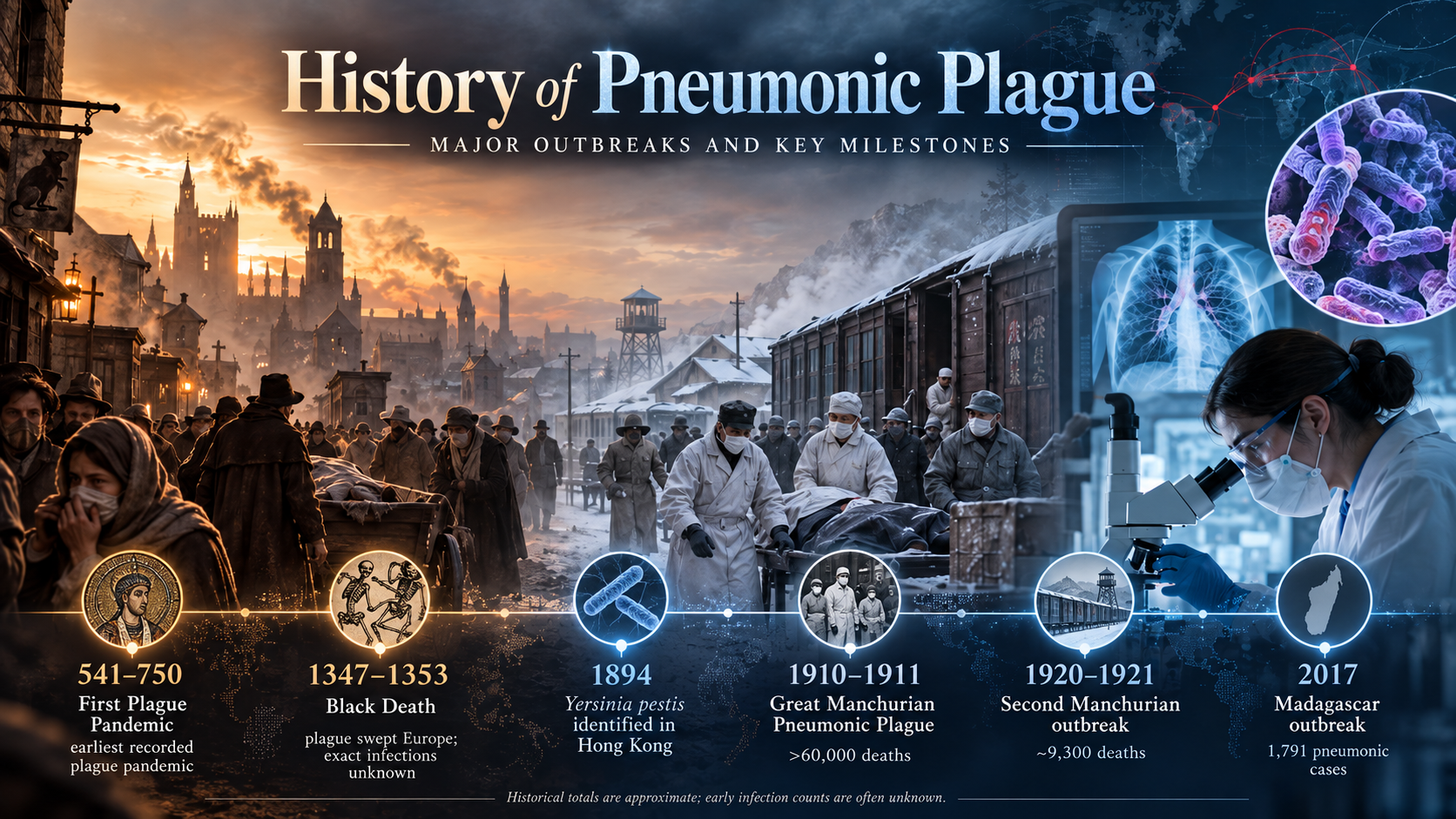
Plague is a bacterial infection caused by Yersinia pestis. The organism is named after Alexandre Yersin, the physician who isolated it in Hong Kong in 1894 (5). It mainly circulates among wild rodents and their fleas, and people are typically infected when that cycle spills over to them (6).
Most people picture the Black Death, the medieval pandemic that killed roughly a third of Europe in the 1300s. But plague isn't just one illness. It takes different forms depending on where the infection settles in the body.
What's the Difference Between Bubonic and Pneumonic Plague?
Bubonic plague is the most common form. It spreads mostly through flea bites and infects the lymph nodes, producing the painful, swollen "buboes" that gave it its name.
Pneumonic plague is rarer but far more dangerous. It infects the lungs, and unlike bubonic plague, it doesn't need a flea. It can spread directly from person to person through respiratory droplets (4). That's why the possibility of pneumonic plague in the Siberia case triggered such a large contact-tracing effort.
| Attribute | Bubonic Plague | Pneumonic Plague |
|---|---|---|
| Primary route | Flea bites from infected rodents | Airborne respiratory droplets |
| Area affected | Lymph nodes (buboes) | Lungs (severe pneumonia) |
| Transmission | Mostly animal-to-human | Person-to-person |
| Untreated outcome | Often fatal, slower progression | Nearly always fatal |
Has Pneumonic Plague Caused Major Outbreaks Before?
Yes. In the winter of 1910, pneumonic plague tore through Manchuria, killing roughly 60,000 people as it moved through fur trappers and migrant workers crowded together against the cold (7). Left untreated, it killed nearly everyone it infected.
The man credited with stopping it, Cambridge-trained physician Dr. Wu Lien-teh, relied on quarantine, careful tracking of cases, and a gauze-and-cotton mask of his own design (7). His work remains one of the classic case studies in outbreak control, and a reminder that pneumonic plague was never eradicated, only contained.
Does Plague Still Exist Today?
It does. Plague persists in wild rodent populations on several continents, and human cases still occur each year. According to the World Health Organization, the countries most affected in recent years include the Democratic Republic of the Congo, Madagascar, and Peru (6). Outbreaks are usually small and local, and most cases are the bubonic form.
What Are the Symptoms?
Plague typically begins suddenly with fever, chills, headache, body aches, weakness, and sometimes nausea and vomiting (6). In bubonic plague, one or more lymph nodes become swollen and tender. Pneumonic plague adds rapidly worsening pneumonia, with cough, chest pain, shortness of breath, and sometimes bloody sputum. It can progress very quickly, sometimes within a day of exposure.
Is Plague Treatable?
Yes, and this is the most important point. Plague responds to common antibiotics, but timing matters enormously. Pneumonic plague in particular needs treatment fast, ideally within about a day of symptoms starting (6).
That's why being prepared matters. Some families choose to keep physician-prescribed medications on hand in an emergency kit, so they aren't scrambling when an outbreak makes the news. If you ever suspect plague, though, seek medical care right away and tell your provider about any possible exposure.
Should I Be Worried?
For most people, the risk is very low. Plague is rare, and the tools that have worked for over a century still work: fast recognition, prompt antibiotic treatment, and sensible isolation of people who may have been exposed.
Stay informed, stay skeptical of stories that keep changing, and don't let panic set up camp in your head. Knowing the facts is the best defense.
Key Takeaway
A 28-year-old anti-plague researcher has died in Siberia, and the official explanation has already shifted more than once. Plague still exists and pneumonic plague can spread between people, but it is treatable with antibiotics when caught early. Recognizing symptoms quickly and getting care fast are what have worked for more than a century.
You Might Also Be Interested In
References
- Inocencio, R. (2026, October 5). Russia plays down plague fears and denies lab accident, says scientist died of "pneumonia of unknown origin." CBS News.
- Ynetnews. (2026, October). Mystery in Siberia: Anti-plague lab worker dies after test tube breaks, nearly 200 isolated. Ynetnews.
- New York Post. (2026, October 5). Russian plague lab researcher was infected after "simple mistake" with test tube, local source claims; now 3 hospitals are locked down. New York Post.
- Meduza. (2026, October 5). Plague may have resurfaced in Russia. But this isn't the Black Death. Meduza.
- Alexandre Yersin. (n.d.). In Wikipedia. Retrieved October 5, 2026, from Wikipedia.
- World Health Organization. (2026, September 29). Plague [Fact sheet]. World Health Organization.
- Manchurian plague. (n.d.). In Wikipedia. Retrieved October 5, 2026, from Wikipedia.
This content is for informational purposes only, is not medical advice, and does not replace consultation with a qualified healthcare professional. Statements about treatment are cautious, general information, not a guarantee of any outcome.


