


View Featured Categories
Mebendazole and Cancer: The Lab Surprise That Started It All


Research · Cancer
In 2009, a research lab at Johns Hopkins ran into a problem most scientists would happily take.
Gregory Riggins and his team grew brain tumors in mice as a matter of routine. It was ordinary, predictable work. Then, one group of mice stopped cooperating. Their tumors simply wouldn't grow.
The difference? Those mice had been given fenbendazole, a veterinary deworming drug.
The team could have filed it under "odd lab results" and moved on. Instead, they were curious, and began testing fenbendazole's chemical relatives to see which one, if any, stood out.
"We screened a lot of drugs in this family of compounds, and it was mebendazole that worked best."
— Gary Gallia, Neurosurgeon, Johns HopkinsWhy Mebendazole Stood Out
Mebendazole is fenbendazole's human-medicine cousin. It has been used for about 60 years to treat intestinal parasites, which made it an unlikely candidate for one of the toughest problems in oncology.
The Hopkins team was studying glioblastoma, an aggressive brain cancer. Riggins put the stakes plainly: "Average survival is 15 to 20 months."
In 2011, the researchers published their results in Neuro-Oncology. Mebendazole extended mean survival by up to 63% in two mouse models of glioma.* The scientists believe the drug interferes with tubulin, a protein that cancer cells rely on to build the structures they need to divide and grow.
Mice are not people, of course. A result like that earns a drug a ticket to the next round. It doesn't hand it the trophy.
From Mice to Patients
The next round came quickly. Johns Hopkins launched a phase 1 trial in 24 patients with glioblastoma, designed to find out whether people could safely tolerate mebendazole at the highest dose review boards would allow. By late 2014, the trial was about halfway done, and patients were tolerating the drug well.†
When NPR caught up with Riggins in 2017, the trial had finished. He called the data "as good as it could get for a phase-1 trial." Yet he had kept expectations firmly in check from the start:
"At best, the drug will slow tumor growth."
— Gregory Riggins, Research Professor, Johns HopkinsThat kind of restraint is rare in cancer headlines. It's also the reason the next data point deserves a careful look.
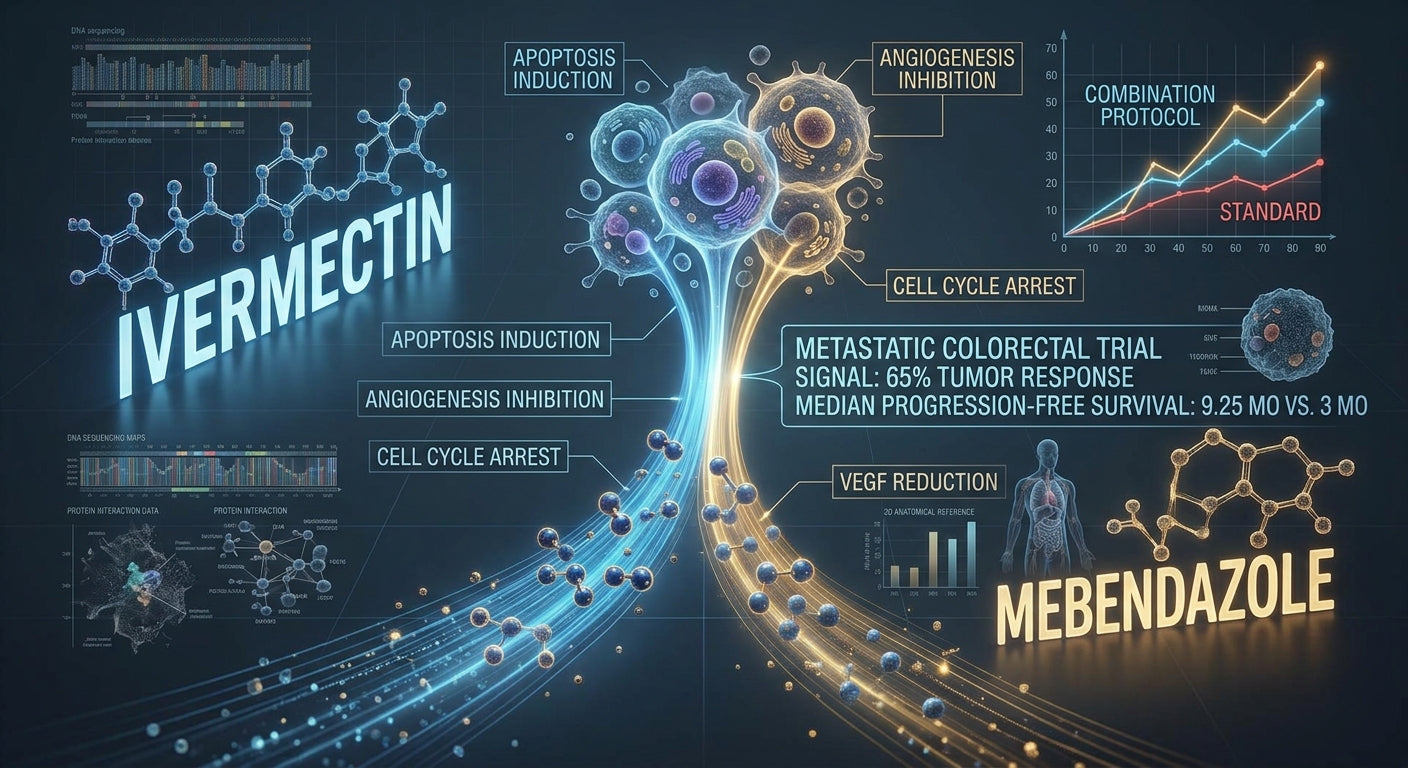
In 2022, Hegazy and colleagues published a randomized, double-masked, placebo-controlled trial in Life Sciences. This time the target was metastatic colorectal cancer. (For background on the colon's own defenses, see how mucus protects against colorectal cancer.) All 40 patients received standard chemotherapy, FOLFOX4 plus bevacizumab. Half also took mebendazole for 12 weeks; half took a placebo.
| Outcome | Mebendazole + chemo | Placebo + chemo |
|---|---|---|
| Tumor response rate‡ | 65% (13 of 20) | 10% (2 of 20) |
| Median progression-free survival‡ | 9.25 months | 3 months |
Brain tumors in mice. A safety trial at Hopkins. A small colorectal trial abroad. Three very different settings, and in each one, mebendazole has been shown to merit a closer look.
Where Mebendazole Cancer Research Stands in 2026
This fall, our research team and the McCullough Foundation posted a review that tries to gather all of it in one place. The 44-page preprint, released Oct. 19, 2026, pairs mebendazole with ivermectin, another decades-old antiparasitic.
For mebendazole alone, the authors cataloged 26 distinct anticancer mechanisms in preclinical research.* Add ivermectin's 29, account for the overlap, and the total comes to 37 mechanism classes across 25 human cancer types.
The authors also addressed safety:
"Both are oral, widely available generic drugs that are well-tolerated alongside chemotherapy."§
— Hulscher et al., Comprehensive Review (2026)Their conclusion echoes the caution Riggins showed years earlier. The authors write that "large, prospective, double-blind, parallel-group, randomized trials" are "urgently needed."
Riggins' mice never read a textbook. Their tumors just stopped growing, and someone happened to be paying attention. Seventeen years later, the question is no longer whether mebendazole is interesting in the lab. It's whether it helps people.
That answer will come from trials, not mice. In the meantime, you can read the full 2026 review for every mechanism and study behind these numbers.
The Bottom Line
Mebendazole's cancer story began with a lab surprise in 2009. Since then it has moved through mouse studies, a Hopkins safety trial, a 40-patient colorectal trial and a 2026 review cataloging 26 anticancer mechanisms. The evidence is intriguing but early, and larger randomized trials are what will settle it.
You Might Also Be Interested In
References
- Aubrey, A. (2017, January 30). A pinworm medication is being tested as a potential anti-cancer drug [Radio broadcast transcript]. NPR. https://www.npr.org/transcripts/512400204
- Bai, R.-Y., et al. (2011). Antiparasitic mebendazole shows survival benefit in 2 preclinical models of glioblastoma multiforme. Neuro-Oncology. https://pubmed.ncbi.nlm.nih.gov/21764822/ (Editor's note: complete author list, volume and page details could not be confirmed.)
- Hegazy, S. K., El-Azab, G. A., Zakaria, F., Mostafa, M. F., et al. (2022). Mebendazole; from an anti-parasitic drug to a promising candidate for drug repurposing in colorectal cancer. Life Sciences, 299, 120536. https://doi.org/10.1016/j.lfs.2022.120536 (Editor's note: the fifth author's name could not be confirmed.)
- Hulscher, N., Thorp, J. A., Victory, K., Gillooly, P., McCullough, P. A., & Risch, H. (2026). Combination ivermectin and mebendazole: A comprehensive review of anticancer mechanisms, preclinical activity, and clinical evidence as adjunctive treatment in cancer patients (Version 1) [Preprint]. Zenodo. https://doi.org/10.5281/zenodo.23475387
- Johns Hopkins Medicine. (2014, November 11). Surprise finding yields a possible tumor-fighting drug. Doorways to Discovery. https://clinicalconnection.hopkinsmedicine.org/news/surprise-finding-yields-a-possible-tumor-fighting-drug
Author
* Preclinical (laboratory and animal) findings do not establish effects in people.
† Phase 1 trials are designed mainly to test safety and dosing, not effectiveness. Results reported to date were preliminary.
‡ This was a small trial (20 patients per arm) and was registered after it started (NCT03925662). The results have not been independently replicated, and no overall-survival benefit was reported.
§ This is the review authors' statement. Mebendazole is not FDA-approved to treat cancer.
The 2026 review's authors are affiliated with The Wellness Company and/or the McCullough Foundation. The review is a preprint and has not yet been peer-reviewed.
Medical disclaimer: This content is for informational purposes only. It is not medical advice and does not replace consultation with a qualified healthcare professional. Talk with your oncologist before making any change to cancer treatment.


