


View Featured Categories
Which Antiparasitic Works Better: Mebendazole or Ivermectin?


Parasites & Antiparasitics · Efficacy
Medically reviewed by TWC Editorial Team
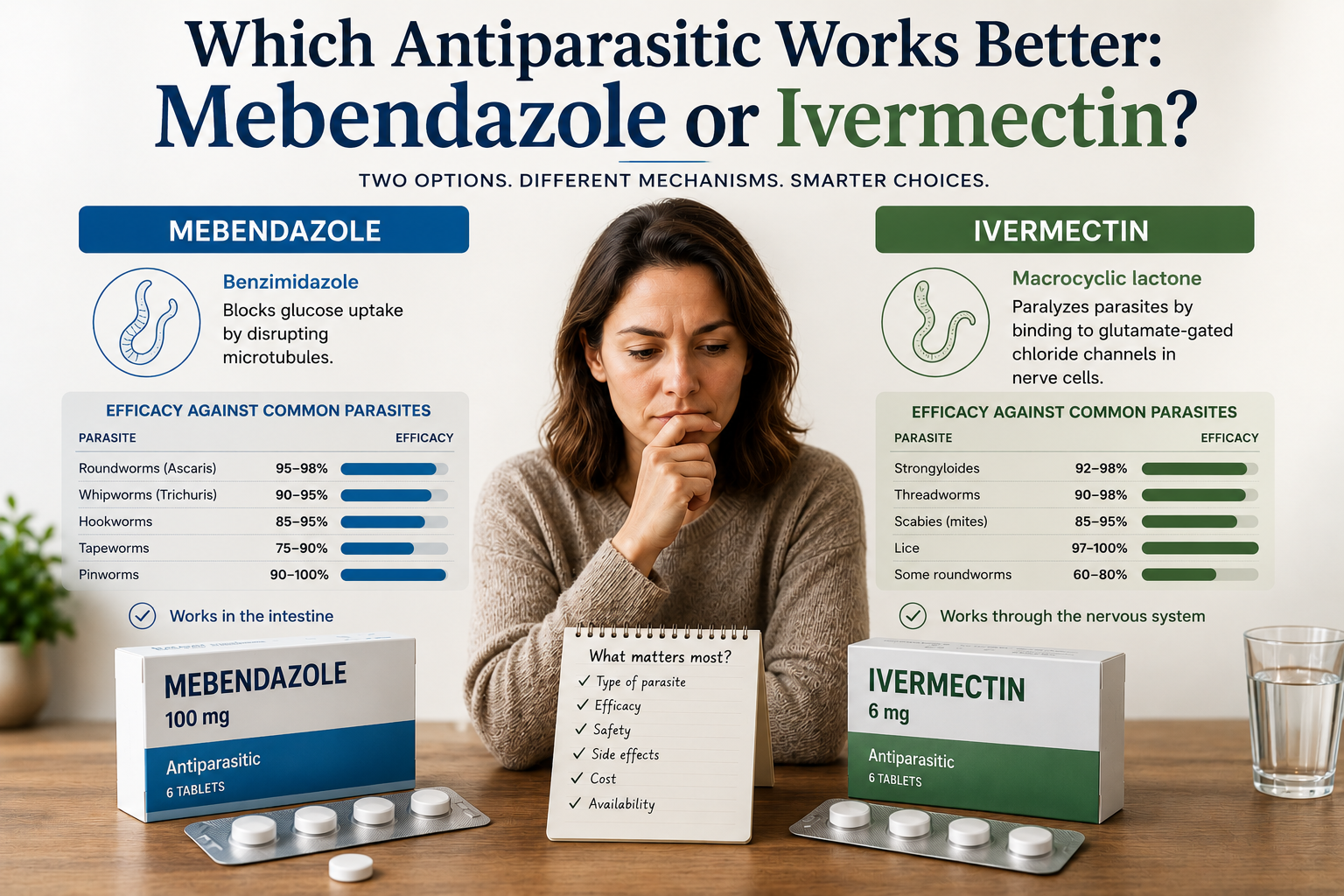
Neither universally outperforms the other. Mebendazole has higher cure rates for pinworm, roundworm, whipworm, and hookworm. Ivermectin outperforms mebendazole for strongyloidiasis, scabies, and tissue-resident parasites. Combination therapy outperforms either drug alone for mixed infections — which is why WHO has recommended combination antiparasitic regimens since 2017.
Which has higher cure rates?
Cure rates depend entirely on which parasite is being treated. Mebendazole achieves >95% cure rates for pinworm and ~70-95% for roundworm. Ivermectin achieves >95% cure rates for strongyloidiasis and scabies. Whipworm is the parasite where both drugs underperform individually — single-drug cure rates often fall below 50%, which is why combination therapy was adopted as the WHO standard.
From the WHO fact sheet on soil-transmitted helminth infections, the four main species (Ascaris, Trichuris, hookworms, Strongyloides) are typically addressed as a group because they need similar diagnostic procedures and respond to the same medicines — but cure rates vary substantially within that group.
Does the answer differ by parasite?
Significantly. The mebendazole vs ivermectin question is best answered as a parasite-by-parasite comparison rather than a single ranking.
| Parasite | Mebendazole | Ivermectin | Better Choice |
|---|---|---|---|
| Pinworm | ~95% | Variable | Mebendazole |
| Roundworm (Ascaris) | ~70-95% | ~80-90% | Either; mebendazole standard |
| Whipworm (Trichuris) | ~30-50% | ~40-60% | Combination outperforms either |
| Hookworm | ~70-90% | ~70-80% | Either; depends on species |
| Strongyloides | Limited | >95% | Ivermectin |
| Scabies | No activity | >95% | Ivermectin |
The pattern is clear: each drug has its specialty, neither is universally superior, and the parasites where both underperform alone (whipworm especially) drove WHO's combination guidelines.
Is combination better than either alone?
Yes, especially for mixed infections and resistant species. Per WHO guidance and clinical trial data, combination therapy delivers higher cure rates and broader coverage than single-drug treatment for soil-transmitted helminths. The McCullough Foundation real-world cohort using ivermectin + mebendazole reports patient-reported clinical benefit rates above 80% in cancer-support contexts.
Why Combination Outperforms
- Different mechanisms catch parasites at different lifecycle stages
- Reduces selection pressure for resistance
- Covers gaps in single-drug spectrum
- Especially valuable for mixed infections (common after travel)
Which is preferred by clinicians?
It depends on training and context. US infectious disease specialists default to single-organism matching — pinworm gets mebendazole, strongyloidiasis gets ivermectin. Functional and integrative medicine clinicians more often default to combination protocols. Telemedicine clinical groups like TWC have moved heavily toward combination compounded products driven by both real-world cohort data and the clinical convenience of one capsule covering more ground.
How Ivermectin + Mebendazole Fits In
Step 1
TWC consult. A clinician matches the protocol to your situation and confirms whether combination therapy fits.
Step 2
Compounded combination capsule prescribed if appropriate — 25mg ivermectin + 250mg mebendazole in one dose.
Step 3
Cycled cleanse protocol — 21 days on, 21 days off, repeated for four cycles with supervision.

Frequently Asked Questions
Is one drug stronger?
Strength is the wrong frame. Each is potent against different parasites. Ivermectin reaches tissues mebendazole cannot; mebendazole acts directly on intestinal worms ivermectin underperforms against.
Why doesn't a single drug cover everything?
Different parasites have different vulnerabilities. Mebendazole's microtubule-disruption mechanism doesn't work on parasites that live outside the GI tract. Ivermectin's nerve-channel mechanism doesn't reach all intestinal nematodes effectively.
Is the combination FDA-approved?
As individual drugs, yes. As a compounded combination capsule, it's prepared off-label by licensed compounding pharmacies under physician prescription.
Does combination double the side effects?
Side effect profiles are largely additive but the combination doesn't multiply rates of serious adverse events. Standard combination protocols are well-tolerated.
What does the McCullough Foundation cohort show?
The 197-patient observational cohort reports an 84.4% self-reported clinical benefit rate at 6 months in cancer patients using the combination off-label. This is observational data, not RCT evidence, but it represents the largest published cohort on this combination.
Get Started Today
Mebendazole and ivermectin each have efficacy advantages depending on the parasite. Combination therapy outperforms either alone for mixed or unclear infections, which is why combination protocols have become the modern standard for parasite cleanse and certain off-label uses.
Learn MoreReferences
- World Health Organization. (2023). Soil-transmitted helminth infections — Fact sheet. who.int
- World Health Organization. (2017). Guideline: Preventive chemotherapy to control soil-transmitted helminth infections in at-risk population groups. who.int
- Amneal Pharmaceuticals. EMVERM (mebendazole) Prescribing Information. U.S. Food & Drug Administration. accessdata.fda.gov
- Merck & Co., Inc. STROMECTOL (ivermectin) Prescribing Information. U.S. Food & Drug Administration. accessdata.fda.gov
- Patel, P. H., & Mada, P. K. (Updated 2023). Mebendazole. In StatPearls. National Center for Biotechnology Information. ncbi.nlm.nih.gov/books/NBK557705
- McCullough Foundation. Real-world cohort study: Ivermectin + Mebendazole protocol. Zenodo preprint records/19455636 (n=197 enrolled, n=122 completed 6-month follow-up).
Author
Works alongside our network of US-licensed clinicians and the McCullough Foundation research team.
This article is for informational purposes only and is not a substitute for professional medical advice, diagnosis, or treatment. Always seek the advice of a qualified healthcare provider with any questions you may have regarding a medical condition.


