


View Featured Categories
Activated Charcoal vs. Zeolite: How Are They Different?


Detox & Wellness · Toxin Binders
Activated charcoal and zeolite both bind certain unwanted compounds, and it's easy to assume they're interchangeable. Although they seem to have the same uses, the two differ chemically and in how they actually work in the body.
Activated Charcoal: A Broad-Spectrum Binder
Activated charcoal is a special form of carbon made by heating materials such as wood, coconut shells, or peat under controlled conditions. This process creates millions of tiny pores in the charcoal, giving it an extremely large surface area that allows many drugs and toxins to stick to its surface. (1)
Activated charcoal works mainly through a process called adsorption — a substance sticking to the surface of another material. In the digestive system, certain drugs and toxins can stick to charcoal, reducing the amount that enters the bloodstream. (1)
Activated Charcoal and Medications
Activated charcoal can also bind some medications. This can be useful in overdose situations, but it can also be a problem if charcoal is taken at the same time as an important medication — when charcoal binds to an oral medication, it may reduce the amount that enters the bloodstream, potentially making it less effective. (1,2) For this reason, oral medications generally should not be taken at the same time as activated charcoal unless a healthcare professional specifically recommends it.
Activated charcoal is primarily used as an emergency treatment for certain poisonings and drug overdoses, but it is not appropriate for every type of poisoning. Whether to use it depends on the substance involved, the amount swallowed, how long ago it was swallowed, and whether charcoal can bind the substance. (3,4) Timing matters too — activated charcoal generally has its greatest potential benefit when given soon after a toxic substance is swallowed, although it is sometimes used later depending on the substance and circumstances. (4)
Always contact poison control or your nearest hospital before administering any substance for poisonings or overdoses.
Zeolite: A More Selective Mineral Binder
Zeolite differs significantly from activated charcoal. It's a naturally occurring mineral made primarily of aluminum, silicon, and oxygen, and one of the most commonly studied types is called clinoptilolite. (4,5) Zeolite has a structure containing many small channels and openings, and its structure and electrical charge allow it to interact with certain molecules and charged particles. (4,5)
Zeolite works mainly through adsorption and ion exchange. Like activated charcoal, it can adsorb certain substances onto its surface, and because it carries a negative charge, it can also attract positively charged particles, including certain metal ions. (6,7) The ability of zeolite to bind metals depends on the type of metal, its chemical form, the type of zeolite, and the surrounding conditions. (6)
Zeolite and Gut Health
Researchers have also studied clinoptilolite for possible effects on gut health. In a small randomized, placebo-controlled human study, zeolite supplementation was associated with changes in zonulin, a protein that helps regulate the intestinal barrier — high levels of zonulin can cause intestinal permeability, also known as "leaky gut." (8) A separate randomized clinical trial in people with irritable bowel syndrome found improvements in some digestive symptoms and a small increase in gut microbiome diversity. (9)
Zeolite and Heavy Metals
One area of particular interest is zeolite's interaction with heavy metals. Research has found that clinoptilolite can interact with several metals, although it does not bind every metal equally well — the results depend on the particular zeolite and metal involved. (10)
Metals Studied for Interaction With Clinoptilolite (10)
- Lead
- Cadmium
- Arsenic
- Nickel
- Aluminum
Human research provides some evidence that certain clinoptilolite preparations can affect measurable metal levels in the blood. A 2022 clinical study examined people receiving a certified clinoptilolite preparation and found that arsenic levels were significantly lower after 12 weeks in one study group; in a separate long-term study, aluminum and nickel levels were significantly lower after four years of supplementation. (11) However, the results did not apply to every metal — lead levels were actually higher during some periods of the study before decreasing later, so researchers did not conclude that zeolite simply removes every heavy metal from the body. (11) Most importantly, these human studies measured blood levels, not metal concentrations directly inside organs.
What About Heavy Metals Already in Organs?
Animal research provides more direct evidence. In a 2023 study, researchers gave activated forms of clinoptilolite to rats for 12 weeks and measured aluminum, arsenic, cadmium, cobalt, lead, nickel, and strontium in the blood, liver, kidneys, brain, femur, and intestines. Metal levels decreased in the kidneys, femur, and intestines, along with changes in blood and serum levels, and researchers suggested that some metals may have temporarily moved from tissues into the bloodstream before being eliminated. (12) This study is important, but it was conducted in rats, not humans.
A 2025 mouse study looked specifically at cadmium. Mice exposed to cadmium and given modified clinoptilolite had substantially less cadmium in their organs than mice exposed to cadmium without the zeolite. (12) Again, this was an animal study — it provides evidence that modified clinoptilolite may reduce cadmium accumulation, but it does not establish that oral zeolite removes cadmium already stored in human organs. Taken together, these studies suggest that zeolite may affect the absorption, distribution, and elimination of certain metals.
Activated Charcoal vs. Zeolite
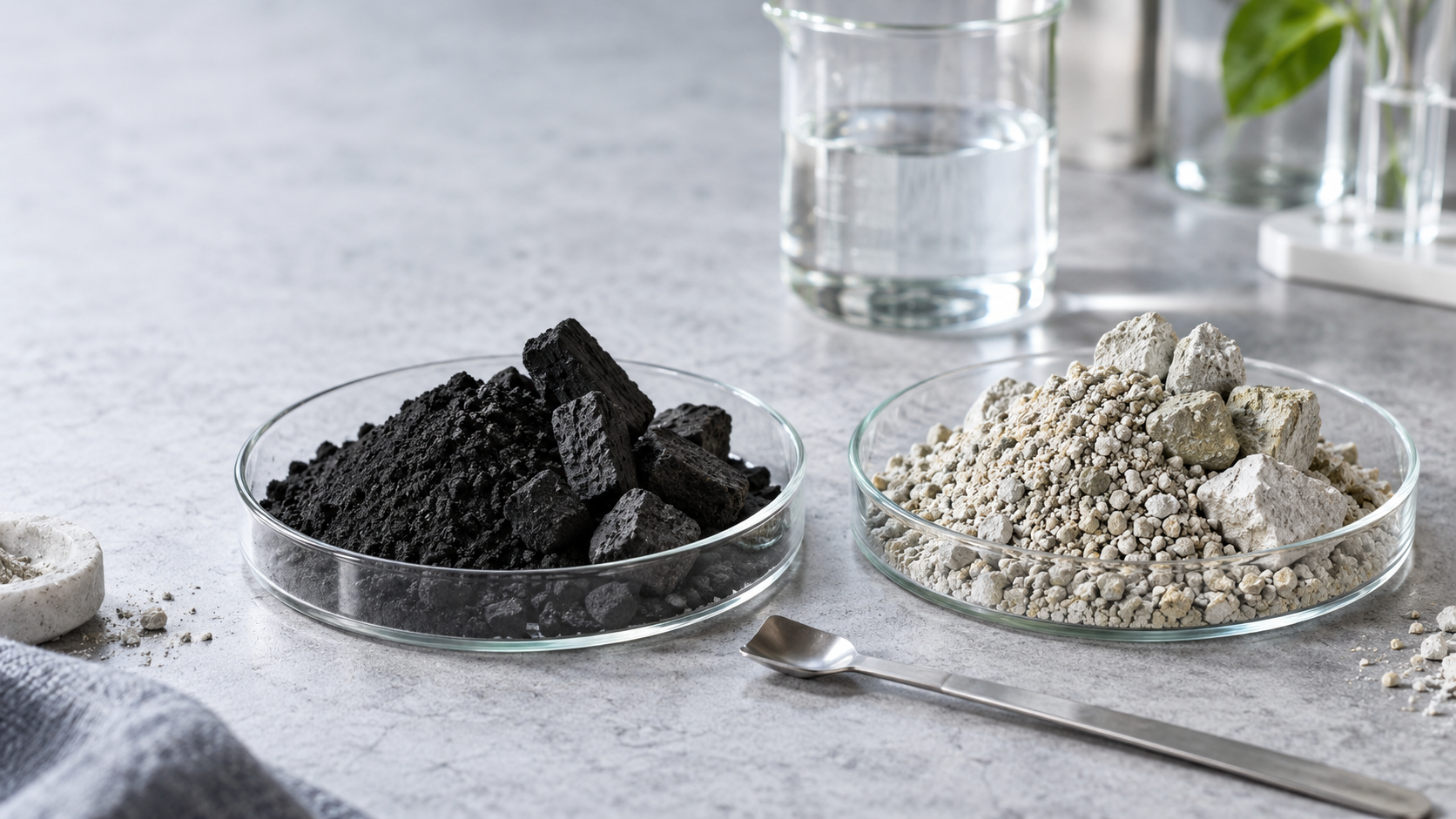
Activated charcoal and zeolite are both binding materials, but they work differently — and choosing between them (or using each for its intended purpose) starts with understanding those differences.
Activated Charcoal
An enormous porous surface that can bind many drugs and chemicals through adsorption. Its best-established medical use is as an emergency treatment for certain poisonings and overdoses.
Zeolite
A mineral structure that allows both adsorption and ion exchange, letting certain zeolites interact with particular metals and compounds. Zeolites like clinoptilolite also show promise for supporting the intestinal gut barrier against leaky gut caused by zonulin — the mechanism behind zeolite-based binders such as ToxiBind.
Two Different Tools, Not Two Versions of the Same Tool
Activated charcoal's strength is its sheer binding surface, which is why it remains an emergency-medicine standard for certain poisonings. Zeolite's strength is its selective structure and ion exchange, which is why it's studied more for gut barrier support and interaction with specific metals over time. Neither replaces the other, and neither replaces contacting poison control or a healthcare provider in an emergency.
Featured Product

ToxiBind™ / Zeolite-Based Toxin Binder
Advanced Toxin-Binder Support for a More Complete Detox
ToxiBind is formulated to help bind unwanted compounds in the digestive tract for safe elimination during a cleanse — the same clinoptilolite zeolite mechanism discussed above.*
Shop NowYou Might Also Be Interested In
References
- Chyka PA, Seger D, Krenzelok EP, Vale JA; American Academy of Clinical Toxicology; European Association of Poisons Centres and Clinical Toxicologists. Position paper: Single-dose activated charcoal. Clin Toxicol (Phila). 2005;43(2):61-87.
- Neuvonen PJ. Clinical pharmacokinetics of oral activated charcoal in acute intoxications. Clin Pharmacokinet. 1982 Nov-Dec;7(6):465-89.
- Taylor A, Galuska MA, Patel P. Activated Charcoal. [Updated 2026 Apr 18]. In: StatPearls [Internet]. Treasure Island (FL): StatPearls Publishing; 2026 Jan-.
- Mumpton, F. A. (1999). La roca magica: Uses of natural zeolites in agriculture and industry. Proceedings of the National Academy of Sciences, 96(7), 3463–3470.
- Kraljević Pavelić, S., Simović Medica, J., Gumbarević, D., Filipašić, T., Prpić, J., & Pavelić, K. (2022). Clinical evaluation of a defined zeolite-clinoptilolite supplementation effect on the selected blood parameters of patients. Frontiers in Medicine, 9, 851782.
- Wang, Shaobin & Peng, Yuelian. (2010). Natural zeolites as effective adsorbents in water and wastewater treatment. Chemical Engineering Journal. 156. 11-24.
- Inglezakis, V. J., & Zorpas, A. A. (2012). Handbook of natural zeolites. Nova Science Publishers.
- Lamprecht M, Bogner S, Steinbauer K, Schuetz B, Greilberger JF, Leber B, Wagner B, Zinser E, Petek T, Wallner-Liebmann S, Oberwinkler T, Bachl N, Schippinger G. Effects of zeolite supplementation on parameters of intestinal barrier integrity, inflammation, redoxbiology and performance in aerobically trained subjects. J Int Soc Sports Nutr. 2015 Oct 20;12:40.
- Anderle, K., Wolzt, M., Moser, G., Keip, B., Peter, J., Meisslitzer, C., Gouya, G., Freissmuth, M., & Tschegg, C. (2022). Safety and efficacy of purified clinoptilolite-tuff treatment in patients with irritable bowel syndrome with diarrhea: Randomized controlled trial. World Journal of Gastroenterology, 28(46), 6573–6588.
- Kraljević Pavelić S, Saftić Martinović L, Simović Medica J, Žuvić M, Perdija Ž, Krpan D, Eisenwagen S, Orct T, Pavelić K. Clinical Evaluation of a Defined Zeolite-Clinoptilolite Supplementation Effect on the Selected Blood Parameters of Patients. Front Med (Lausanne). 2022 May 27;9:851782.
- Dolanc I, Ferhatović Hamzić L, Orct T, Micek V, Šunić I, Jonjić A, Jurasović J, Missoni S, Čoklo M, Pavelić SK. The Impact of Long-Term Clinoptilolite Administration on the Concentration Profile of Metals in Rodent Organisms. Biology (Basel). 2023 Jan 26;12(2):193.
- Beltcheva M, Tzvetanova Y, Ostoich P, Aleksieva I, Chassovnikarova T, Tsvetanova L, Rusew R. Oral Supplementation with Modified Natural Clinoptilolite Protects Against Cadmium Toxicity in ICR (CD-1) Mice. Toxics. 2025 Apr 27;13(5):350.
Author
This article is for educational purposes only and is not medical advice. Always contact poison control or emergency services before administering any substance for a suspected poisoning or overdose. Statements about dietary supplements have not been evaluated by the FDA and are not intended to diagnose, treat, cure, or prevent any disease. Consult your healthcare provider before starting any new supplement.


