


View Featured Categories
Peptides and NSAIDs: Different Approaches to Recovery


Recovery · Inflammation Science
Peptides and NSAIDs: Different Approaches to Recovery
When people think about treating pain and inflammation, they often think of medications such as ibuprofen or naproxen. These drugs belong to a group called nonsteroidal anti-inflammatory drugs (NSAIDs) and have been used for decades.
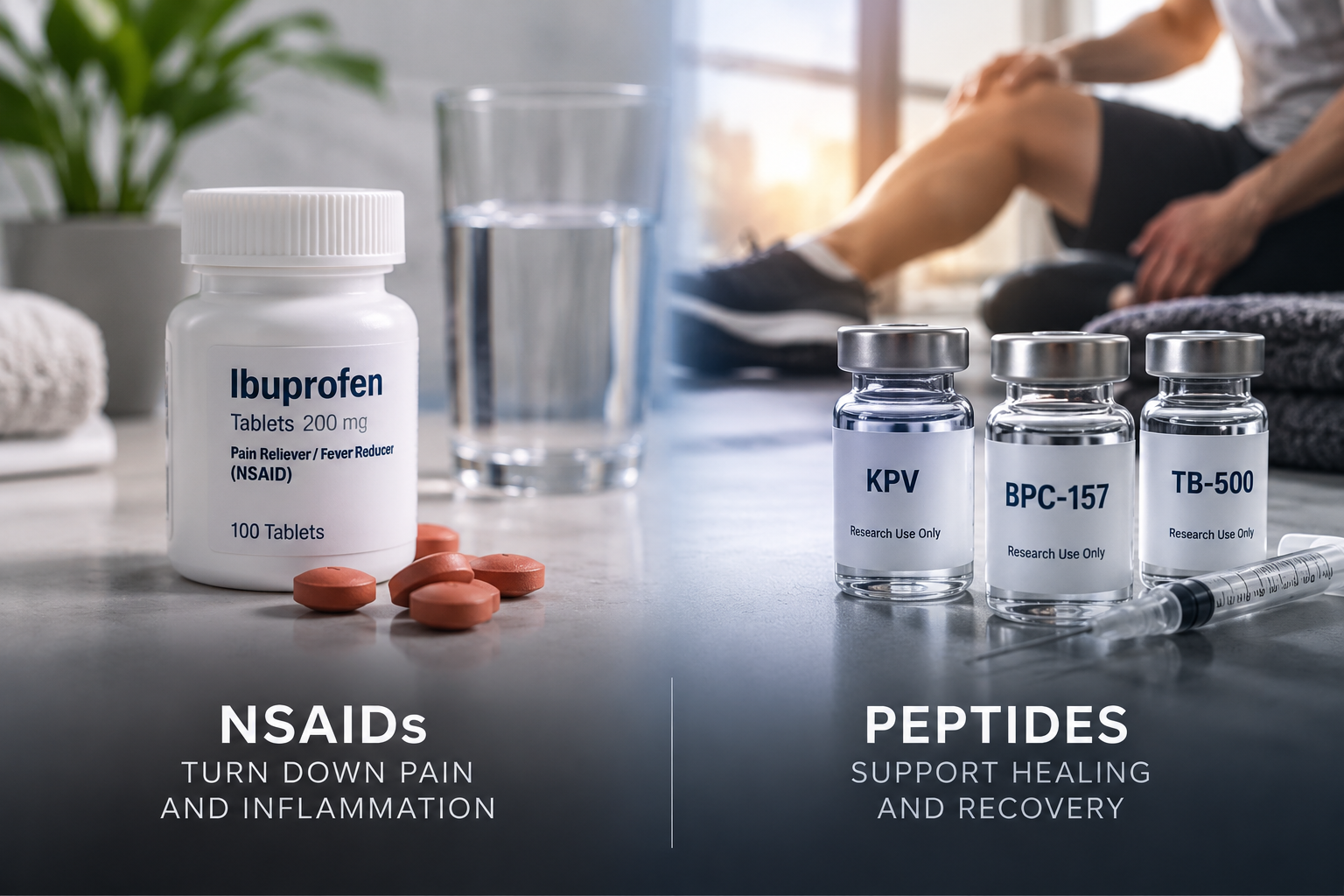
More recently, peptides such as KPV, BPC-157, and TB-500 have attracted attention because researchers are investigating whether they may influence inflammation and the body's ability to repair damaged tissue. Although all of these substances may affect inflammation, they do not work in the same way.
The simplest way to understand the difference is this: NSAIDs turn down the body's inflammation and pain signals. Peptides are being investigated for their ability to influence the biological processes involved in inflammation, tissue repair, blood-vessel formation, and cellular recovery.
NSAIDs: Turning Down the Inflammation Signal
Naproxen, ibuprofen, and similar NSAIDs work primarily by blocking enzymes called cyclooxygenase-1 (COX-1) and cyclooxygenase-2 (COX-2). These enzymes help the body produce substances called prostaglandins, which contribute to pain, swelling, and inflammation.(1) So in simple terms: injury raises prostaglandins, and rising prostaglandins raise pain and inflammation. An NSAID interrupts part of that process — COX enzymes get inhibited, prostaglandins drop, and pain and inflammation decrease.(1) This is one reason NSAIDs can be effective relatively quickly for conditions such as muscle aches, arthritis, headaches, and other inflammatory pain.
The problem is that prostaglandins are not exclusively "bad." The body also uses them for important protective functions, including helping protect the stomach and maintaining normal blood flow to the kidneys. Consequently, blocking prostaglandin production can produce unwanted effects.[2] NSAIDs are very good at reducing the inflammatory response, but the same mechanism that produces their benefits can also contribute to some of their side effects.
NSAID Side Effects
- Stomach irritation or indigestion
- Stomach ulcers
- Gastrointestinal bleeding
- Kidney injury or impaired kidney function
- Fluid retention and swelling
- Increased blood pressure
- Increased cardiovascular risk in some people
The gastrointestinal risks are well documented because reducing protective prostaglandins can weaken the stomach and intestinal lining.(2)
KPV: Calming Inflammatory Signaling
KPV is a very small peptide consisting of three amino acids: lysine-proline-valine.(3) It's interesting because researchers have found anti-inflammatory effects that appear to be different from the COX inhibition produced by NSAIDs. Research suggests KPV can interfere with inflammatory signaling — in animal experiments, KPV reduced inflammatory-cell migration and inflammation.(3) A review of α-MSH-related peptides concluded that much of the anti-inflammatory activity of α-MSH appears to reside in its C-terminal KPV sequence, with research also demonstrating effects on inflammatory cytokines and NF-κB signaling.(3)
Think of inflammation as an emergency response. An NSAID is somewhat like turning down the volume on the alarm by reducing prostaglandin production. KPV is thought to change the instructions inflammatory cells send to each other — it may influence how inflammatory cells communicate and respond rather than simply blocking the COX enzymes responsible for prostaglandin production. KPV's anti-inflammatory effects come from laboratory and animal research, showing potential as an effective treatment for pain and inflammation. Reported side effects are mild, including nausea and headache.(3)
BPC-157: More Focused on Repair and Recovery
BPC-157 is a synthetic 15-amino-acid peptide that has been extensively studied in laboratory and animal models of tissue injury.(4) Research has investigated its effects on processes involved in blood-vessel formation, endothelial-cell activity, nitric-oxide signaling, collagen production, and tissue repair. BPC-157 has been associated with increased angiogenesis — the formation of new blood vessels — which may help injured tissues receive oxygen and nutrients during repair. Other research has found effects on blood-vessel signaling involving pathways such as VEGFR2 and nitric oxide.(4)
Imagine an injury as a damaged construction site. An NSAID primarily helps by turning down some of the inflammatory alarm signals, which can reduce pain and swelling. BPC-157 is being studied more as something that could potentially help coordinate the repair process — including blood-vessel development and cellular activity involved in healing. Its most common side effects are mild, including gastrointestinal distress and headache.(5)
TB-500: Encouraging the Repair Process
TB-500 is commonly discussed as a synthetic peptide related to thymosin beta-4 (Tβ4), a naturally occurring peptide found in the body.(6) This distinction matters because much of the scientific literature is about thymosin beta-4, not every product marketed commercially as "TB-500."(6) Thymosin beta-4 has been investigated for its role in cell migration, blood-vessel formation, tissue repair, and inflammation. Research has found that it can promote processes involved in wound healing and tissue regeneration, with animal-model evidence and clinical studies of thymosin beta-4 both investigating wound healing outcomes.(6)
If NSAIDs are thought of as turning down the inflammatory alarm, thymosin beta-4 is being investigated more like a construction coordinator. After an injury, cells need to move into the damaged area, new blood vessels may need to develop, and damaged tissue has to be reorganized and rebuilt — thymosin beta-4 appears to influence several of these processes, which is why it's sometimes described as a regenerative or tissue-repair peptide rather than simply an anti-inflammatory. Some individuals may experience mild side effects, such as fatigue or dizziness.
The Big Difference: Suppressing Inflammation vs. Supporting Repair
The easiest way to remember the difference is to think about what happens after an injury. NSAIDs work on symptom and inflammation control: pain and injury raise inflammatory chemicals, the NSAID blocks COX, prostaglandins decrease, and pain and inflammation decrease. The peptides above work on a different axis entirely — tissue repair, regeneration, and inflammation modulation. NSAIDs and these peptides are not simply different versions of the same type of treatment.
NSAIDs
Primarily tell the body to "turn down the inflammation."(1,2)
KPV
Being studied for telling inflammatory pathways to "calm down."(3)
BPC-157
Being studied for helping coordinate "repair."(4,5)
TB-500 / Thymosin Beta-4
Being studied for helping cells "move, rebuild, and regenerate."(6)
Two Different Tools, Not Two Versions of the Same Tool
NSAIDs remain a fast, well-established way to quiet pain and inflammation — but that speed comes from blocking prostaglandins the body also relies on for protection, which is where their side-effect profile comes from. The peptides discussed here are being studied for a different job entirely: influencing the biological processes behind inflammation, blood-vessel formation, and tissue repair, with early research suggesting fewer and milder reported side effects. Neither approach replaces the other — understanding what each one actually does is what lets you have a more informed conversation with your healthcare provider about recovery.
Featured Product

Regenerate / Recovery Support
The Same Three Peptides, in One Formula
Regenerate is an oral triple-peptide blend of BPC-157, KPV, and TB-500 — the exact three peptides discussed above — formulated to support gut integrity, a healthy inflammatory response, and tissue recovery at the cellular level.*
Shop NowYou Might Also Be Interested In
References
- Gunaydin C, Bilge SS. Effects of Nonsteroidal Anti-Inflammatory Drugs at the Molecular Level. Eurasian J Med. 2018 Jun;50(2):116-121. doi: 10.5152/eurasianjmed.2018.0010. Epub 2018 Jun 1. PMID: 30002579; PMCID: PMC6039135.
- Gunaydin C, Bilge SS. Effects of Nonsteroidal Anti-Inflammatory Drugs at the Molecular Level. Eurasian J Med. 2018 Jun;50(2):116-121. doi: 10.5152/eurasianjmed.2018.0010. Epub 2018 Jun 1. PMID: 30002579; PMCID: PMC6039135.
- PeptideJournal. (2026, February). KPV: Anti-inflammatory peptide profile. https://www.peptidejournal.org/peptides/kpv-anti-inflammatory-peptide-profile
- McGuire FP, Martinez R, Lenz A, Skinner L, Cushman DM. Regeneration or Risk? A Narrative Review of BPC-157 for Musculoskeletal Healing. Curr Rev Musculoskelet Med. 2025 Dec;18(12):611-619. doi: 10.1007/s12178-025-09990-7. Epub 2025 Aug 12. PMID: 40789979; PMCID: PMC12446177.
- Fonvita Research. (2026, June 12). BPC-157 side effects and safety: Complete research review. https://fonvita.com/research/guides/bpc-157-side-effects-safety
- McGuire, F., Hughes, E., Maak, T., & Cushman, D. M. (2026). Thymosin Beta-4 and TB-500 in Tissue Healing, Regeneration, and Musculoskeletal Repair: A Scoping Review. Applied Sciences, 16(12), 6202. https://doi.org/10.3390/app16126202
Author
This blog is intended for educational use only. Some of the supplements have not yet been endorsed by the FDA for human use. Consult with your primary care provider for all your healthcare needs.


