


View Featured Categories
The Detox Step Nobody Talks About: How Toxin Binders Support Your Liver


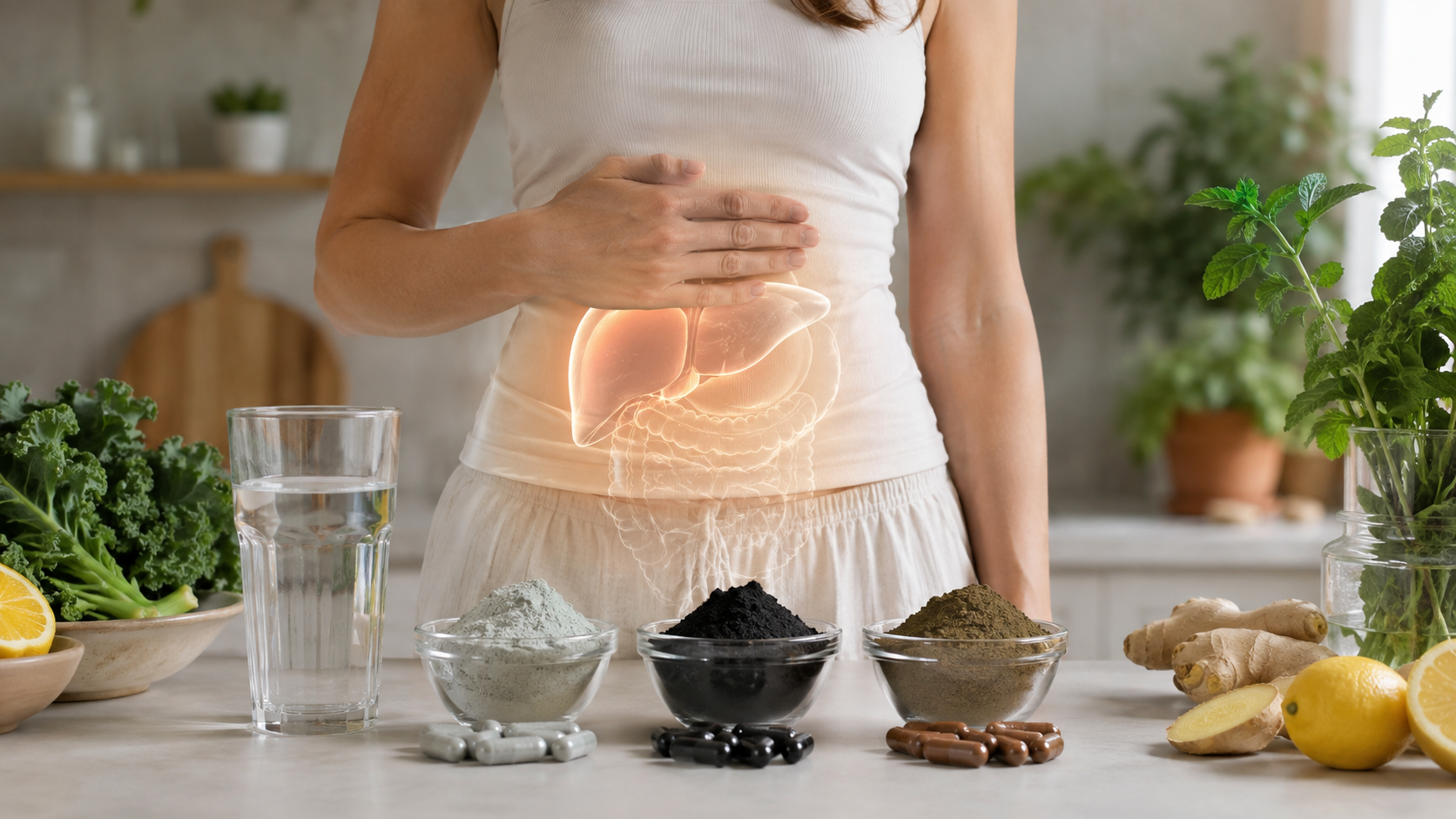
Detox · Liver Health
When people hear the word "detox," they often picture something that scrubs toxins out of the body in one clean sweep. In reality, the body already has sophisticated systems for processing and eliminating unwanted compounds, and the liver plays the central role. It's a major site of biotransformation, helping process drugs, environmental chemicals, and hormones so they can leave the body through urine, bile, or feces.(1)
Here's the part that rarely gets discussed: when you actively pursue a detox, the substances you're trying to remove have to go somewhere. Ideally, that "somewhere" is out of the body for good — not back into circulation. Understanding what happens after toxins are mobilized is where natural toxin binders come in.
The Liver and Natural Elimination
The liver doesn't work alone, but it does most of the heavy lifting. It processes compounds through a series of metabolic and transport pathways that prepare them for elimination, modifying them and attaching other molecules so they can be transported out through bile or back into circulation for eventual removal by the kidneys.(1,2) Working together with the kidneys, intestines, and biliary system (liver, gallbladder, and bile ducts), the liver forms one connected network for processing and eliminating compounds from the body.(1,2)
What the Liver Actually Does
- Processes compounds through metabolic and transport pathways that prepare them for elimination(1,2)
- Modifies compounds and attaches other molecules to them, readying them for transport out of the body(1,2)
- Works alongside the kidneys, intestines, and biliary system as part of the body's broader elimination network(1,2)
Why This Distinction Matters for Binders
Binders operate through a different mechanism than hepatic detoxification. Rather than metabolizing compounds the way the liver does, certain adsorbent materials interact with substances directly in the gastrointestinal tract, reducing their absorption before the liver ever needs to process them.
How Binders Work
- Capture substances such as heavy metals, mycotoxins, and endotoxins while they're still in the gut(3,4,5)
- Help ensure those substances are eliminated rather than reabsorbed into the bloodstream(3,4,5)
- Support the liver's efforts by reducing the load it has to process and re-process(3,4,5)
Three natural binders in particular have the strongest evidence base for this kind of gut-level support: clinoptilolite zeolite, humic acid, and fulvic acid.
Clinoptilolite Zeolite: A Natural Volcanic-Derived Mineral
Over geological time, volcanic ash and glass can alter through interaction with water and dissolved minerals, forming zeolite minerals such as clinoptilolite.(6,7) Its porous crystalline structure contains channels and exchange sites, and its framework of exchangeable cations gives it strong adsorption and ion-exchange properties.(8)
Studies have demonstrated clinoptilolite's ability to bind lead, cadmium, copper, chromium, zinc, nickel, and mercury, as well as aflatoxin.(9,10) Aflatoxin B1 — a mycotoxin produced by certain Aspergillus fungi that grow on crops like corn, peanuts, and grains — is classified as a Group 1 human carcinogen and is strongly linked to liver cancer. Research has shown that clinoptilolite can bind aflatoxin B1 directly.(3,4,11)
Humic Acid: A Natural Organic Binder
Humic acid belongs to a larger family of naturally occurring substances known as humic substances, which develop as plant and other organic materials break down and transform in soil, water, sediments, and other natural environments.(12) These substances interact with metals and other compounds through complexation, adsorption, electrostatic interactions, and hydrogen bonding.(12,13)
Humic acid has been studied for its ability to interact with lead, cadmium, mercury, copper, zinc, and chromium, as well as pesticides such as glyphosate.(9,12,14) One particularly relevant study examined humic acid preparations in an in-vitro digestive model using aflatoxin B1 and found substantial adsorption, with the highest values approaching 98–100% under the experimental conditions. A zeolitic material used for comparison also demonstrated substantial adsorption.(5)
That finding points to something worth noticing: different natural materials can interact with the same unwanted compound even though they work through different structures and chemical properties.(5,8) It's part of why comprehensive binder formulas — such as ToxiBind™, which combines clinoptilolite zeolite with humic acid and fulvic acid — are built around ingredients that complement each other rather than relying on a single mechanism.
Fulvic Acid: Soluble and Reactive
Fulvic acid is another component of the humic-substance family — a group of organic substances that interact with metal ions and other compounds.(12) It binds to and immobilizes a wide range of toxic heavy metals through a process called chelation, with active chemical groups that have a strong affinity for capturing lead, cadmium, mercury, arsenic, chromium, copper, and zinc.(13)
Fulvic acid's benefits go further than binding alone: it promotes digestive enzyme activity, supports intestinal tight junctions, and helps stabilize gut microbiota.(13) Other research has looked at its effects on antioxidant, inflammatory, and immune-related markers.(16,17) Some laboratory research has also reported effects of fulvic acid preparations on liver cancer-cell viability and apoptosis (cancer cell death); however, these findings are primarily experimental and should not be interpreted as evidence that fulvic acid prevents or treats cancer in humans.(12,13)
Why Are Humic and Fulvic Substances Removed From Municipal Water?
Here's an irony worth knowing: you lose most of the health-promoting benefits of humic and fulvic acid when you drink from municipal water supplies. Humic and fulvic substances occur naturally in rivers, lakes, reservoirs, groundwater, and soils — components of natural organic matter formed largely through the decomposition of plant, animal, and microbial material.(12,18)
That natural organic matter matters to water-treatment facilities because it can react with disinfectants like chlorine and chloramine, contributing to the formation of disinfection by-products (DBPs).(17,18) Drinking water utilities disinfect water to control harmful microorganisms and reduce the risk of waterborne disease, and because natural organic matter can serve as a DBP precursor, treatment processes often remove or reduce it before or during disinfection.(18,19)
Regulated Disinfection By-Products
- Trihalomethanes and haloacetic acids are among the most common regulated DBPs(20)
- Bromate and chlorite are also regulated under U.S. drinking-water rules(20)
The Bigger Picture
Natural binders aren't a replacement for the liver's work — they're the other half of the picture. Rather than metabolizing compounds the way the liver does, adsorbent materials like clinoptilolite, humic acid, and fulvic acid capture certain substances while they're still in the gastrointestinal tract, so they're less likely to be reabsorbed after they've already been mobilized.(3,5) Understanding both sides of that process — what the liver does, and what happens after — is what makes a detox protocol complete rather than half-finished.
Featured Product

ToxiBind™ / Detox Support
Advanced Binder Support for a More Complete Detox
Formulated with micronized clinoptilolite zeolite, humic acid, and fulvic acid, ToxiBind™ helps capture unwanted compounds in the digestive tract and supports their natural removal — without relying on activated charcoal or additional binding clays.*
Shop NowYou Might Also Be Interested In
References
- Healan-Greenberg, C. et al. Methods to Evaluate Biliary Excretion of Drugs in Humans: an Updated Review. Drug Metabolism and Disposition.
- Levine, W. G. "Biliary excretion of drugs and other xenobiotics." Annual Review of Pharmacology and Toxicology, 1978;18:81–96.
- Ranftler C, Zehentner M, Tschegg C, Nagl D. High Sorption Efficiency of Purified Clinoptilolite-Tuff for Aflatoxins B1 and M1: A Case Study in Plant-Based Beverages and Milk. Int J Mol Sci. 2025 Nov 21;26(23):11265. doi: 10.3390/ijms262311265. PMID: 41373422; PMCID: PMC12691791.
- Raj, J. et al. "Effects of a modified clinoptilolite zeolite on growth performance, health status and detoxification of aflatoxin B1 and ochratoxin A in male broiler chickens." British Poultry Science, 2021;62(4):601–610.
- Maguey-González, J. A. et al. "Humic Acids Preparation, Characterization, and Their Potential Adsorption Capacity for Aflatoxin B1 in an In Vitro Poultry Digestive Model." Toxins, 2023;15(2):83.
- Glanzman, R. K., & Rytuba, J. J. "Zeolite-clay mineral zonation of volcaniclastic sediments within the McDermitt caldera complex of Nevada and Oregon." U.S. Geological Survey, 1979.
- "Fundamental properties and sustainable applications of the natural zeolite clinoptilolite." Environmental Science and Pollution Research.
- "Ion Exchange in Natural Clinoptilolite: Aspects Related to Its Structure and Applications." Minerals, 2022;12:1628.
- Sprynskyy, M., Buszewski, B., Terzyk, A. P., & Namieśnik, J. "Study of the selection mechanism of heavy metal (Pb2+, Cu2+, Ni2+, and Cd2+) adsorption on clinoptilolite." Journal of Colloid and Interface Science, 2006;304(1):21–28.
- "Adsorption of heavy metals on natural zeolites: A review." Chemosphere, 2023;328:138508.
- International Agency for Research on Cancer. "Mycotoxins as human carcinogens — the IARC Monographs classification." IARC.
- "Impact of humic/fulvic acid on the removal of heavy metals from aqueous solutions using nanomaterials: A review." Science of the Total Environment, 2014;468–469:1014–1027.
- ScienceInsights. (2026, April 29). Is fulvic acid a binder? How it works in your body. scienceinsights.org.
- Piccolo, A., Celano, G., Conte, P. "Adsorption of Glyphosate by Humic Substances." J. Agric. Food Chem. 1996;44(8):2442–2446.
- "Adsorption of heavy metals on natural zeolites: A review." Chemosphere, 2023;328:138508.
- Feng, P. et al. "Effects of fulvic acid on growth performance, serum index, gut microbiota, and metabolites of Xianju yellow chicken." Frontiers in Nutrition, 2022;9:963271.
- Liu, L. et al. "Effects of fulvic acid on broiler performance, blood biochemistry, and intestinal microflora." Poultry Science, 2024;103(2):103273.
- Pant, K. et al. "Anti-proliferative and anticancer properties of fulvic acid on hepatic cancer cells." Journal of Clinical and Experimental Hepatology, 2015; U.S. EPA, "Treatment and Control of Drinking Water Contaminants Research."
- Centers for Disease Control and Prevention. "About Water Disinfection with Chlorine and Chloramine." CDC, February 14, 2024.
- U.S. Environmental Protection Agency. "Water Systems, Disinfection Byproducts, and the Use of Monochloramine." EPA.
Author
This blog is for educational purposes and is not intended to diagnose or treat any disease. Consult with your primary care provider before starting any new supplements or treatments.


