


View Featured Categories
2,000 FU vs. 8,000 FU: Does Your Nattokinase Dose Matter?


Heart Health · Nattokinase
Nattokinase has earned a loyal following among people looking for natural cardiovascular support. But one question comes up again and again: how much do you actually need? The answer depends on what you want nattokinase to do — and the research suggests that the dose that supports healthy blood flow is not the same dose that reaches arterial plaque.
Here is what the studies show at 2,000 FU, why researchers point to a higher threshold for plaque, and what to keep in mind before you start.
36.6%Carotid plaque reduction at 26 weeks
1,062Participants in the largest clinical study
What Is Nattokinase?
Nattokinase is a proteolytic enzyme, which is a special protein that breaks down other proteins into smaller pieces called amino acids. It is found in abundance in a fermented soy food widely consumed by the Japanese called natto. (1)
Because it is an enzyme, its strength is not measured in milligrams alone. Nattokinase activity is measured in fibrin units (FU) — a measure of how much fibrin, the protein that forms the mesh of a blood clot, the enzyme can break down. That is why the FU number on a label matters more than the capsule size.
Nattokinase Dosage Matters: The Benefits at 2,000 FU
Research continues to find multiple health benefits to nattokinase, but the dosage matters. At the commonly studied dose of 2,000 FU, the evidence centers on circulation:
Degrades blood clots
In one study, nattokinase demonstrated the ability to degrade blood clots between 2–4 hours. This benefit lasted upwards of 8–12 hours. (2)
Reduces blood pressure
In a previous study, 73 participants diagnosed with pre-hypertension or stage 1 hypertension took 2,000 FU nattokinase for 8 weeks. This resulted in a significant reduction of both systolic and diastolic blood pressure, leading researchers to conclude that nattokinase may play an important role in preventing and treating hypertension. (3)
Those are meaningful results. But when the goal shifts from blood flow to the buildup inside artery walls, 2,000 FU appears to fall short.
Why Arterial Plaque Raises the Stakes
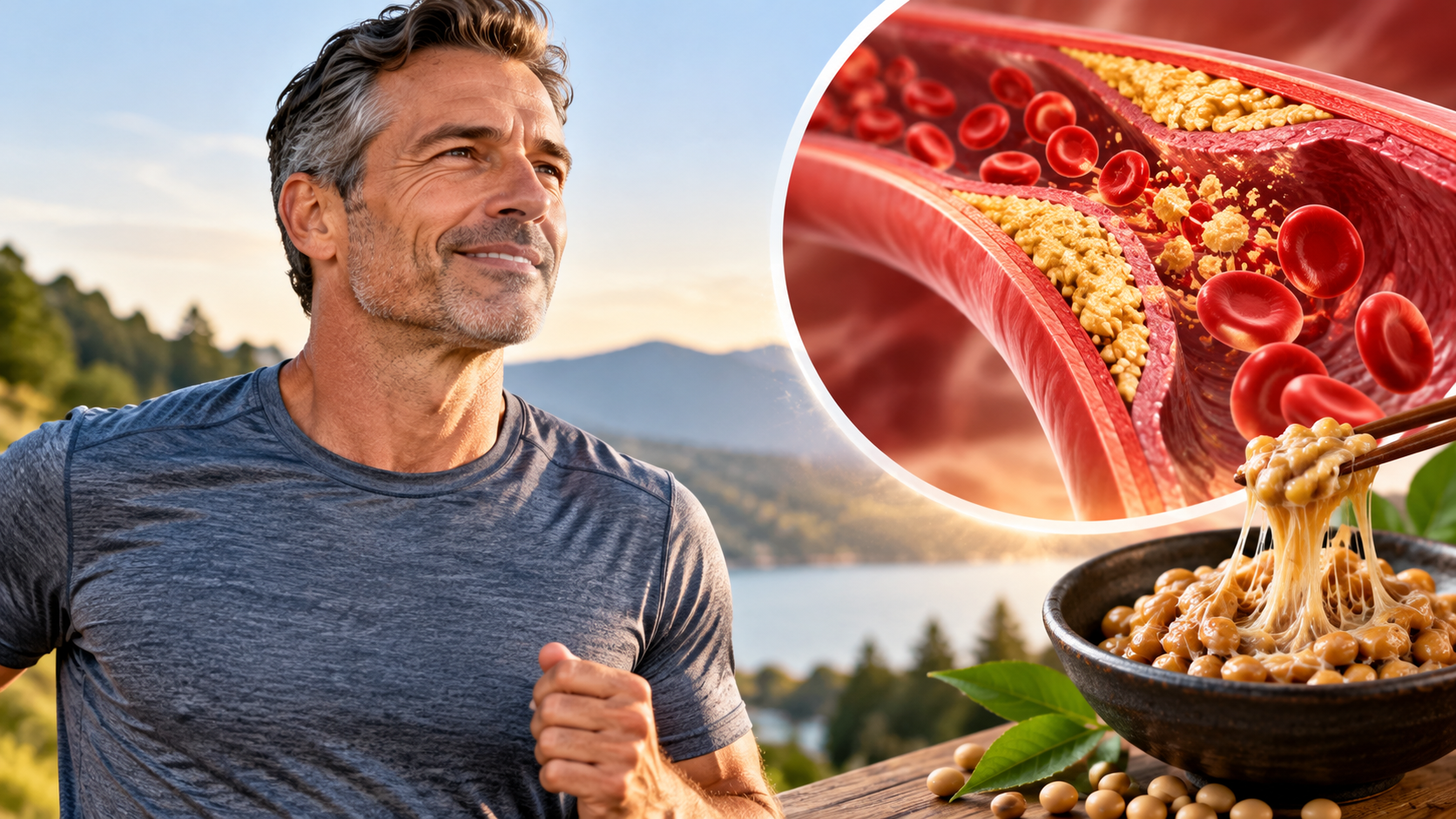
Arterial plaque is made up of cellular waste, calcium, and fibrin, and it is the cause of atherosclerosis — the hardening and narrowing of the arteries.
How Plaque Becomes Dangerous
- As plaque accumulates, the lumen (the inner channel of the artery) narrows, and oxygen deprivation of tissues and organs follows.
- In the heart, narrowed coronary arteries cause angina (chest pain) and can lead to heart attack.
- If an artery is suddenly blocked — either through degradation of the artery wall or a sudden blockage — heart attack, stroke, or aneurysm can occur.
Nattokinase for Plaque: The Case for 6,000 to 10,000 FU
This is where dose makes the biggest difference. While 2,000 FU was ineffective at reducing arterial plaque, 6,000 FU daily reduced carotid plaque area by 36.6% over 26 weeks, and 10,800 FU daily produced an approximately 36% reduction over 12 months.
This led researchers to speculate that “NK at a dose of 10,800 FU is highly effective in the treatment of hyperlipidemia and progression of atherosclerosis, two main contributors to the development of CVD (cardiovascular disease).” (4)
Review of these findings has led researchers to suggest that NK at the 6,000 FU dose would be the lower threshold for effectiveness. (5) The average of these two doses brings nattokinase to approximately 8,000 FU — the sweet spot for effective carotid plaque management.
Nattokinase Dose at a Glance
- 2,000 FU: studied for clot breakdown and blood pressure support (2,3)
- 6,000 FU: suggested lower threshold for reducing arterial plaque (5)
- ~8,000 FU: the midpoint between the effective plaque doses studied
- 10,800 FU: approximately 36% plaque reduction over 12 months (4)
Spike Protein Degradation
The same protein-dissolving action that targets fibrin may reach beyond the cardiovascular system. Evidence points to the ability of nattokinase to degrade spike protein in coronaviruses.
Spike proteins act like a key that unlocks a healthy cell, entering the cell to pull the virus membrane and human cell membrane together. From there the virus injects its genetic material, turning the cell into a virus-making factory. Nattokinase has demonstrated the ability to degrade spike proteins from SARS-CoV-2 in vitro, theoretically neutralizing the spike protein’s ability to infect. (6)
Cautions: This Powerful Enzyme Comes With Precautions
The same blood-thinning effect that makes nattokinase useful is also the reason to use it thoughtfully, especially at higher doses.
Before You Start
- Nattokinase thins blood. Use with caution and consult your care provider before using if you are on blood thinners such as warfarin or aspirin.
- Because of its ability to thin blood, upcoming surgery or recent surgery is a contraindication.
- If you have a history of a clotting disorder, consult your care provider before use.
What This Means for Your Nattokinase Dose
Researchers are discovering even more health benefits of nattokinase — from its ability to aid in healthy lipid levels and blood pressure regulation to reducing arterial plaque and degrading coronavirus spike proteins. The takeaway on dosage is clear: 2,000 FU has been studied for circulation and blood pressure, while plaque results appeared at 6,000 FU and above. Know your goal, read the FU number on the label, and talk with your care provider about the dose that fits your health picture.
Featured Product

Ultimate Spike Detox / Nattokinase
4x the Nattokinase of Our Original Spike Support
If you are looking for a higher-strength nattokinase formula, Ultimate Spike Detox delivers four times the nattokinase of our original Spike Support, paired with turmeric and bromelain for a healthy inflammatory response and dandelion root for gentle liver support. It is the extra-strength formula designed and used by Dr. Peter McCullough.
Shop NowYou Might Also Be Interested In
References
- Nagata C, Wada K, Tamura T, Konishi K, Goto Y, Koda S, Kawachi T, Tsuji M, Nakamura K. Dietary soy and natto intake and cardiovascular disease mortality in Japanese adults: the Takayama study. Am J Clin Nutr. 2017 Feb;105(2):426-431. doi: 10.3945/ajcn.116.137281. PMID: 27927636.
- Kurosawa Y, Nirengi S, Homma T, Esaki K, Ohta M, Clark JF, Hamaoka T. A single-dose of oral nattokinase potentiates thrombolysis and anti-coagulation profiles. Sci Rep. 2015 Jun 25;5:11601. doi: 10.1038/srep11601. PMID: 26109079; PMCID: PMC4479826.
- Kim J, Gum S, Paik J, et al. Effects of Nattokinase on Blood Pressure: A Randomized, Controlled Trial. Hypertens Res 31, 1583–1588 (2008). https://doi.org/10.1291/hypres.31.1583
- Chen H, Chen J, Zhang F, Li Y, Wang R, Zheng Q, Zhang X, Zeng J, Xu F, Lin Y. Effective management of atherosclerosis progress and hyperlipidemia with nattokinase: A clinical study with 1,062 participants. Front Cardiovasc Med. 2022 Aug 22;9:964977. doi: 10.3389/fcvm.2022.964977. PMID: 36072877; PMCID: PMC9441630.
- Hulscher N. (2026, September 22). Breaking manuscript: Nattokinase breaks down spike protein, amyloid microclots, blood clots, and shrinks arterial plaque. Focal Points. https://www.thefocalpoints.com/p/breaking-study-nattokinase-breaks
- Tanikawa T, Kiba Y, Yu J, Hsu K, Chen S, Ishii A, Yokogawa T, Suzuki R, Inoue Y, Kitamura M. Degradative Effect of Nattokinase on Spike Protein of SARS-CoV-2. Molecules. 2022 Aug 24;27(17):5405. doi: 10.3390/molecules27175405. PMID: 36080170; PMCID: PMC9458005.
Author
This article is not intended to diagnose or treat any disease or illness. Consult with your care provider before starting this or any other supplement or therapy.


