


View Featured Categories
Ebola in the US: The Outbreak Is Spreading Fast. Here's What It Means for You (and What It Doesn't)


Infectious Disease · Outbreak News
This year's Ebola outbreak in the Democratic Republic of Congo (DRC) is spreading faster than any before it, and it has plenty of Americans wondering about the risk of Ebola in the US.
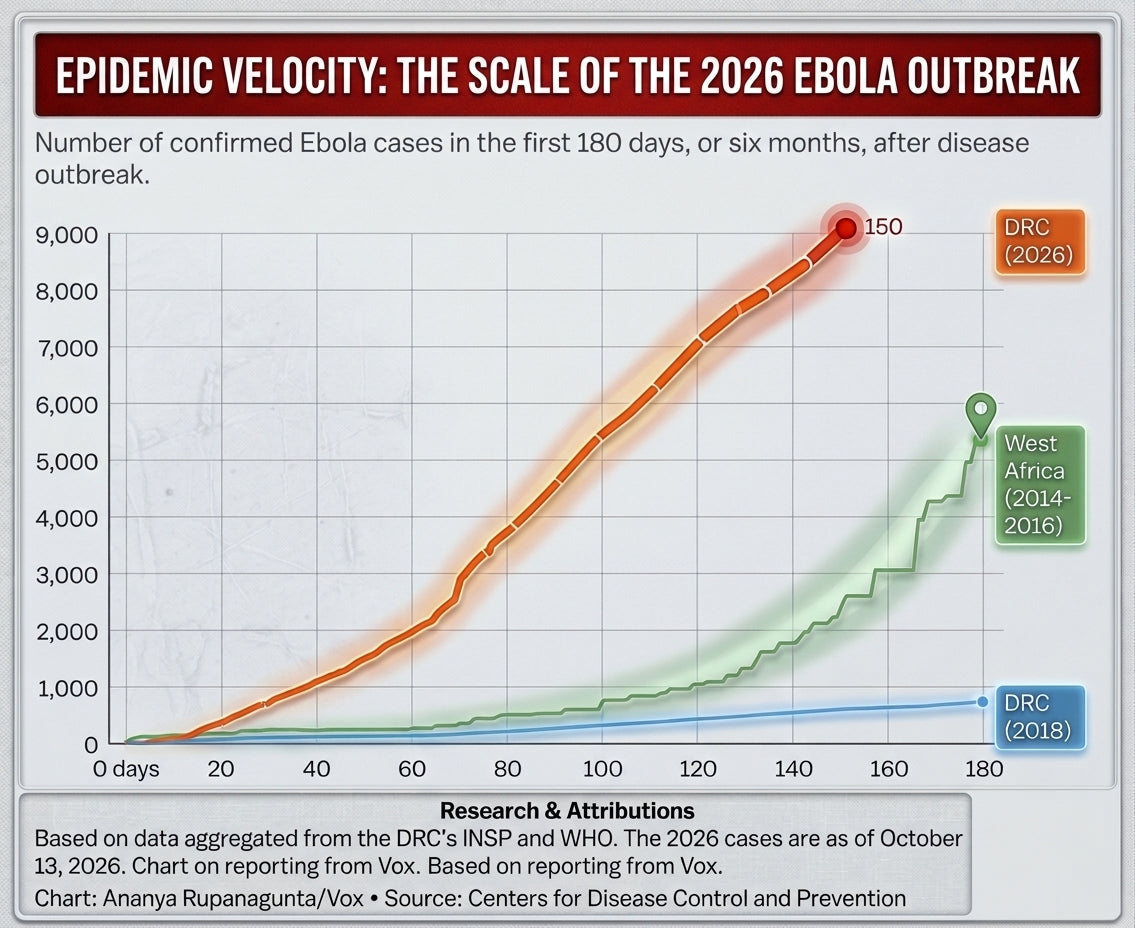
The CDC reported on Oct. 20 that the DRC has logged 9,637 confirmed cases and 4,646 confirmed deaths in the roughly five months since the outbreak began. Uganda has reported 20 confirmed cases. Kenya has reported nine, and Nigeria and France one each.
For perspective, look at the 2014 West Africa epidemic, which eventually killed more than 11,000 people. According to Vox, about 150 days in, it had 2,599 reported cases. At the same point this year, there were 8,978.
That's roughly 3.5 times as many.
The strain is part of the story, too. This outbreak is driven by Bundibugyo, a rarer relative of the Zaire strain behind the 2014 and 2018 epidemics. According to Vox, Bundibugyo doesn't respond to the same medical tools, and the CDC notes that no vaccine or medication has been approved for it.
Those are sobering numbers. To make sense of them, though, it helps to go back, way back, to the year the great inventor Thomas Edison was born.
A Lesson From 1847
In the spring of 1847, a young doctor at Vienna General Hospital had a problem nobody wanted to hear about.
Women who gave birth in the hospital's doctor-run clinic were dying of fever far more often than women in the clinic run by midwives. By one account, they died about five times as often. Ignaz Semmelweis suspected the doctors themselves were carrying something from patient to patient on their hands.
So, in May 1847, he ordered the staff to scrub with a chlorinated lime solution. By 1848, the death rate in the doctors' ward had fallen to 1.27%, lower than the midwives' 1.33%.
His reward? His boss gave credit to the new ventilation system. (Some lessons take a while to sink in. About 179 years, give or take.)
That story matters, as you'll soon see. First, though, the question most readers are actually asking.
So, Should You Worry About Ebola in the US?
This is where the fear and the facts part ways.
Ebola spreads through direct contact with the body fluids of someone who is sick with the disease or has died from it. That's a very different picture from a respiratory virus. A measles outbreak can move through a room on shared air. Ebola needs much closer contact than that. At a June 18 CDC briefing, Capt. Satish Pillai, who leads the agency's Ebola response, put it plainly:
"It does not spread through the air like measles or influenza."
— Capt. Satish Pillai, Ebola Response Lead, CDCHe added that "the risk to the United States remains low because of the public health measures in place." Those measures are real. Non-U.S. citizens who have been in the DRC, Uganda, or South Sudan in the past 21 days are barred from entering the country under a CDC order that now runs through Nov. 10, and travelers from the region are routed through designated airports for screening.
The CDC's formal risk assessment, published in June, reached the same conclusion: low risk to the U.S. population over the following three months. It also noted that people infected with Bundibugyo are not known to be contagious before their symptoms start, and that only 11 people with Ebola disease have ever been treated in the United States. As of the CDC's Oct. 20 update, no Ebola cases linked to this outbreak had been reported here.
| Question | What the CDC Says |
|---|---|
| How does it spread? | Direct contact with body fluids of a person who is sick with Ebola or has died from it |
| Is it airborne? | No, it doesn't spread through the air like measles or flu |
| When do symptoms appear? | Anywhere from 2 to 21 days after exposure |
| Contagious before symptoms? | Not known to be |
| Approved vaccine for Bundibugyo? | None approved so far |
| Risk to the U.S. public | Low |
That's the CDC's view. Now for ours.
Follow the Soap
Dr. Peter McCullough, chief scientific officer at The Wellness Company, looked at the same headlines and came to a pointed conclusion. Writing in The Focal Points, he described the outbreak as "a sanitation crisis, not a virological one requiring mass vaccination."
He also argued that it "poses negligible threat to Western populations where handwashing and sanitation infrastructure exist."
The data gives that view real footing. World Bank figures show that as of 2020, only 19% of people in the DRC lived in a home with a basic handwashing station with soap and water. Flip that around. More than 80% did not.
Remember Dr. Semmelweis? Same lesson, different century. For a virus that spreads through contact, the humble act of washing up may be one of the most important lines of defense there is.*
Dr. McCullough has also been openly skeptical of how outbreaks get presented to the public. He has described what he calls "the pharmaceutical industry's playbook of manufacturing fear to prime populations for product acceptance." You don't have to agree with every word to see the point: fear is a poor guide to risk.
Vox also points to deep cuts in U.S. aid, years of armed conflict in eastern DRC, widespread food insecurity, and rampant mistrust of health authorities. All true. Every one of those problems is real and serious for the people living through it. But none of them changes how Ebola spreads.
What You Can Do
For most people in the United States, the practical steps are modest, and none of them involve panic.
Wash Your Hands
Do it often, with soap and water. It isn't glamorous, but Dr. Semmelweis would approve.*
Check Before You Travel
Heading to central or eastern Africa? Look up current CDC travel notices first, and read our guide to preparing for travel to Africa. For the everyday illnesses that can derail any trip, a travel emergency kit covers the basics. It isn't a defense against Ebola.
Know the 21-Day Window
Symptoms can appear 2 to 21 days after exposure. Anyone returning from an affected area who develops symptoms in that window should call a health care provider right away.
Skip the Panic
Fear sells headlines. It doesn't do anything to protect anyone.
The Simplest Answer Is Often the Hardest Sell
Semmelweis's colleagues didn't reject his idea because it was wrong. They rejected it because it was too simple. Soap couldn't possibly be the answer, not when a fancier explanation like a new ventilation system was available.
Nearly two centuries later, the outbreak is different, and the headlines are louder. The urge to reach for something fancier is the same.
The smartest response may still be sitting next to your sink. For a deeper look at the outbreak, read Dr. McCullough's full Ebola breakdown in The Focal Points.
Frequently Asked Questions About Ebola in the US
Is Ebola in the US right now?
As of the CDC's Oct. 20, 2026, update, no Ebola cases linked to the current outbreak had been reported in the United States. The CDC rates the overall risk to the American public as low and has restricted entry for non-U.S. citizens who were recently in the DRC, Uganda, or South Sudan.
Is Ebola airborne?
No. According to the CDC, Ebola does not spread through the air like measles or influenza. It spreads through direct contact with the body fluids of a person who is sick with Ebola or has died from it.
How long after exposure do Ebola symptoms appear?
Symptoms can appear anywhere from 2 to 21 days after exposure. Anyone who develops symptoms within 21 days of returning from an affected area should call a health care provider right away and mention their travel.
Key Takeaway
The 2026 Ebola outbreak is moving faster than any before it, but the CDC rates the risk of Ebola in the US as low, and no cases tied to it have been reported here. Ebola spreads through direct contact, not the air. That makes basic hygiene, smart travel planning, and a calm read of the facts far more useful than fear.
You Might Also Be Interested In
References
- Centers for Disease Control and Prevention. (2026, June 18). Transcript – Update on Ebola outbreak in the Democratic Republic of the Congo and Uganda and CDC's World Cup 2026 activation [Press briefing transcript]. CDC.
- Centers for Disease Control and Prevention. (2026, October 20). Ebola outbreak: Current situation. CDC.
- Richard, D. M., Routledge, I., Koeller, S., et al. (2026). Assessment of risk to the U.S. population from the Ebola disease outbreak caused by Bundibugyo virus, 2026. MMWR, 75(22), 290–292. CDC MMWR.
- Index Mundi. (n.d.). People with basic handwashing facilities including soap and water (% of population) – Country ranking – Africa [Data set; World Bank data]. Index Mundi.
- Johnston, K. (n.d.). Ignaz Semmelweis: The saviour of mothers. Canadian Museum of Health Care. Museum of Health Care.
- Mass.gov. (2026, July). Ebola disease (Bundibugyo virus) [Fact sheet]. Mass.gov.
- McCullough, P. A. (2026, June 3). Ebola hype: How the WHO manufactures outbreak stories to push future vaccines. The Focal Points. The Focal Points.
- Rupanagunta, A. (2026, October 21). This chart shows just how rapidly Ebola is spreading. Vox. Vox.
*Handwashing and avoiding contact with body fluids are among the prevention steps public health agencies recommend. They may lower the risk of exposure but can't remove it entirely. This content is for informational purposes only and is not medical advice. It does not replace consultation with a qualified health care professional. Talk to your doctor or other qualified provider about any questions you have about a medical condition or travel health.


