


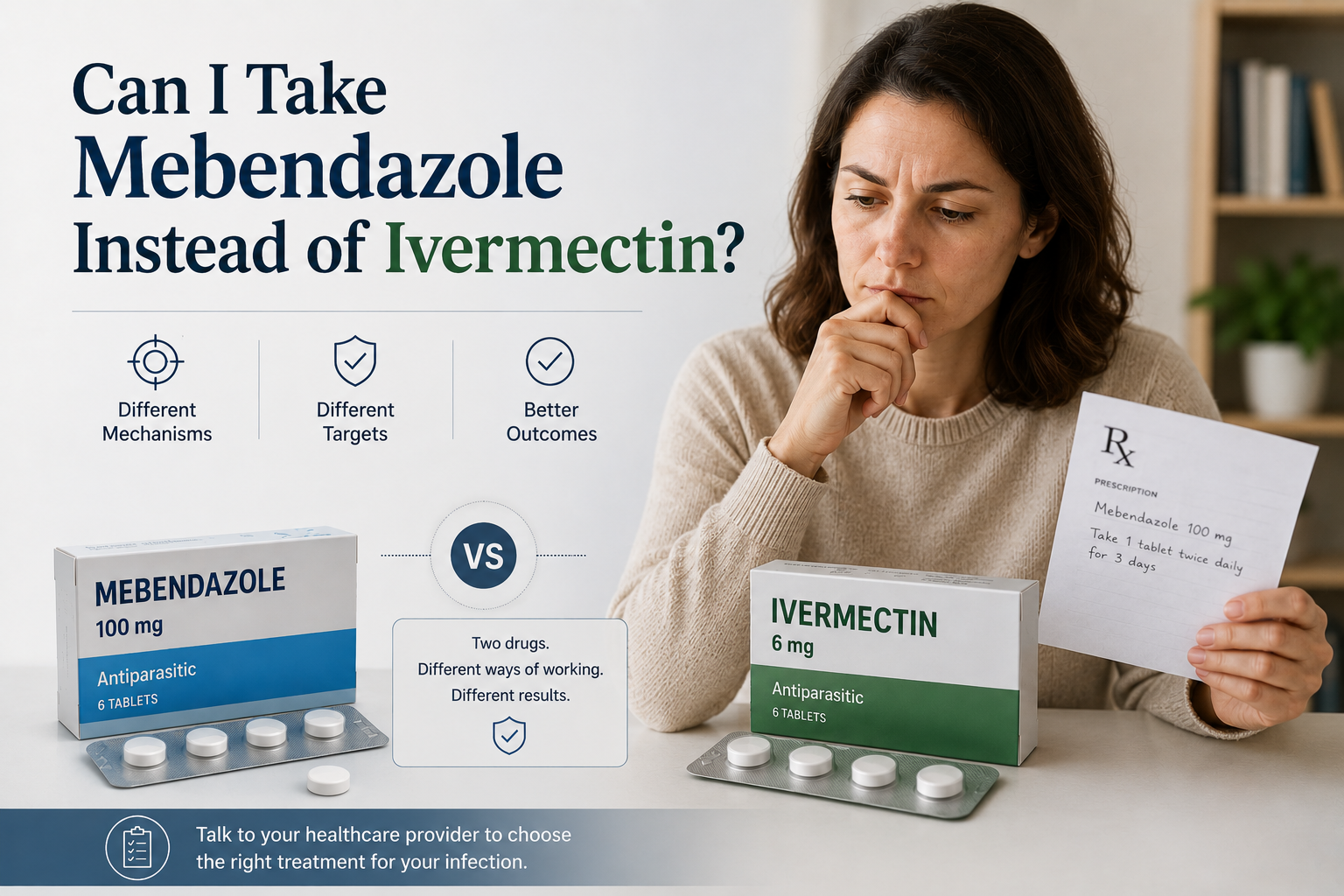
Can I Take Mebendazole Instead of Ivermectin?
Parasites & Antiparasitics · Substitution
Medically reviewed by TWC Editorial Team
Sometimes yes, often no. Mebendazole and ivermectin treat overlapping but distinct parasites. For pinworm, roundworm, whipworm, or hookworm, mebendazole can substitute or even outperform. For strongyloidiasis, scabies, head lice, or tissue-resident parasites, mebendazole is not an effective substitute. Self-substituting based on availability rather than clinical match is how parasitic infections persist.
When can mebendazole substitute for ivermectin?
Mebendazole can substitute for ivermectin when treating common intestinal worms — pinworm, roundworm, whipworm, hookworm — where mebendazole has FDA-approved indications and ivermectin has off-label activity. For these parasites, mebendazole's cure rates often equal or exceed ivermectin's.
Reasonable Substitution Scenarios
- Confirmed pinworm and ivermectin is unavailable
- Roundworm in a non-tissue-invasive presentation
- Hookworm where mebendazole tolerability is preferred
- Mixed intestinal nematodes where mebendazole already covers the spectrum
When can mebendazole NOT substitute?
Mebendazole cannot effectively substitute for ivermectin when the indication is strongyloidiasis, scabies, head lice, river blindness (onchocerciasis), or any tissue-resident parasitic infection. Mebendazole's mechanism — disrupting microtubules in intestinal cells — fails when the parasite lives outside the GI lumen.
Substitution Failures
- Strongyloidiasis — ivermectin >95% cure; mebendazole essentially inactive
- Scabies — ivermectin oral or topical; mebendazole has no scabicidal activity
- Lice — ivermectin oral or topical; mebendazole inactive
- Onchocerciasis — ivermectin first-line; no mebendazole role
- Filariasis — ivermectin in combination protocols; mebendazole not standard
What are the risks of self-substituting?
Self-substituting based on which drug is available rather than which drug fits the parasite leads to treatment failure, prolonged infection, and missed opportunities for diagnosis. The most common risk: dosing mebendazole for a strongyloidiasis or scabies infection it cannot effectively treat.
Patient-Side Substitution Often Involves
- Misidentified parasite (assuming worms when it's a protozoan)
- Wrong dose for the parasite (pinworm dose for what's actually whipworm)
- No follow-up testing to confirm clearance
- Skipping repeat dose at 2-3 weeks
What does a clinician evaluate?
A clinician matching drug to organism evaluates: the suspected or confirmed parasite, exposure history, symptom pattern, prior treatment failures, contraindications, and concurrent medications. The matching itself takes minutes; the patient-side benefit is avoiding the failed treatment that comes from drug-on-availability prescribing.
How Ivermectin + Mebendazole Fits In
Combination therapy resolves the substitution dilemma — instead of choosing between two drugs with different parasite coverage, the combination capsule provides both mechanisms in one prescription.
Step 1
Telemedicine consult. A TWC clinician confirms whether your situation fits combination therapy.
Step 2
Compounded Ivermectin + Mebendazole capsule — both medications in adult doses (25mg + 250mg).
Step 3
21-on / 21-off / 4-cycle protocol with clinical supervision.

Frequently Asked Questions
Is mebendazole safer than ivermectin?
Safety profiles are similar at standard doses. Both have decades of use data. Neither is categorically safer; the right choice is the one that works against your specific parasite.
Can I switch mid-course if one isn't working?
Don't switch mid-course without clinical guidance. Apparent treatment failure may be expected timing rather than wrong drug.
What if the pharmacy is out of ivermectin?
Talk to your prescriber. They can either source from another pharmacy, switch to mebendazole if appropriate, or prescribe the compounded combination.
Is it cheaper to take mebendazole?
Mebendazole as Emverm is expensive (~$638/tablet). Compounded mebendazole is more affordable. Generic ivermectin is generally cheaper than branded mebendazole. Compounded combinations split the difference.
What if I'm not sure which parasite I have?
That's exactly when combination protocols outperform single-drug substitution. The combination covers both drug spectrums — treating broad categories of nematodes without requiring perfect organism identification.
Get Started Today
Mebendazole substitutes for ivermectin only when the parasite falls within mebendazole's spectrum. For ivermectin's specialty indications (strongyloidiasis, scabies, lice, onchocerciasis), mebendazole is not an effective substitute. The cleanest answer to substitution questions is the combination protocol.
Learn MoreReferences
- Amneal Pharmaceuticals. EMVERM (mebendazole) Prescribing Information. U.S. Food & Drug Administration. accessdata.fda.gov
- Merck & Co., Inc. STROMECTOL (ivermectin) Prescribing Information. U.S. Food & Drug Administration. accessdata.fda.gov
- Patel, P. H., & Mada, P. K. (Updated 2023). Mebendazole. In StatPearls. National Center for Biotechnology Information. ncbi.nlm.nih.gov/books/NBK557705
- Centers for Disease Control and Prevention. Parasites — Strongyloides: Resources for Health Professionals. cdc.gov
- World Health Organization. (2023). Soil-transmitted helminth infections — Fact sheet. who.int
- Drugs.com. Ivermectin and Mebendazole Drug Interactions. drugs.com
Author
Works alongside our network of US-licensed clinicians and the McCullough Foundation research team.
This article is for informational purposes only and is not a substitute for professional medical advice, diagnosis, or treatment. Always seek the advice of a qualified healthcare provider with any questions you may have regarding a medical condition.


