


View Featured Categories
How Do You Know If a Cancer Supplement Is Safe and Effective?


Cancer Care · Supplement Safety
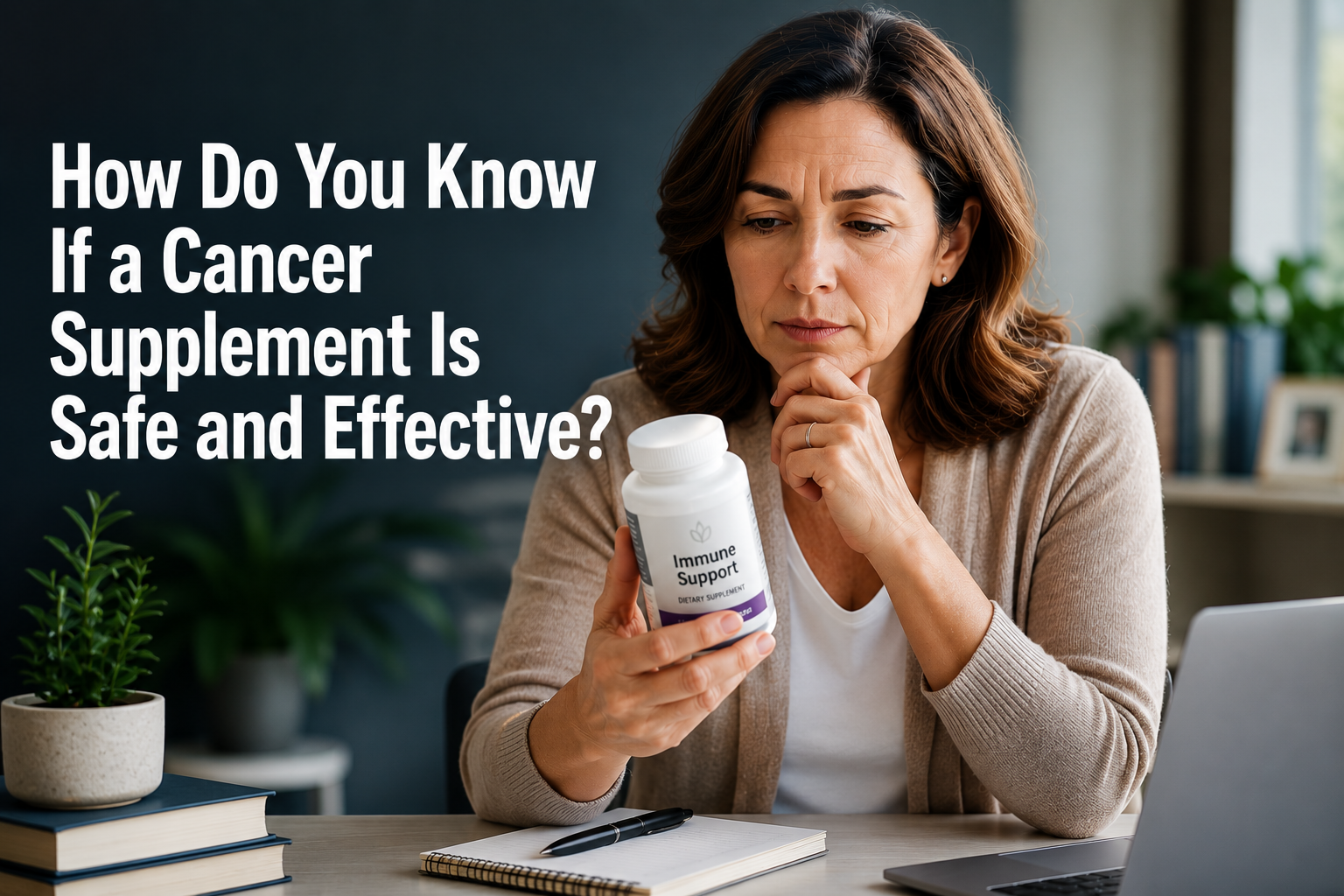
How Do You Know If a Cancer Supplement Is Safe and Effective?
The label says it supports immune health. The website has testimonials. There’s a doctor photo. And the price is steep enough to feel credible.
None of that tells you whether it works.
Here’s how to actually evaluate a cancer supplement — not how to be sold one.
Start With the Evidence Tier
Not all research is equal. There’s a hierarchy, and it matters. At the top: randomized controlled trials (RCTs) with cancer patients. Below that: observational studies in humans. Below that: animal studies. Below that: cell culture (lab) studies.
A supplement that has only been tested in a petri dish is not a supplement that has been proven to work in a human. This sounds obvious. It is routinely ignored in marketing. (1)
When a company says “studies show,” the first question is: studies in whom? If the answer is mice, that’s preliminary data — not a treatment.
Evidence Hierarchy — Strongest to Weakest
- Randomized controlled trials in cancer patients
- Observational studies in humans
- Animal studies
- Cell culture (lab) studies
Check Who Funded the Research
Industry-funded studies are more likely to produce favorable results than independently funded ones. That’s not a conspiracy theory — it’s a documented phenomenon in scientific literature called publication bias and funding effect. (2)
This doesn’t mean industry-funded research is wrong. It means it requires more scrutiny, not blind trust.
Look for the Specific Claim vs. the General One
“Supports immune health” is not a specific claim. Neither is “promotes cellular wellness.” These phrases are carefully worded to suggest benefit without making a testable medical claim — because making a specific medical claim requires FDA review.
If a supplement claims to “support” something, that word is doing a lot of work. Look for specifics: which compound, at what dose, in what type of cancer patient, with what measured outcome.
Check for Third-Party Testing
Supplements are not regulated the same way drugs are. The FDA does not approve supplements before they go to market. What you can look for is third-party certification from organizations like NSF International, USP (United States Pharmacopeia), or ConsumerLab. These verify that what’s on the label is actually in the bottle — in the right amounts, without contaminants. (3)
That’s not a guarantee of effectiveness. It is a guarantee you’re getting what you paid for.
Use the Right Resources
The Memorial Sloan Kettering Cancer Center maintains a free, evidence-based database called About Herbs. It’s one of the most rigorous tools available to patients and clinicians evaluating supplements. The National Cancer Institute also maintains an office of cancer complementary and alternative medicine with searchable research summaries. (4)
These are not perfect resources. They are far more reliable than a supplement company’s website.
The Hard Truth
Most cancer supplements on the market have limited evidence behind them — and that limited evidence rarely comes from studies in cancer patients on active treatment. That doesn’t mean none of them work. It means the bar for proof hasn’t been cleared yet. Choosing a supplement with that information in hand is a reasonable thing to do. Choosing one without it is a gamble with your treatment.

Supplements / Cellular Defense
SHIELD — Dual-Delivery Cellular Defense Protocol
Formulated by Dr. Kelly Victory, SHIELD combines an antioxidant-rich cocoa drink with a targeted botanical softgel. Key ingredients — curcuminoids, EGCG, and adaptogenic botanicals — are referenced in oncology-adjacent peer-reviewed literature for their potential role in supporting immune function and quality of life alongside medical care.
Shop NowYou Might Also Be Interested In
References
- Melnick, S. J. (2006). Developmental therapeutics: The role of nutraceuticals in cancer chemoprevention. Journal of Pediatric Hematology/Oncology, 28(3).
- Bekelman, J. E., Li, Y., & Gross, C. P. (2003). Scope and impact of financial conflicts of interest in biomedical research. JAMA, 289(4), 454–465.
- USP Verified Dietary Supplements. https://www.usp.org/verification-services/verified-supplements
- Memorial Sloan Kettering. About Herbs Database. https://www.mskcc.org/cancer-care/diagnosis-treatment/symptom-management/integrative-medicine/herbs
Author
This article is for informational purposes only and does not constitute medical advice. Always consult your oncologist or a qualified healthcare provider before starting, stopping, or changing any supplement regimen during cancer treatment.


