


View Featured Categories
Grounding: Ancient Wisdom Meets Science


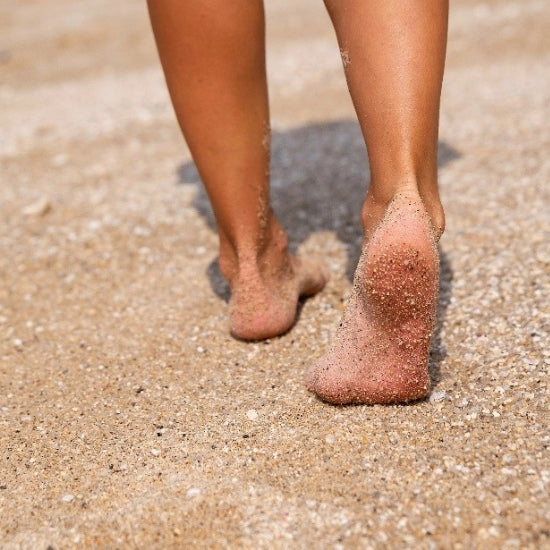
Ever wonder why you feel so calm and refreshed after walking barefoot on the beach, or why taking off your shoes and feeling the ground beneath your feet feels so good?
Science has confirmed what we have always instinctively known about grounding: it not only feels good—it is good for our health.
Grounding is simply going barefoot—no socks or shoes between you and the earth.
Dr. Peter McCullough, our Chief Scientific Officer, discussed the science and proven health benefits of grounding with barefoot podcaster Owen Shroyer ("Ask the Doctor").
 How it Works
The Earth's surface contains abundant free electrons, which are replaced and recharged through lightning strikes (1). These free electrons can enter the body through bare feet and act as natural antioxidants, neutralizing reactive oxygen species and reducing inflammation (2).

Ancient Practices and Modern Science
Ancient civilizations realized the importance of connecting to the ground to harness its benefits, including its ability to:
- Reduce inflammation (3)
- Accelerate wound healing (3)
- Reduce pain, especially in patients with Lupus and autoimmune disorders (3)
- Improve heart rate variability (4)
- Improve circulation (4)
- Normalize cortisol patterns and circadian rhythm, resulting in improved sleep quality and improved daytime alertness (4)
- Provide cognitive benefits such as decreased stress and mental fatigue (4)
The Foot: A Gateway to Health
After the conversation, Dr. McCullough further explored the complex features of the foot—often the most underrated part of the body.
The foot serves more purposes than just mobility and balance; when barefoot, it is intimately connected to:
- Improved balance and proprioception: Proprioception is your body's innate sense of its own position, movement, and action in space (5).
- Reduced stress and load on knee joints during barefoot running: Shifting mechanical demand from knees to ankles and calves reduces injury risk (6).
- Reduced load on knee joints during walking: Barefoot walking reduces peak knee adduction moment by 11.9% (7).
Modern Footwear and Its Impact on Health
With 26 bones, 33 joints, and over 100 muscles, ligaments, and tendons, the often-overlooked foot is a true work of art (7).
When barefoot, the foot naturally spreads into a tripod formation, with the heel and the tips of the toes forming three stable contact points. This alignment provides inherent stability and reduces the need for external arch support.
Conventional shoes compress the toes together, compromising stability and contributing to balance difficulties, flat-footedness, and plantar fasciitis (8). In addition, the physiological benefits of going barefoot are lost.
Citations
- Rycroft, M. J., Israelsson, S., Price, C. (2000). The global atmospheric electric circuit, solar activity and climate change. Journal of Atmospheric and Solar-Terrestrial Physics, 62, 1563–1576. https://ui.adsabs.harvard.edu/abs/2000JASTP..62.1563R
- Oschman, J. L., Chevalier, G., Brown, R. (2015). The effects of grounding (earthing) on inflammation, the immune response, wound healing, and prevention and treatment of chronic inflammatory and autoimmune diseases. Journal of inflammation research, 8, 83–96. https://doi.org/10.2147/JIR.S69656
- McCullough, P. A. (2025, December 2). Bare feet, grounding, and health from the Earth up through the body. FOCAL POINTS (Courageous Discourse). https://www.thefocalpoints.com/p/bare-feet-grounding-and-health-fro
- Learn Genetics. (n.d.). Proprioception. Genetic Science Learning Center, University of Utah. Retrieved December 15, 2025, from https://learn.genetics.utah.edu/content/senses/proprioception/
- Authors unknown. (2013). Article on sports and exercise-related tendinopathies. British Journal of Sports Medicine, 47(6), 387–392. https://bjsm.bmj.com/content/47/6/387
- Arthritis Rheum. 2006 Sep;54(9):2923-7. doi: 10.1002/art.22123. PMID: 16947448.
- Kumar, R., Dussa, C. U. (2023). Anatomy, bony pelvis and lower limb, foot joints. In StatPearls. StatPearls Publishing. https://www.ncbi.nlm.nih.gov/books/NBK536941
- Allen, S., Waerlop, I. (2012, February 1). The foot tripod: The importance of the toe extensors in raising the arch. The Gait Guys. https://www.thegaitguys.com/thedailyblog/the-foot-tripod-the-importance-of-the-toe


