


View Featured Categories
Is Mebendazole the Same as Ivermectin?


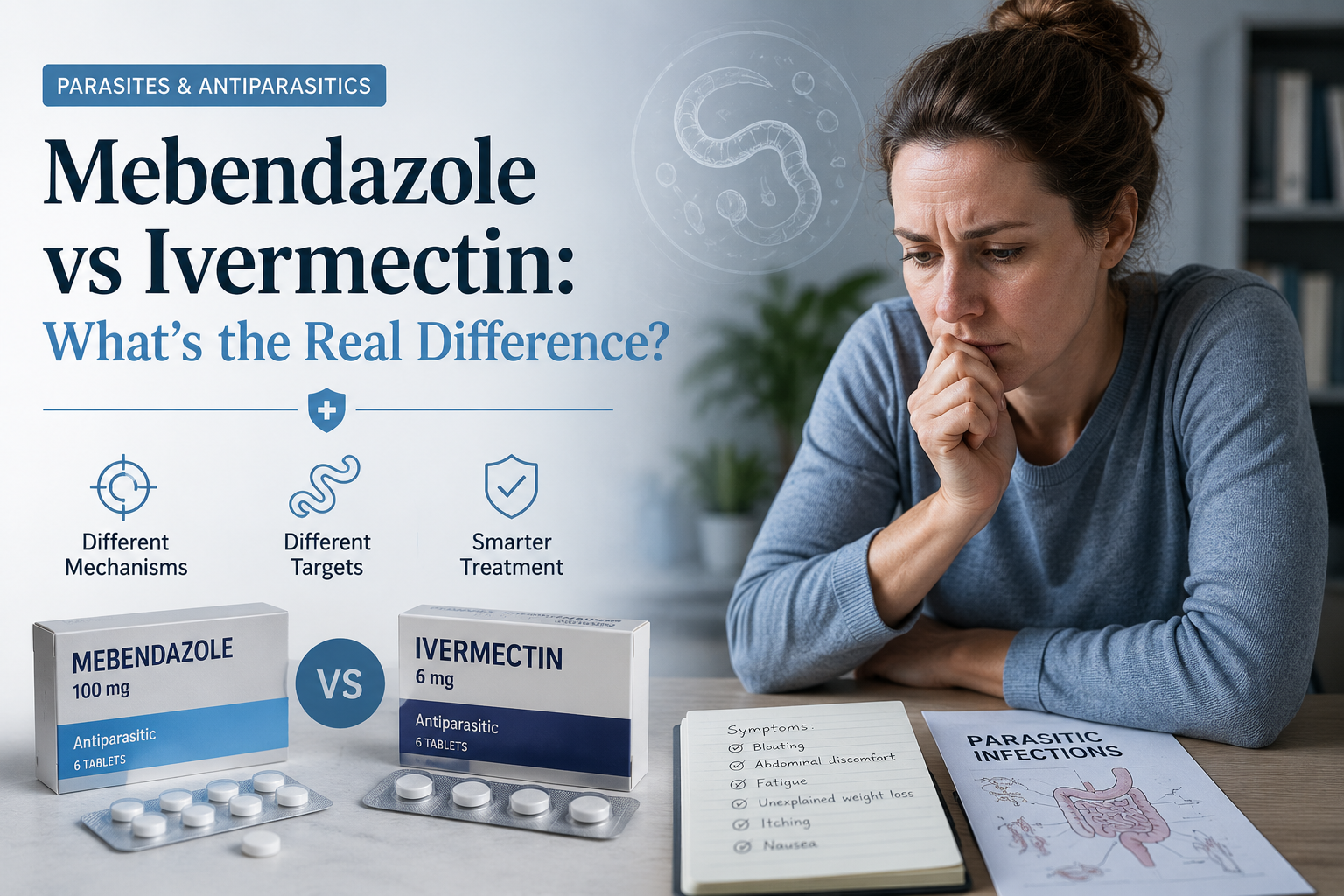
Parasites & Antiparasitics · Comparison
Medically reviewed by TWC Editorial Team
Mebendazole and ivermectin are not the same drug. Mebendazole belongs to the benzimidazole class and starves intestinal worms by blocking glucose uptake. Ivermectin belongs to the macrocyclic lactone class and paralyzes parasites by binding glutamate-gated chloride channels in their nerve cells. Both treat parasitic infections, but they target different worms through different mechanisms — which is why clinicians sometimes prescribe them together.
You searched for an answer because something doesn't feel right. Maybe a colonoscopy mentioned possible parasitic exposure. Maybe a relative came back from travel and now you are reading symptom checklists at midnight.
Mebendazole and ivermectin sound similar. They both treat "worms." Pharmacy shelves and online forums use the names almost interchangeably. They are not interchangeable.
What's the difference between mebendazole and ivermectin?
Mebendazole and ivermectin belong to different drug classes with different mechanisms. Mebendazole is a benzimidazole that disrupts microtubule formation in parasite cells, blocking glucose uptake. Ivermectin is a macrocyclic lactone that binds glutamate-gated chloride channels in invertebrate nerves, causing paralysis. They target overlapping but distinct parasites.
Mebendazole is a typical, broad-spectrum benzimidazole used for more than 40 years in humans. It interferes with cellular tubulin formation in the helminth and causes ultrastructural degenerative changes — disrupting glucose uptake, digestive function, and reproduction, which leads to immobilization and death of the helminth.
Ivermectin works on a completely different pathway. It is a member of the avermectin class that binds selectively and with high affinity to glutamate-gated chloride ion channels in invertebrate nerve and muscle cells. The result is paralysis.
Two drugs, two completely different attack vectors. Mebendazole cuts off the parasite's food supply; ivermectin cuts its power lines.
| Attribute | Mebendazole | Ivermectin |
|---|---|---|
| Drug class | Benzimidazole | Macrocyclic lactone (avermectin) |
| Mechanism | Disrupts microtubules → blocks glucose uptake | Binds GluCl channels → paralyzes parasite |
| Brand names | Vermox, Emverm | Stromectol |
| Typical onset | 1–3 days | Hours to 1 day |
| FDA-approved use (US) | Pinworm, whipworm, roundworm, hookworm | Strongyloidiasis, onchocerciasis |
| Federal Rx required | Yes | Yes |
Which parasites does each medication treat?
Mebendazole is FDA-approved for pinworm, whipworm, roundworm, and hookworm — the most common intestinal worm infections in the US. Ivermectin is FDA-approved for strongyloidiasis and onchocerciasis (river blindness), with off-label use against scabies and other nematodes.
Per FDA-approved labeling, mebendazole tablets treat Enterobius vermicularis (pinworm), Trichuris trichiura (whipworm), Ascaris lumbricoides (roundworm), Ancylostoma duodenale and Necator americanus (hookworms) in single or mixed infections.
Ivermectin's FDA-approved indications are narrower in name but broader in geography. It is approved for combating head lice, onchocerciasis, rosacea, scabies, and worm infestations within the gastrointestinal tract.
Why doctors sometimes prescribe both
Single-agent therapy works for clean, single-species infections. Real life is messier. Mixed parasitic infections are common, especially after international travel, and resistance to mebendazole alone has been documented. WHO has recommended combination antiparasitic therapy for soil-transmitted helminths since the early 2010s.
That is the rationale behind compounded ivermectin + mebendazole protocols: combine the glucose-blocking action of mebendazole with the neurological paralysis of ivermectin.
Is one stronger than the other?
Neither is universally stronger. Strength depends on the parasite. Ivermectin reaches tissues mebendazole cannot, including skin and the nervous system. Mebendazole acts directly on intestinal worms with high cure rates for pinworm and roundworm. The right choice matches the right organism.
Ivermectin treats a wide range of nematode infections including onchocerciasis, strongyloidiasis, loiasis, ascariasis, filariasis, and cutaneous larva migrans — a tissue-penetration advantage. But for a child with pinworm or an adult with confirmed roundworm, mebendazole's direct intestinal action is hard to beat.
Can you take mebendazole and ivermectin together?
The two drugs have no documented direct interaction in standard pharmacology databases, and combination protocols are increasingly used. Dosing both at once requires medical supervision because of overlapping side effects, contraindications, and individual factors.
Per Drugs.com, no interactions were found between ivermectin and mebendazole. The TWC compounded capsule combines 25mg ivermectin and 250mg mebendazole in a single dose, sized for a typical adult and dosed under telemedicine guidance — significantly different from splitting two prescription bottles and timing them yourself.
How Ivermectin + Mebendazole Fits In
Step 1
Order the consultation. Schedule a telemedicine visit with a TWC clinician to confirm whether antiparasitic therapy fits.
Step 2
Get the compounded protocol. If appropriate, the clinician prescribes the Ivermectin + Mebendazole compounded capsule.
Step 3
Follow the cleanse cycle. Standard protocol is 21 days on, 21 days off, repeated for four cycles.

Frequently Asked Questions
Are mebendazole and ivermectin the same drug?
No. Mebendazole is a benzimidazole that blocks parasite glucose uptake. Ivermectin is a macrocyclic lactone that paralyzes parasites. They share the broad category of antiparasitic but belong to entirely different drug classes.
Is mebendazole still available in the US?
Generic mebendazole and brand-name Emverm are available by prescription. Vermox was discontinued. Compounded mebendazole — including TWC's combination — is prepared by licensed compounding pharmacies.
Does ivermectin work on pinworms?
Ivermectin has activity against several nematodes, but mebendazole is the first-line for pinworm in the US.
Why do clinicians prescribe both at once?
Combination therapy provides broader coverage when mixed infection is suspected, when single-drug treatment failed, or for protocols supported by emerging research like the McCullough Foundation cohort.
Can I get ivermectin and mebendazole over the counter?
At the federal level, both remain prescription. Five states permit OTC ivermectin (Idaho, Arkansas, Tennessee, Louisiana, Texas). Mebendazole remains prescription-only nationwide.
Get Started Today
Mebendazole and ivermectin are not the same drug, and treating them as interchangeable is how parasitic infections quietly persist. Mebendazole starves intestinal worms. Ivermectin paralyzes them through their nervous system. The right answer depends on the organism, your medical history, and a clinician who can prescribe the right protocol.
Learn MoreReferences
- Amneal Pharmaceuticals. EMVERM (mebendazole) Prescribing Information. U.S. Food & Drug Administration. accessdata.fda.gov
- Merck & Co., Inc. STROMECTOL (ivermectin) Prescribing Information. U.S. Food & Drug Administration. accessdata.fda.gov
- Patel, P. H., & Mada, P. K. (Updated 2023). Mebendazole. In StatPearls. National Center for Biotechnology Information. ncbi.nlm.nih.gov/books/NBK557705
- Drugs.com. Ivermectin and Mebendazole Drug Interactions. drugs.com
- World Health Organization. (2023). Soil-transmitted helminth infections — Fact sheet. who.int
- Laing, R., Gillan, V., & Devaney, E. (2017). Ivermectin – Old Drug, New Tricks? Trends in Parasitology, 33(6), 463–472. pmc.ncbi.nlm.nih.gov
Author
Works alongside our network of US-licensed clinicians and the McCullough Foundation research team.
This article is for informational purposes only and is not a substitute for professional medical advice, diagnosis, or treatment. Always seek the advice of a qualified healthcare provider with any questions you may have regarding a medical condition.


