


View Featured Categories
Difference Between Mebendazole and Ivermectin


Parasites & Antiparasitics · Comparison
Medically reviewed by TWC Editorial Team
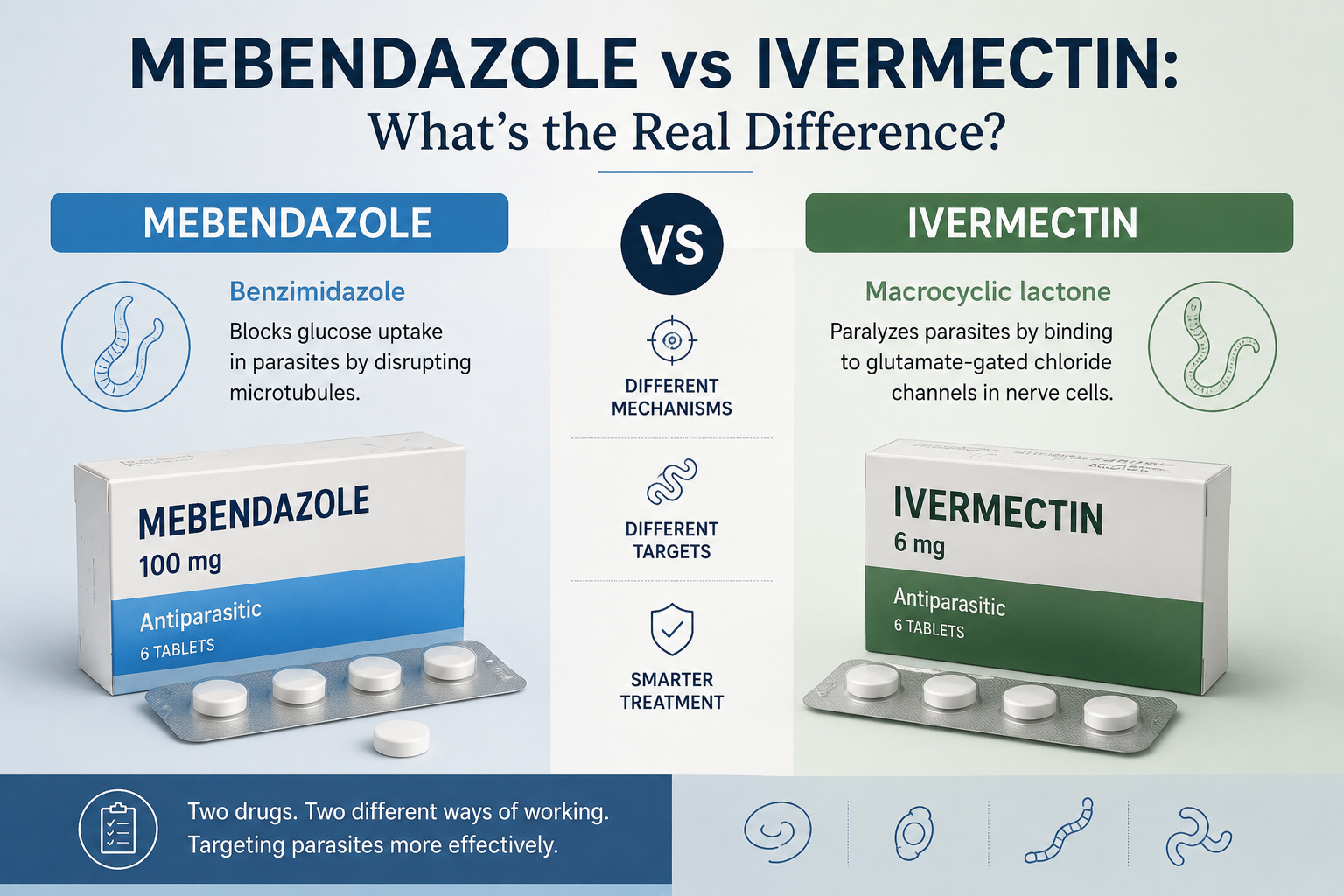
Mebendazole and ivermectin treat parasitic infections through different mechanisms and are FDA-approved for different parasites. Mebendazole targets common intestinal worms (pinworm, roundworm, whipworm, hookworm) by blocking glucose uptake. Ivermectin treats tissue-resident parasites (strongyloidiasis, river blindness) by paralyzing them via nerve channels. Combination protocols exist where coverage gaps overlap.
If you've already done the basic comparison and want the practical differences — what each does, when each is prescribed, and how the combination protocol changes the picture — that's what this guide covers.
What are the practical differences?
Practically: mebendazole is a 3-day intestinal-worm regimen; ivermectin is often a single weight-based dose for tissue-resident parasites. Mebendazole side effects skew GI; ivermectin side effects skew toward itching from parasite die-off. Mebendazole has 40+ years of human use data; ivermectin earned the 2015 Nobel Prize in Medicine for its discoverers.
Common Practical Contrasts
- Standard regimen — Mebendazole: 100mg twice daily for 3 days (most worms) or 100mg once for pinworm. Ivermectin: 200 mcg/kg single weight-based dose (often).
- Onset — Both start working immediately; symptoms improve over days.
- Tissue penetration — Ivermectin reaches skin and tissues mebendazole struggles to access.
- Egg coverage — Neither kills eggs; both require repeat dosing.
- OTC availability — Mebendazole prescription-only nationwide; ivermectin OTC in 5 states.
Are they used for different things?
Yes. Mebendazole is FDA-approved for four common intestinal worms — pinworm, roundworm, whipworm, hookworm. Ivermectin is FDA-approved for strongyloidiasis, onchocerciasis (river blindness), head lice, and rosacea (topical). They overlap on some species but each has its specialty.
Decision Shortcut
- Pinworm in a household with kids → Mebendazole first-line
- Travel-acquired strongyloidiasis → Ivermectin first-line
- Scabies → Ivermectin (oral or topical)
- Mixed nematode infection or unclear diagnosis → Combination protocols increasingly used
- River blindness (onchocerciasis) → Ivermectin only
Do they have different side effects?
The side effect profiles overlap but skew differently. Mebendazole side effects are mostly GI — abdominal pain, nausea, diarrhea — and rare with single-dose use. Ivermectin side effects often include itching from parasite die-off (Mazzotti reaction), mild dizziness, and GI symptoms. Both have rare serious reactions in high-dose extended protocols.
Profile Differences
- Mebendazole — rare neutropenia, hepatic effects (mostly with high-dose long-term use)
- Ivermectin — occasional postural hypotension, transient eye irritation in onchocerciasis treatment
- Combination — GI overlap; neither drug is hepatotoxic at standard doses
Which is more commonly prescribed?
Worldwide, ivermectin is one of the most prescribed antiparasitics due to its role in treating filariasis and onchocerciasis in WHO-led mass drug administration programs. In the US, prescriptions for both drugs together have grown substantially since 2020, partly driven by interest in repurposed-drug protocols. Mebendazole prescriptions in the US are limited by Emverm's price (single-source brand, ~$638/tablet) and have shifted heavily toward compounded versions.
How Ivermectin + Mebendazole Fits In
Step 1
Telemedicine consult. A TWC clinician evaluates which drug or combination fits your situation.
Step 2
Compounded Ivermectin + Mebendazole capsule (25mg + 250mg) if combination is indicated.
Step 3
21-on / 21-off / 4-cycle protocol with clinical supervision.

Frequently Asked Questions
Should I take mebendazole or ivermectin first?
Neither — your clinician matches the drug to the parasite. For confirmed pinworm, mebendazole. For confirmed strongyloidiasis, ivermectin. For unclear or mixed infections, combination protocols.
Can I substitute one for the other?
Not without clinical guidance. Their parasite coverage overlaps but isn't identical, and dose conversion isn't direct.
Is one safer for pregnant women?
Both are FDA pregnancy category C — limited human data. WHO permits use in 2nd/3rd trimester for mass deworming where benefits outweigh risks. Pregnant patients should not self-prescribe either.
Do they treat the same household parasites?
Mebendazole covers pinworm (most common household parasite) better; ivermectin covers scabies (also common household parasite) better. The combination protocol covers both.
Is the combination FDA-approved?
As individual drugs, both are FDA-approved. The compounded combination capsule is a custom-prepared formulation prescribed off-label.
Get Started Today
Mebendazole and ivermectin differ in drug class, target parasites, dosing schedules, and side effect profile. Their combination is increasingly used because the strengths complement each other — but the right choice depends on what you're treating.
Learn MoreReferences
- Amneal Pharmaceuticals. EMVERM (mebendazole) Prescribing Information. U.S. Food & Drug Administration. accessdata.fda.gov
- Merck & Co., Inc. STROMECTOL (ivermectin) Prescribing Information. U.S. Food & Drug Administration. accessdata.fda.gov
- Patel, P. H., & Mada, P. K. (Updated 2023). Mebendazole. In StatPearls. National Center for Biotechnology Information. ncbi.nlm.nih.gov/books/NBK557705
- World Health Organization. (2023). Soil-transmitted helminth infections — Fact sheet. who.int
- Drugs.com. Ivermectin and Mebendazole Drug Interactions. drugs.com
- The Nobel Prize in Physiology or Medicine 2015. (2015). NobelPrize.org. nobelprize.org
Author
Works alongside our network of US-licensed clinicians and the McCullough Foundation research team.
This article is for informational purposes only and is not a substitute for professional medical advice, diagnosis, or treatment. Always seek the advice of a qualified healthcare provider with any questions you may have regarding a medical condition.


