


August 2026 - Zenodo Pre-Print
1st Ever Study Finds Vaccines May Be Contributing to the Explosion of Alpha-Gal Syndrome
Over 90% of American children are injected with Alpha-Gal-bearing vaccines before they're allowed to enter school.
Our study looks to see if this may be contributing to the 10,000% rise in suspected Alpha-Gal syndrome since 2013.
Authored by The Wellness Company’s Chief Medical Board & The McCullough Foundation


Americans Estimated to Have Clinical Alpha-Gal Syndrome
The real number is likely much higher; most people with this allergy have never been diagnosed.
Understanding the research
We studied 3 ways a person could contract alpha-gal
Everyone already carries antibodies to alpha-gal, roughly 1% of all circulating immunoglobulin. The question isn't how the body learns to recognize the sugar. It's what makes a small number of people switch that recognition into an allergy.
Pathway 1
Most well-knownTick Bite Alone
A tick feeds for days, depositing alpha-gal into the skin along with saliva that acts as its own immune amplifier. The skin isn't the gut, and none of the machinery that teaches the body to ignore food is there.
See Evidence
- Alpha-gal sits inside the salivary vesicles of lone star and black-legged ticks, so the bite delivers it.
- Tick saliva carries its own adjuvant, so salivary extract alone sensitized mice fully.
- Human IgE rose after documented bites; seroprevalence tracks tick territory, 31.2% in Arkansas to 1.1% in Washington.
Takeaway:
Ticks are the reference standard. But the model shows a necessary exposure, not sufficiency, dose, or who is at risk.
Pathway 2
ProposedDirectly From Vaccines
Gelatin comes from cow and pig connective tissue, and it carries alpha-gal. Used as a vaccine stabilizer, it is injected, bypassing the gut's tolerance system entirely.
See Evidence
- Injected alpha-gal on a carrier protein with aluminum adjuvant caused IgE and anaphylaxis in mice, with no tick.
- Sensitization needs route, carrier, and adjuvant; gelatin-containing injections satisfy all three.
- In Japan, gelatin DTaP was followed by new anti-gelatin IgE in 41 of 44 anaphylaxis cases; reactions fell after gelatin was removed.
Takeaway:
Every link holds on its own. The study connecting them, alpha-gal antibodies before and after vaccination in humans, has never been run.
Pathway 3
ProposedVaccine Priming Plus a Tick-Bite Boost
Injected gelatin sensitized the body to alpha-gal. Years later, a tick bite acts as the booster. Neither alone would be enough in most people, but together they clear the threshold to trigger reaction.
See Evidence
- The two-stage sequence already happened in Japan: low-dose gelatin primed infants, later high-dose gelatin triggered.
- Prime-boost is foundational vaccinology; swapping a tick bite for the second hit needs no new immunology.
- It explains the 170-fold gap between 24% seroprevalence and 0.14% disease, and why cases track ticks despite uniform vaccine coverage.
Takeaway:
The version that fits the real-world data best — geography, gradients, and the gap between carrying antibodies and getting sick.
"Given the very rapid rise in cases, this syndrome is worthy of urgent large-scale epidemiologic investigation together with interventional studies exploring methods of amelioration and reversal of antigen sensitization and of the clinical syndrome of alpha-gal syndrome."- Dr. Peter McCullough.
The Causes
Two Proposed Vaccine Pathways to Alpha-Gal Syndrome
Researchers have outlined two potential pathways for how alpha-gal antibodies may form: direct induction from vaccine gelatin and priming followed by a tick-bite boost.


Observational evidence
Do vaccinated individuals have more allergies?
Separate observational cohorts have compared allergic outcomes in vaccinated vs. unvaccinated children, an indirect test of whether adjuvanted vaccination is associated with a broader shift toward allergy.
8.88x
Higher anaphylaxis rate in vaccinated vs unvaccinated children in one retrospective cohort.
6.53x
Higher proportion of asthma diagnoses in the same vaccinated cohort.
3 of 3
Independent cohorts reporting higher allergic outcomes in vaccinated children.
The problem
Suspected cases have risen ~100-fold in the last decade
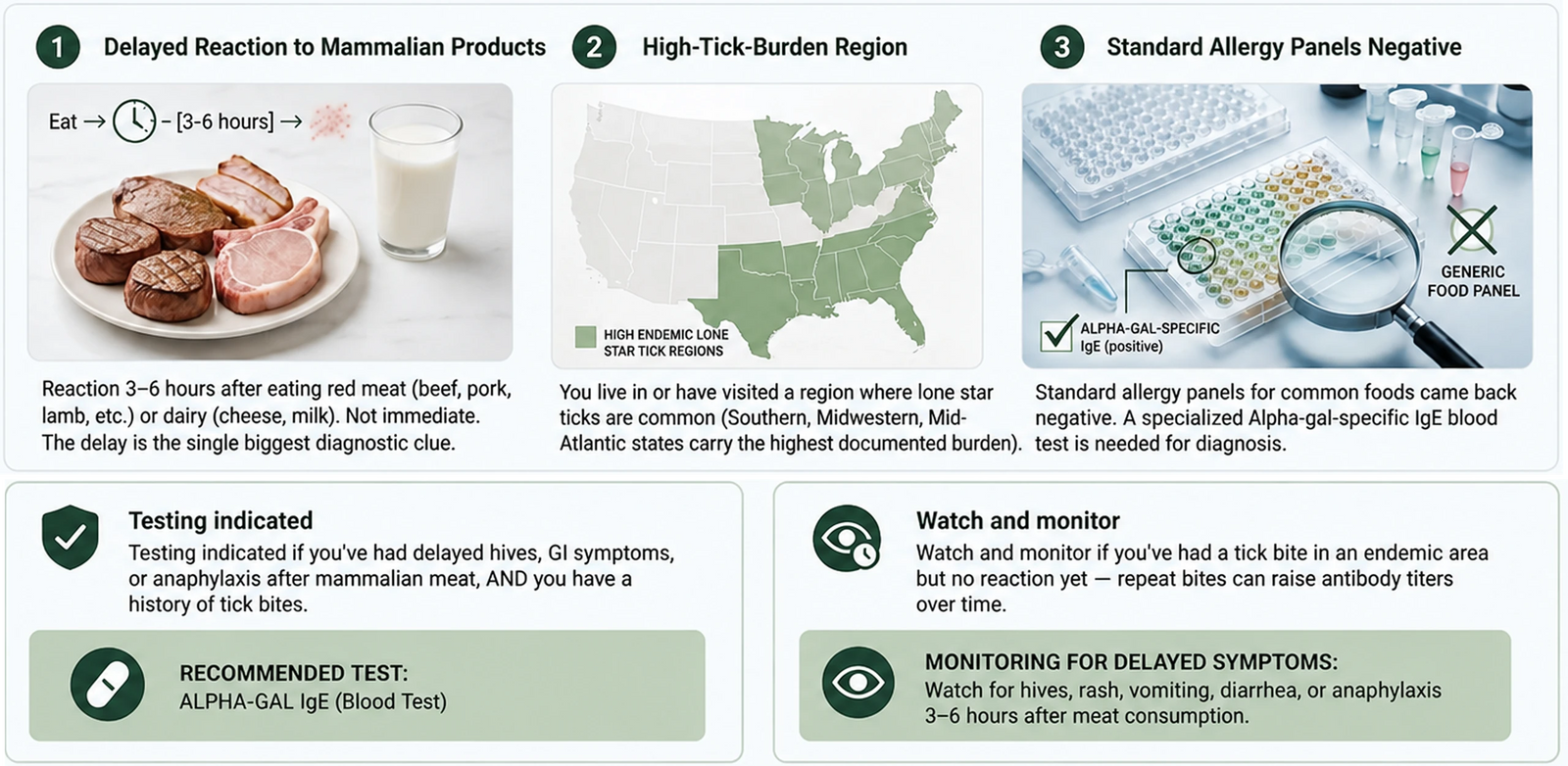
Alpha-gal syndrome (AGS) is an allergic reaction to galactose-α-1,3-galactose (“alpha-gal”), a sugar found in red meats like beef, pork, lamb, dairy, and animal gelatin. It's not a typical food allergy. The reaction doesn't happen at the table — it happens 3 to 6 hours later, long after most people have stopped thinking about what they ate.
Suspected cases have risen roughly 100-fold in the last decade among tested patients. Separately, blood donor testing across five high-burden states found 24% seropositivity for alpha-gal antibodies — a population-level signal, not just a diagnostic trend.
The reaction is delayed and easy to miss
Symptoms — hives, abdominal pain, nausea, or anaphylaxis — appear 3 to 6 hours after eating mammalian meat or dairy, long after the meal is forgotten. Patients and even clinicians frequently miss the connection for months or years.
The trigger could be a single tick bite or vaccine-induced + tick bite
Tick saliva — most often from the lone star tick — delivers alpha-gal directly into the skin, bypassing the gut's normal tolerance and setting off IgE antibody production against a sugar humans don't otherwise react to.
Standard allergy testing can miss it
Some sensitized patients react to gelatin-containing products even when standard gelatin-specific IgE tests come back negative — alpha-gal-specific testing is what actually confirms it
The evidence-based pathway
Three decisions, made in order, to catch alpha-gal syndrome before it controls your diet
Step 1 — Prevent the bite that starts it all
Tick bites remain the best-documented route to sensitization.
No bite, no antibody.
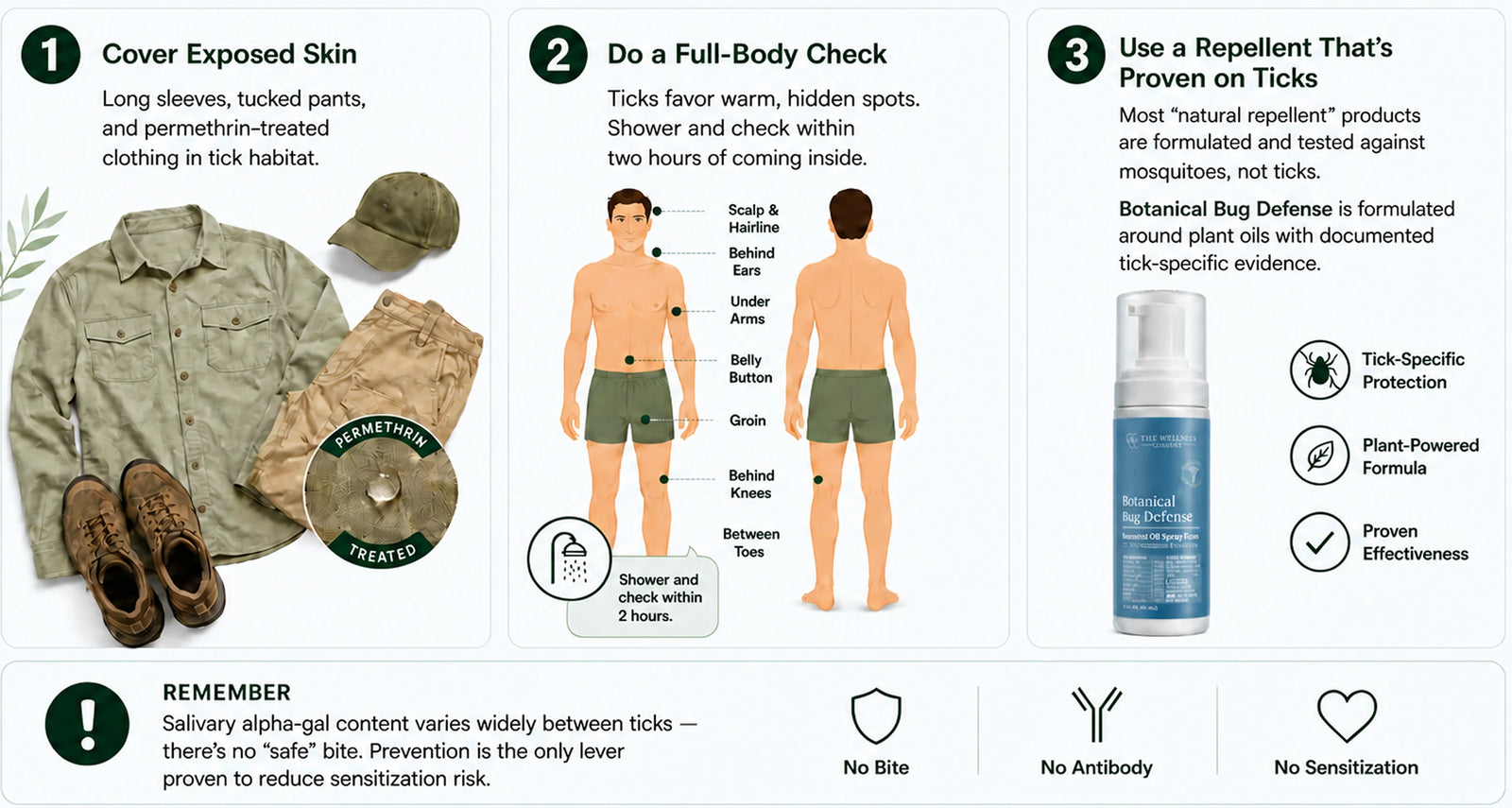


Step 2 —How to know if you may have alpha-gal syndrome.
If you experience these criteria, consider talking to your doctor about alpha-gal and be prepared with an epi-pen.


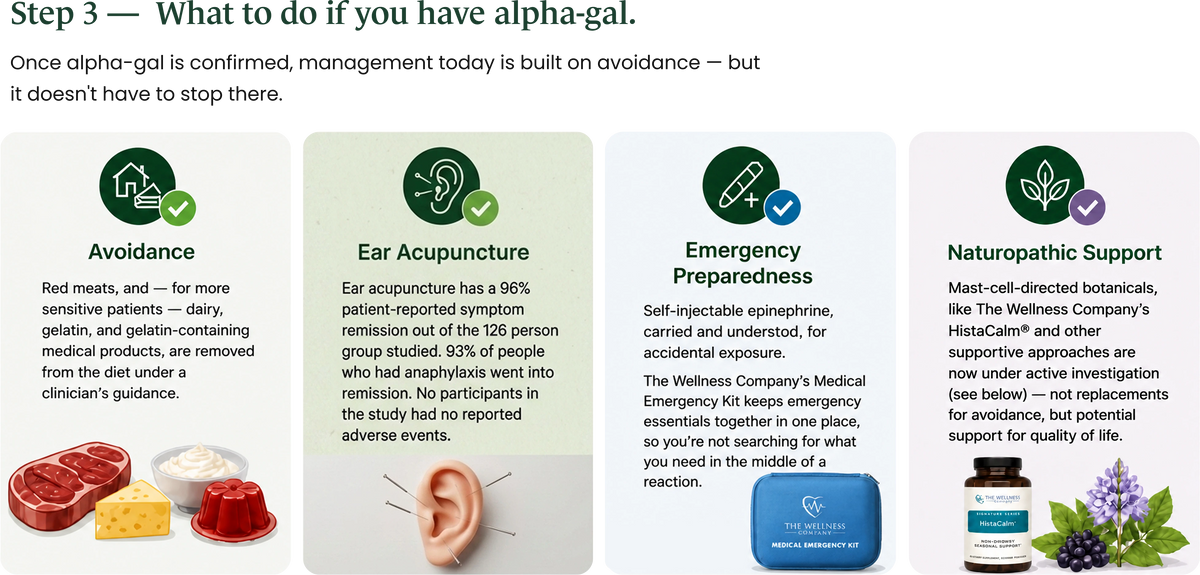
Step 3 — What to do if you have alpha-gal.
Once alpha-gal is confirmed, management today is built on avoidance, but it does not have to stop there.


24%
Alpha-gal IgE seropositivity among adults tested across five high-burden US states.
100x
Rise in suspected alpha-gal cases among tested adults, 2013 to 2024.
96%
Reported symptom remission in the largest published series of patients treated with auricular acupuncture.
From Confusing Symptoms To A Clear Diagnosis
Alpha-gal syndrome isn’t a normal food allergy, and the medical field is playing catch-up. Here's what the research actually shows.
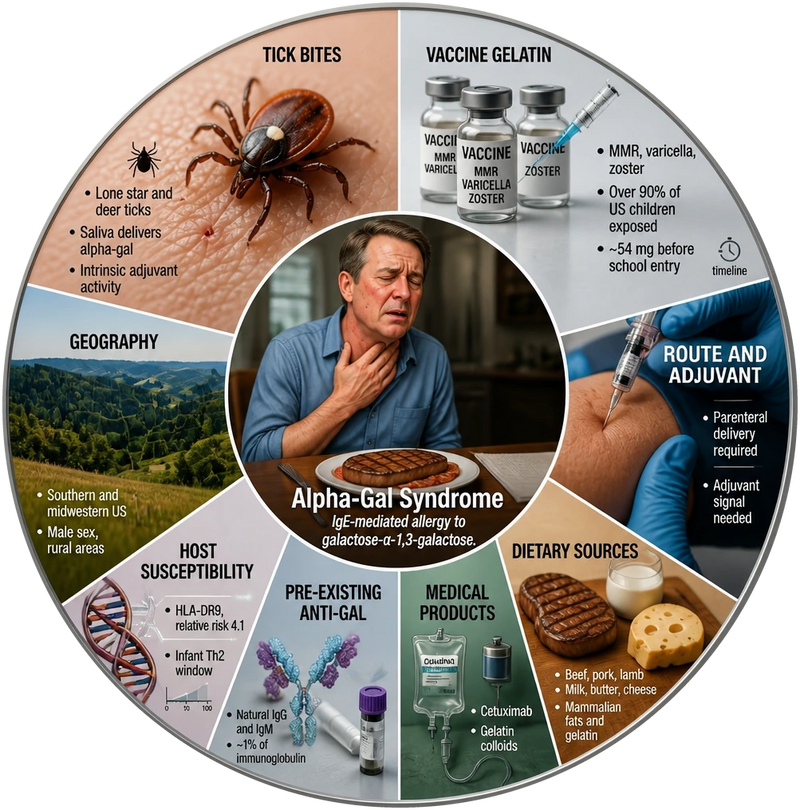
The allergic response delay is the diagnostic key. A 3–6 hour gap between eating and reacting is what separates alpha-gal from a typical allergy - and it's the detail most likely to get missed in a rushed visit.
Sensitization is far more common than disease. Roughly a quarter of adults in some states carry the antibody, but a much smaller fraction ever develop symptomatic AGS - meaning a positive test alone isn't a diagnosis.
Standard gelatin testing isn't equivalent to alpha-gal testing. Patients can react to gelatin-containing products with a negative standard gelatin IgE result. Ask specifically for alpha-gal IgE.
Avoidance works, but it's a management strategy, not a cure. No therapy has yet been proven in a randomized trial to reverse sensitization - which is exactly why the research pipeline below matters.
Risk Factors, Pathogenesis, and Management of Alpha-Gal Syndrome
Published August 2026 on Zenodo Read the full report →
Could there be more to sensitization than the tick bite alone?
Ticks are the best-supported and most extensively documented cause of alpha-gal sensitization — that part of the science is solid. Researchers have also raised an open, unproven question worth knowing about: whether repeated early-life exposure to gelatin-containing vaccines might, in a genetically susceptible subset of people, contribute to priming the same antibody response that a later tick bite then boosts.
Investigational research
Can Natural Compounds Help Calm The Reaction?
Alpha-gal syndrome is, at its core, a mast-cell and basophil problem: allergen exposure triggers a cascade of histamine, leukotrienes, and inflammatory cytokines. Some researchers are now looking at whether targeting that cascade directly - alongside strict avoidance, never instead of it - could lower the chance a reaction occurs before it happens..
Quercetin
Blocks mast cell degranulation; outperformed cromolyn on cytokine release in lab studies
Blocks mast cell degranulation; outperformed cromolyn on cytokine release in lab studies
Cell-culture studies only — not yet tested in AGS patients
Luteolin
Mast cell stabilization; suppresses IL-4/IL-13 production by basophils
Mast cell stabilization; suppresses IL-4/IL-13 production by basophils
Cell-culture studies only — not yet tested in AGS patients
Apigenin
Among the strongest tested inhibitors of basophil IL-4/IL-13; also suppresses IL-31
Among the strongest tested inhibitors of basophil IL-4/IL-13; also suppresses IL-31
Cell/tissue studies only — not yet tested in AGS patients
Pine bark extract
Lowers leukotriene generation; inhibits histamine release comparably to cromolyn
Lowers leukotriene generation; inhibits histamine release comparably to cromolyn
Human studies in other conditions — not yet tested in AGS
Butterbur
Antihistamine and antileukotriene activity, without antihistamine drowsiness.
Antihistamine and antileukotriene activity, without antihistamine drowsiness.
Randomized trial in seasonal allergies — not yet tested in AGS
Note: None of these compounds, alone or combined, has been tested in a randomized controlled trial specifically in alpha-gal syndrome. The mechanistic rationale is well established in other allergic conditions; the AGS-specific evidence does not yet exist.
The five-layer defense that stops most bites before they start
Not every product marketed as a “natural tick repellent” has tick-specific evidence behind it. Some proven mosquito repellents don't work on ticks at all.


Three Products. One Line of Defense.
Alpha-gal isn’t managed with one decision, it’s three.
Botanical Bug Defense helps prevent the tick bite that starts the sensitization. HistaCalm offers daily support for the potential histamine response at the center of every reaction. The Medical Emergency Kit keeps emergency essentials in one place, so you can be prepared for the unexpected.
Important Note
This page summarizes findings from a peer-reviewed literature review on alpha-gal syndrome. It is intended for general educational purposes and is not a substitute for individualized medical advice. Alpha-gal syndrome should be diagnosed and managed by a licensed healthcare provider using alpha-gal-specific IgE testing and a compatible reaction history.
Some content discussed here — including the vaccine-priming hypothesis and the natural-compound and acupuncture management approaches — reflects early-stage research and should not be treated as established medical guidance.
Decisions about diagnosis, testing, avoidance, medications, or supplements should be made with a licensed healthcare provider based on individual history and clinical evaluation.
Authors & Disclosures
Nicolas Hulscher, MPH; James A. Thorp, MD; Drew Pinsky, MD; Peter Gillooly, MSc; Harvey Risch, MD, PhD; Peter A. McCullough, MD, MPH; Kelly Victory, MD.
Affiliations: McCullough Foundation; The Wellness Company; Yale School of Public Health.
Conflict of Interest: All authors are affiliated with and/or receive salary support from The Wellness Company (TWC).
Funding: No external funding was received for this project.