



Nattokinase — one enzyme with two targets: spike protein and the clots it leaves behind.
Nattokinase does not recognize a disease. It recognizes a molecular shape — shared by fibrin clots, misfolded microclots, spike protein, and amyloid. A new review from The Wellness Company's Chief Medical Board assembles what the science does and does not yet show.
What nattokinase does
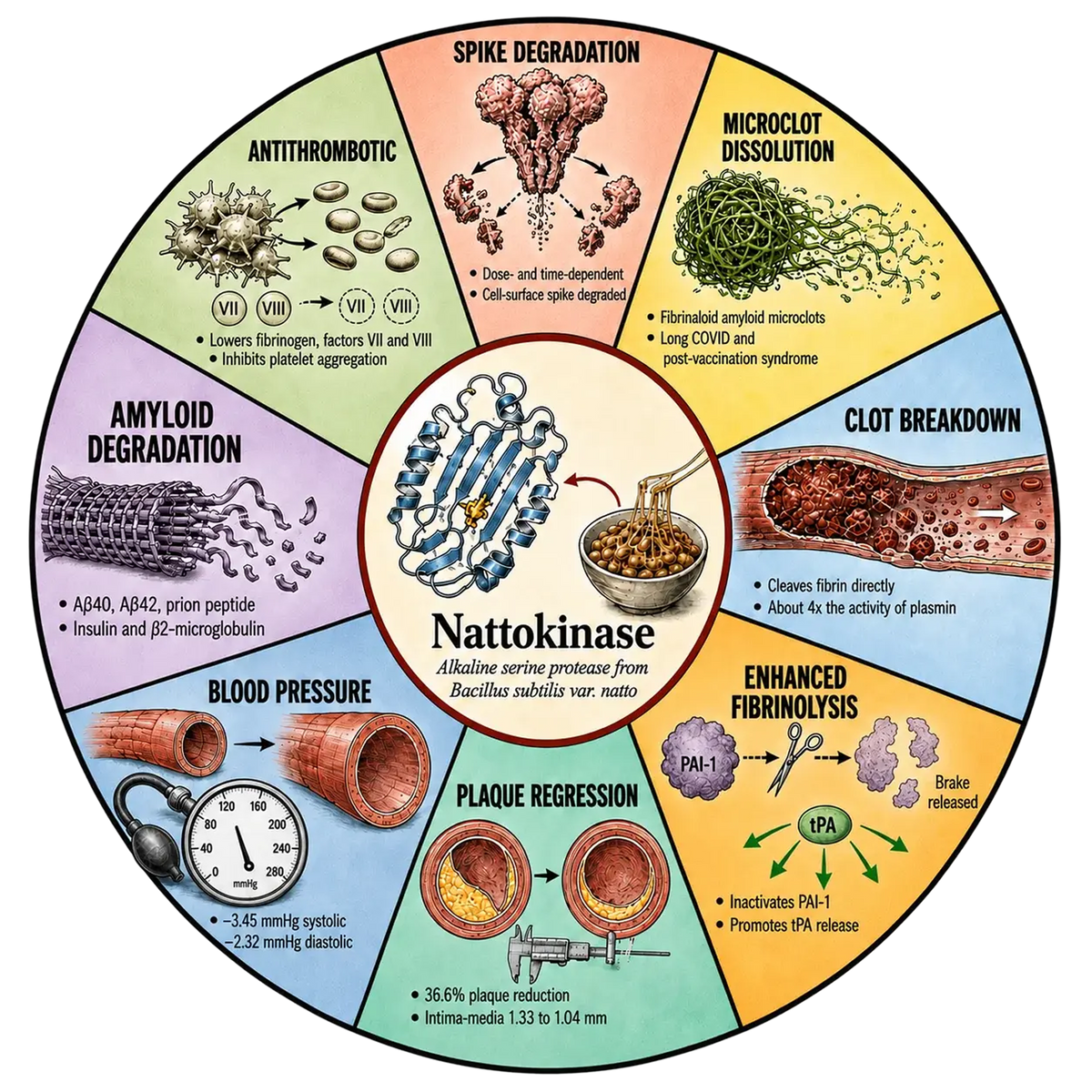
The study identified eight specific mechanisms of action. Each wedge below is a separate line of evidence and each carries a different amount of weight.
Caveat:
Figure: nattokinase as a multi-target proteolytic agent, adapted from the review manuscript. Hover or tap any wedge to read the evidence behind it.
The Wellness Company's Chief Medical Board has submitted for peer review a comprehensive review of nattokinase — the fibrin-dissolving enzyme produced during the fermentation of soybeans into natto — as a multi-target proteolytic agent.
In laboratory studies, purified nattokinase degraded full-length spike protein and dissolved the amyloid microclots that spike protein creates. In randomized human trials, oral dosing measurably shifted clot-related blood chemistry within hours.
Those are two different tiers of evidence, and the review is emphatic about not blurring them. Every claim on this page is labeled with the strength of evidence behind it.
In the authors' own words: "We do not claim clinical efficacy for any of the indications discussed."
Why spike protein and blood clots are the same problem
Normal clotting is reversible. Spike protein causes undissolvable clots that linger in the body far longer than they should. Fibrinogen becomes fibrin, fibrin forms a mesh, and plasmin dissolves the mesh when the job is done. The review's central argument is that spike protein breaks that last step.
Spike misfolds fibrinogen
Lab studies showed that when purified spike protein was added to fibrinogen, it produced insoluble amyloid microclots indistinguishable from those pulled out of patients' blood.
The clots resist plasmin
These fibrinaloid microclots are small, dense, and do not clear the way normal clots do. In long-COVID cohorts, microclot burden ran roughly 20-fold higher than in healthy people.
Nattokinase dissolves the protein
Nattokinase attacks the cross-β pleated sheet itself — the architecture common to fibrin, microclots, spike, and amyloid plaque. In a dish, recombinant nattokinase degraded these microclots dose-dependently.
What the enzyme measurably does
Four findings, each with the strength of its evidence attached.
Concentration range across which purified nattokinase degraded full-length spike and the S2 subunit — down to 7.8 ng/mL, including spike sitting on living cell surfaces.
Lab only · no human dataEfficiency against cross-linked fibrin versus plasmin, the body's own clot-dissolving enzyme. About 4× plasmin at dissolving an actual clot in rats at equal dose.
Lab + animalWindow in which a single 2,000 FU oral dose shifted human blood chemistry: D-dimer up, fibrin degradation products up, factor VIII down, antithrombin up, clotting time lengthened.
Randomized, double-blind, placebo-controlledLower cardiovascular mortality in the highest quartile of natto intake across 29,079 Japanese adults followed 16 years (HR 0.75). Stroke mortality was 32% lower.
Observational · confounding possibleThe single most important variable: dose
The most common commercial dose — 2,000 FU — is the dose that failed in the largest, longest, best-designed trial: 265 people over a median three years, with no effect on blood pressure, any lab value, or artery measurements. Every artery benefit in this literature appears at 6,000 FU and above.
Because 6,000 and 10,800 FU produced similar results despite nearly double the dose, the authors propose a threshold near 6,000 FU rather than "more is better" — explicitly labeled a hypothesis. Two caveats they raise themselves: the two positive studies share three authors, and the dose ordering is confounded by differences in design, population, and duration. Note also that "FU" measures activity, not mass, and the assays are not harmonized across manufacturers.
For scale: natto contains roughly 40 fibrinolytic units per gram. Against a proposed 6,000 FU threshold, that is about 150 grams of natto every day — a useful answer for anyone asking why they shouldn't simply eat the food.
Nattokinase as a Multi-Target Proteolytic Agent: Spike Protein and Amyloid Degradation, Fibrinolysis, and Cardiovascular Risk Reduction
Nicolas Hulscher, MPH · Harvey Risch, MD, PhD · James A. Thorp, MD · Drew Pinsky, MD · Peter Gillooly, MSc · Kelly Victory, MD · Peter A. McCullough, MD, MPH
Published on Zenodo · DOI 10.5281/zenodo.22876167
Before you choose a product
- Check the FU dose. 2,000 FU is the most common — and the dose that failed the best trial.
- Check the vitamin K2 content. Natto is rich in menaquinone-7 and preparations differ in whether it's retained. The review calls any recommendation that doesn't specify K2 "underspecified."
- Check for enteric coating. Nattokinase is degraded by stomach acid, and coated, softgel, and uncoated products deliver very different amounts to the small intestine.
- Talk to your physician first if you take blood thinners or have a bleeding disorder.
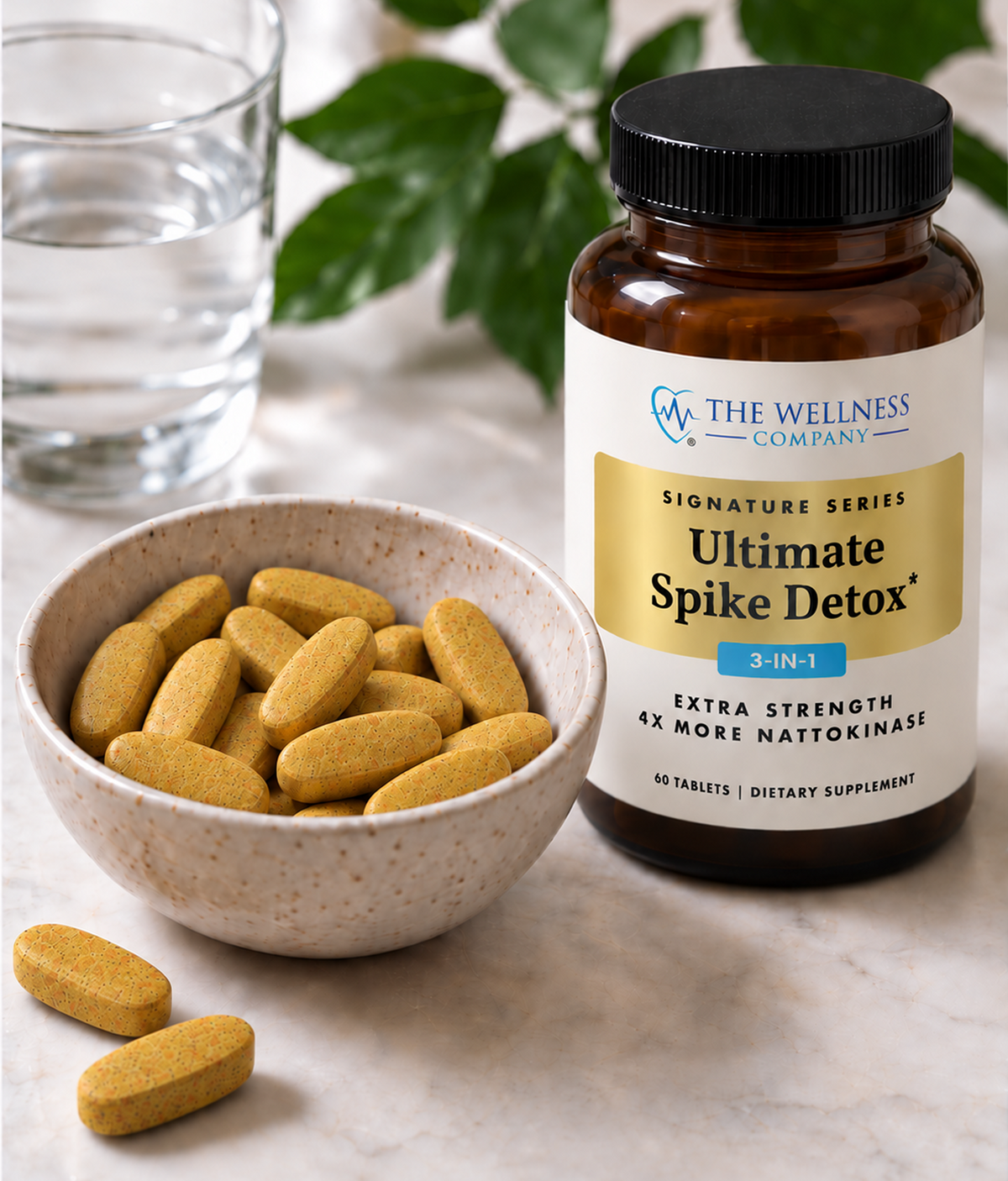
Ultimate Spike Detox (8,000 FU Nattokinase)
Formulated by Dr. Peter McCullough as part of the McCullough Protocol. Nattokinase is one component of a broader daily protocol built for people who want to take control of their own health.
*These statements have not been evaluated by the Food and Drug Administration. This product is not intended to diagnose, treat, cure, or prevent any disease.
This page summarizes a review manuscript submitted for peer review. It is intended for educational purposes and should not be read as medical advice or a guarantee of results for any individual. The authors state explicitly that they do not claim clinical efficacy for any of the indications discussed, and that the spike-degradation and microclot findings are in vitro only, with no human or animal data.
The review also notes that detecting spike protein in tissue does not establish that it causes symptoms, and that its conclusions about nattokinase do not depend on any position regarding the origin of persistent antigen. In the authors' words: "Whether the persistent antigen derives from infection, from vaccination, or from both, the enzymology question is identical." Individual decisions about vaccination, treatment, or supplementation belong with your physician.
The Wellness Company and the McCullough Foundation remain committed to investigating medicine's unanswered questions and advancing our scientific knowledge.
Disclaimer: These statements have not been evaluated by the Food and Drug Administration. These products are not intended to diagnose, treat, cure, or prevent any disease.
The information provided on this page is intended for informational purposes only and should not be considered medical advice or used as a substitute for professional healthcare guidance. Nattokinase affects coagulation. Consult a licensed healthcare provider before use, particularly if you take anticoagulant or antiplatelet medication, have a bleeding disorder, or are scheduled for surgery.